
The enterprise conversation around immersive workplace and XR has matured. Today, leaders are no longer asking whether extended reality is compelling. Instead, they are asking how does XR work, how it integrates with the digital workplace stack, and how it delivers measurable return on investment. PwC outlines the pain points:
“Employers are facing a dilemma: Their workforce often needs to learn new skills, upgrade existing capabilities or complete compliance training. Yet the new reality of remote and hybrid work has made traditional, in-person upskilling more challenging.”
In 2026, immersive workplace initiatives are not experimental pilots. Rather, enterprise XR functions as managed infrastructure. It connects hardware, software, collaboration platforms, analytics systems, and governance frameworks to improve how employees train, collaborate, and operate in complex environments.
This guide explains how XR actually works inside the enterprise, how it integrates with existing systems, and where measurable performance gains appear.
What Is XR in the Enterprise?
Extended reality (XR) is an umbrella term that includes virtual reality (VR), augmented reality (AR), and mixed reality (MR). In enterprise environments, XR acts as a spatial computing layer. In other words, it enhances — rather than replaces — existing collaboration and operational systems. Andrea Willige, Senior Writer at the World Economic Forum sets the foundation:
“Spatial computing leverages these technologies along with advanced hardware like depth-sensing cameras and inertial measurement units (IMUs) to enable seamless interaction between digital and physical realms. This integration facilitates innovative applications such as immersive virtual field trips and interactive science simulations, revolutionizing fields from education to industrial design.”
In practical terms, XR supports:
- Simulation-based training
- AR-powered remote assistance
- Spatial collaboration
- Digital twin interaction
- Complex design validation
- Frontline workflow optimisation
However, enterprise XR differs from consumer XR in key ways. Organisations focus on governance, integration, scale, and measurable results. As a result, they evaluate XR hardware based on security controls, endpoint management compatibility, identity integration, and operational fit — not novelty.
How Does XR Work Technically?
To understand how does XR work in business environments, it helps to examine four connected layers: hardware, software, data, and governance. Together, these layers transform immersive technology into operational infrastructure.
1. The Hardware Layer: XR as an Enterprise Endpoint
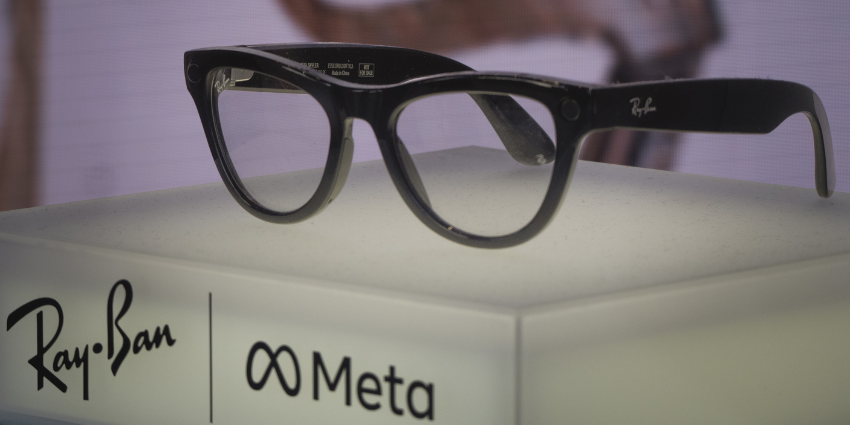
First, the hardware layer provides access to immersive environments. It includes VR headsets, AR smart glasses, mixed reality devices, controllers, and spatial sensors.
Enterprise IT teams assess XR hardware just as they would laptops or mobile devices. Key considerations include:
- Endpoint encryption and security controls
- Identity provider integration
- Mobile Device Management (MDM) compatibility
- Remote provisioning and fleet management
- Durable design for frontline use
- Battery life for shift-based work
- Display quality for simulation accuracy
What “tier 1” XR endpoints look like in practice:
- Microsoft HoloLens 2 is commonly deployed in industrial AR workflows where hands-free guidance and remote support are critical, such as field service and complex assembly.
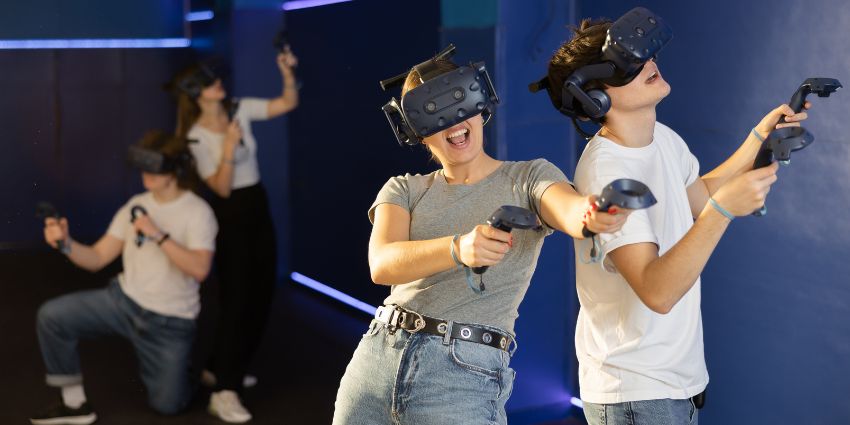
- Meta (Oculus) headsets are often used for VR training at scale in large workforces, including retail and logistics environments.
- HTC Vive is widely used in enterprise VR design and validation environments, including automotive development workflows.
- Apple Vision Pro is positioned for spatial workspaces, collaboration, training, and field guidance scenarios in enterprise contexts.
If immersive hardware cannot integrate with existing endpoint systems, scaling becomes difficult. Therefore, in enterprise environments, XR devices must operate as governed endpoints — not standalone tools.
2. The Software and Integration Layer
Next, the software layer is where business value begins to appear. Enterprise XR platforms typically include immersive training modules, AR workflow overlays, 3D collaboration environments, and digital twin interfaces.
- VR-based safety and compliance training
- 3D engineering simulation environments
- AR-guided maintenance workflows
- Spatial design collaboration
- Immersive product validation
Real-world examples of software-led use cases:
- VR training content at scale: Walmart has used VR learning programmes to train associates using experiential scenarios and repeatable simulations.
- Spatial computing collaboration: Apple’s enterprise positioning includes spatial collaboration and fieldwork guidance; Porsche has explored Apple Vision Pro for engineering collaboration and training-related scenarios.
Crucially, XR integrates with existing enterprise systems. Strong deployments connect directly to:
- Learning Management Systems (LMS)
- ERP and asset management platforms
- Digital twin platforms
- Unified communications tools such as Microsoft Teams or Zoom
- Enterprise analytics dashboards
This integration explains in practical terms how XR works at scale. XR sessions generate measurable outcomes because they feed into existing systems. Without system-level connectivity, immersive initiatives often become isolated pilots.
3. The Data and Analytics Layer
Another defining feature of enterprise XR is data generation. Every immersive session produces measurable performance metrics.
These metrics may include time-to-competency, task accuracy, procedural compliance, session duration, collaboration engagement, or mean time to repair.
For instance, simulation-based training can reduce time-to-certification while improving retention. Similarly, AR-enabled remote assistance can lower equipment downtime and improve first-time fix rates. When these metrics feed into enterprise dashboards, leadership gains clear visibility into operational impact.
In enterprise settings, ROI is not assumed. It is measured — and this is central to understanding how XR works as business infrastructure.
4. The Governance and IT Management Layer
Finally, governance determines whether XR initiatives scale successfully.
Enterprise XR programmes require structured provisioning policies, identity and access control integration, software lifecycle management, bandwidth planning, compliance alignment, and defined data governance frameworks.
As a result, CIOs increasingly treat XR hardware as part of the broader endpoint estate. This ensures consistent security standards and policy enforcement across devices.
Without governance maturity, deployments stall after initial pilots. However, when governance is embedded from the start, XR becomes sustainable infrastructure.
How Does XR Work to Deliver ROI?
Enterprise leaders adopt immersive technologies to solve operational challenges. Most often, ROI appears in three areas: training acceleration, frontline productivity, and spatial collaboration.
Accelerated Workforce Training
Simulation-based XR training allows employees to practise complex or hazardous tasks in controlled environments. As a result, organisations reduce risk while improving knowledge retention and process consistency.
An example of an engineering development workflows is BMW, which has used HTC Vive-based VR/mixed reality to improve flexibility and reduce cost/time in vehicle development.
Many organisations report faster time-to-competency, lower travel costs, and improved compliance readiness. In industries such as manufacturing, healthcare, logistics, and energy, accelerated training directly improves operational performance.
AR-Driven Frontline Productivity
AR-enabled smart glasses and immersive overlays provide hands-free, contextual guidance to frontline workers.
A remote expert can annotate a technician’s field of view in real time. Consequently, escalation time drops and first-time fix rates improve. In asset-intensive environments, reduced downtime creates immediate financial value.
For service-driven enterprises, XR solutions help protect service-level agreements while reducing operational friction.
Spatial Collaboration and Digital Twin Interaction
Engineering and product teams use XR to interact with digital twins and complex 3D assets before physical production begins.
Immersive collaboration reduces prototype waste, shortens approval cycles, and improves cross-site alignment. While traditional video conferencing supports discussion, immersive environments enable spatial problem-solving.
Where design complexity limits productivity, spatial computing provides a clear advantage.
Where Does XR Deliver the Strongest Impact?
XR generates the strongest performance gains in environments where:
- Procedures are high-risk or highly regulated
- Training costs are substantial
- Assets are geographically distributed
- Design complexity is high
- Downtime carries financial penalties
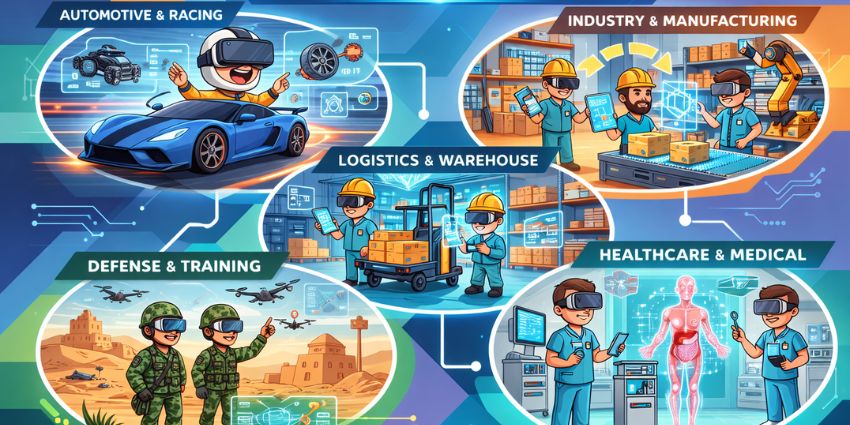
Industries seeing measurable impact include manufacturing, energy and utilities, healthcare, logistics, construction, and engineering.
In these sectors, XR acts as a performance multiplier rather than an experimental tool.
Why Do Some XR Initiatives Fail?
Not every deployment succeeds. The difference between experimentation and operational success lies in strategic discipline.
Successful programmes define clear use cases, establish KPIs before deployment, validate IT readiness, embed governance early, and align content strategy with business goals. They also invest in workforce adoption and change management.
By contrast, initiatives fail when XR is introduced as novelty, when pilots lack measurable outcomes, when security and compliance are ignored, or when hardware is purchased without integration planning.
Enterprise XR succeeds when treated as infrastructure — not theatre.
How Does XR Fit into the Unified Communications Stack?
XR does not replace unified communications platforms. Instead, it extends them.
- A simulation engine
- A spatial collaboration layer
- A frontline efficiency tool
- A digital twin interface
- A training accelerator
As digital environments grow more complex, spatial computing represents a shift in how people interact with systems. Although hardware attracts attention, integration, analytics, and governance determine long-term value.
The Bottom Line: How Does XR Work in the Enterprise?
XR works in the enterprise when implemented as managed infrastructure.
It delivers measurable performance gains when hardware, software, governance, analytics, and workflow integration align around defined KPIs. When organisations treat XR devices as enterprise endpoints and embed them into existing systems, immersive initiatives scale.
In 2026, the real question is not whether XR is interesting. It is whether it aligns operationally with enterprise objectives.
For CIOs, UC leaders, and digital workplace strategists, XR is no longer experimental. It is a performance tool — provided it is implemented with the same rigour as any other enterprise system.