
You’ve already run XR pilots. You’ve tested headsets. You’ve seen the demos. So why go to AWE USA 2026?
Because somewhere between experimentation and execution, most organisations get stuck.
XR looks promising, spatial computing keeps appearing in strategy decks and AI is clearly reshaping how people interact with technology – but turning any of that into something reliable, scalable, and defensible inside a real organisation remains difficult.
That gap is exactly what AWE USA 2026 is designed to address.
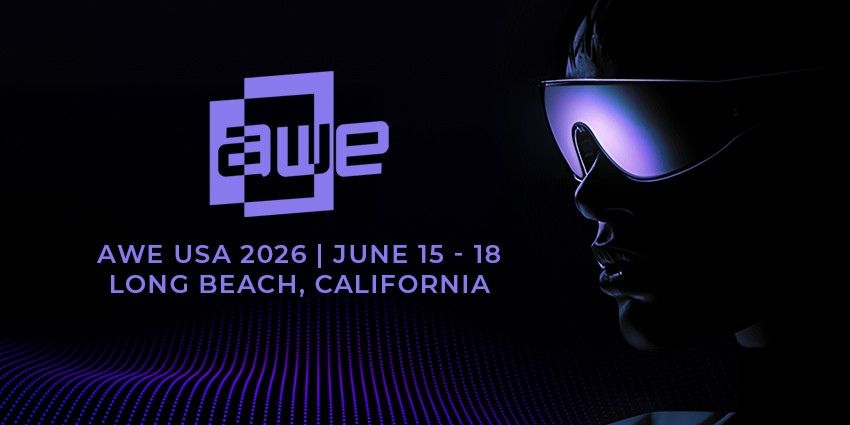
Taking place June 15–18, 2026, in Long Beach, California, AWE USA 2026 will bring together the people building the platforms, deploying immersive systems at scale, validating outcomes in healthcare and industry, and stress‑testing XR where performance actually matters.
It isn’t about convincing anyone that immersive technology is interesting. It’s about helping attendees decide what’s usable now, what still needs work, and what belongs on — or off — the roadmap.
If you approach it well, AWE can provide clarity that’s hard to find elsewhere. If you don’t, it can just as easily blur everything together.
This guide is here to make sure the first outcome applies.
Why AWE USA 2026 Matters Right Now
AWE has always covered a rich spectrum. What makes the 2026 edition feel different is how clearly the industry’s current inflection point shows up in the agenda — and in who is speaking.
The event will fully kick off on June 16, with a welcome keynote from Ori Inbar, Co-Founder and CEO of AugmentedReality.org, framing this year’s theme: “I, Spatial – Humans Empowered by Spatial AI.”
That framing will carry through into early main‑stage sessions from platform leaders including Qualcomm and NVIDIA, represented by Ziad Asghar, SVP & GM of XR at Qualcomm, and David Chu, VP of Spatial Computing and XR at NVIDIA.
What’s notable is how quickly the agenda moves beyond platform vision into enterprise reality.
Sessions throughout the week will feature practitioners from organisations such as The Boeing Company, Rolls‑Royce, Raytheon, NASA, Blue Origin, Chase, Liberty Mutual, and Fidelity Investments, all sharing how immersive technology is being tested, deployed, and evaluated inside complex, high‑stakes environments.
Speakers including Sydney Hamilton from Boeing, Andrew Lowe from Rolls‑Royce, James Cooper from Raytheon, and Alex Goldberg from Blue Origin bring operational credibility rooted in real deployment challenges.
They’re joined by voices like Erik Fuentes, VP of Innovation at Chase, Jamie Barras from the Fidelity Center for Applied Technology, and Andy O’Sullivan, Senior Innovation Consultant at Liberty Mutual, highlighting how XR is being assessed inside highly regulated, risk‑sensitive organisations.
That shift in tone — from possibility to practicality — is one of the clearest reasons AWE USA 2026 matters.
What Kind of Event AWE Actually Is
AWE isn’t a conference you casually drift through. It’s large, dense, and deliberately multi‑audience.
Across four days, attendees will move between enterprise leaders discussing deployment challenges, developers debating standards and toolchains, healthcare professionals presenting clinical outcomes, and creators sharing lessons from building immersive experiences — often in adjacent rooms, at the same time.
The agenda reflects this variety. Alongside main‑stage keynotes, AWE USA 2026 will include Enterprise VIP roundtables focused on scaling XR beyond pilots, a Builder‑to‑Founder workshop led by Ori Inbar and industry operators, unconference sessions hosted by communities such as the XR Guild and Virtual World Society, and live podcasts, lightning rounds, and fireside chats taking place on the Expo floor.
Some of the most valuable conversations will happen in these formats, not on the biggest stages. The programme is designed to reward people who choose depth over coverage.
The Big Conversations You’ll Hear Everywhere
Rather than thinking about AWE in terms of tracks, it’s more useful to think in terms of the conversations that will surface repeatedly across the four days.
One of the most prominent will be spatial AI. This will appear on the main stage, in AI + XR sessions, and in enterprise discussions about smart glasses, automation, and contextual assistance.
Talks such as “The View in 2036: How New Head‑Mounted Devices and Always‑On AI Will Change the Way We See the World,” delivered by Cortney Harding, will explore how always‑on intelligence could change day‑to‑day interaction — while also acknowledging current technical and social limits.
Another recurring theme will be enterprise deployment reality. Sessions featuring contributors from Boeing, Raytheon, Rolls‑Royce, NASA, and Blue Origin will focus on what happens after pilots, including device management, content updates, security considerations, and integration with existing IT infrastructure.
These conversations are especially prominent in Enterprise VIP roundtables, where assumptions about scale tend to be challenged most directly.
Digital twins will also feature heavily, increasingly framed as operational tools rather than visual showcases. Speakers from organisations such as Astec Industries and Collins Aerospace will explore how immersive simulations are used for training, engineering analysis, and decision‑making, rather than standalone experiences.
Healthcare will continue to act as a proving ground for XR. Sessions featuring contributors from the National Institutes of Health and academic medical centres will focus on clinical training, functional assessment, and mental health, often with a level of evidence that cuts through hype. Even for attendees outside healthcare, these sessions tend to provide a valuable reality check.
Finally, builders and creators remain central to AWE’s identity. Builder lightning rounds, developer‑focused sessions sponsored by Qualcomm, and creator storytelling talks will offer a grounded view of what it actually takes to ship XR products today — and where workflows still struggle.
Who Gets the Most Out of AWE — and How
AWE will deliver different kinds of value depending on how you engage with it.
Enterprise and IT leaders tend to get the most from case‑study sessions and Enterprise VIP roundtables, where peers discuss what has and hasn’t worked when scaling XR across teams and locations. Hearing directly from organisations such as Boeing, Rolls‑Royce, Raytheon, Chase, and Blue Origin often proves more valuable than vendor messaging alone.
Product owners and innovation leads use AWE to compare approaches rather than vendors, building a clearer picture of ecosystem maturity and trade‑offs.
Developers and technical teams benefit most from builder tracks, workshops, and developer‑sponsored sessions, where constraints around tooling, performance, and standards are discussed openly.
Healthcare, education, and industrial practitioners gain perspective from sector‑specific sessions grounded in outcomes rather than promise.
Investors and strategists often find the strongest signals in the Startup Pitch Competition, where early‑stage companies surface problems the broader market hasn’t yet solved.
How to Approach the Programme
Main‑stage sessions will be useful for orientation. They help frame how platform providers and industry leaders see the moment.
Depth tends to sit elsewhere. Roundtables, workshops, and smaller breakout sessions are where conversations become more candid, especially if you arrive with specific questions rather than general curiosity.
The Expo and Playground will be most valuable when treated as validation environments. Try products, ask how they behave outside ideal conditions, and understand what changes after six months of use.
Startup sessions are worth attending not because every idea will succeed, but because they reveal friction points the rest of the market hasn’t yet resolved.
How to Work the Expo Without Wasting Time
The most effective way to approach the Expo floor is in passes.
Use an initial walk‑through to identify which exhibitors are relevant to your use case. On subsequent visits, go deeper. Ask who is using the product in production, what changed after deployment, what still breaks, and how success is measured.
AWE is one of the few environments where being direct is expected — and appreciated.
Practicalities: Passes, Planning, and Effort
The event will offer Expo‑only access alongside paid conference passes that unlock guaranteed seating and additional sessions.
The right option depends on how much time you plan to spend in structured sessions versus meetings and hands‑on exploration.
Either way, expect long days and a lot of context switching. Planning fewer, higher‑value sessions almost always leads to better outcomes.
Success at AWE won’t be measured by how many sessions you attend.
It will be measured by whether you leave with clearer thinking than you arrived with — about what XR can do today, where it still struggles, and what makes sense for your organisation next.
For some attendees, AWE USA 2026 will validate investment plans. For others, it will provide permission to stop chasing the wrong use cases. Both outcomes are valuable.
Approached intentionally, the event won’t just show you what’s happening in immersive technology. It will help you decide where it fits — and where it doesn’t.
That clarity is what makes the trip worthwhile.
Full registration details are available via the official AWE website: https://www.awexr.com/usa-2026/