
AI in unified communications is moving past the assistant era. Copilots still matter, but enterprise research is increasingly centered on UC Multi Agent Systems, Autonomous AI, and agentic architectures that can take action with fewer prompts.
Techtelligence tracking shows this change is not subtle. Research interest in agentic AI has tripled over the last 90 days, and combined buyer intent across agentic AI, autonomous AI, and multi-agent systems now exceeds every other tracked enterprise technology theme.
That acceleration matters because it signals where shortlists will form. When buyers concentrate research on a small set of emerging architectures, vendors that are visible during this learning phase tend to win early mindshare.
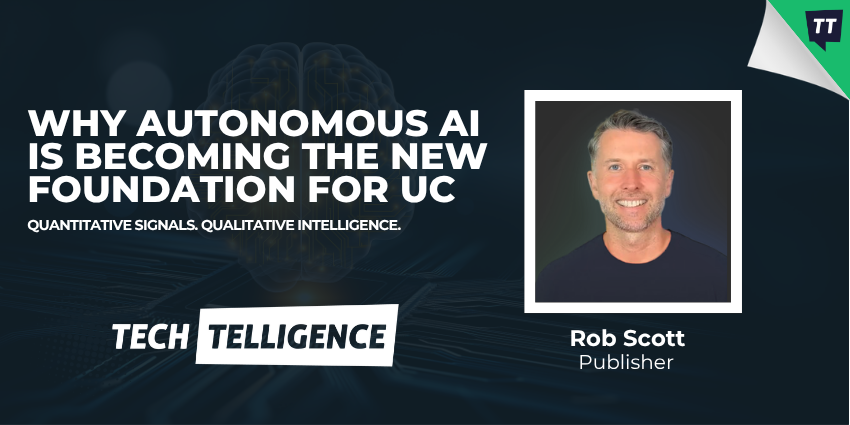
Rob Scott, Publisher of Techtelligence, explained:
“When a research signal grows this quickly, it becomes a market filter. Buyers start forming preferences early, and visibility during that phase has real commercial consequences.”
Read More
- The Benefits of Recognition for Employee Experience in the UC Stack
- Workflow Automation: How Techtelligence Research Shows Buyers Are Shifting Priorities
- UC Interest Rising in 2025: What the Market Signals Suggest
What’s Changing For AI In UC
Copilots made AI feel practical in collaboration. They summarize meetings, draft messages, and help people find information faster. That value remains. But buyer research is now drifting toward what happens after the summary and after the suggestion, when work needs to move forward across systems, teams, and processes.
This is where autonomous and multi-agent designs become the next architecture discussion. Instead of a single assistant sitting beside the user, enterprises are exploring systems made up of multiple agents that can coordinate responsibilities, exchange context, and execute steps with defined oversight.
Rob frames the shift as a move from productivity support to operational execution.
“Copilots improved work inside the moment. The new demand is for systems that can carry work forward responsibly, especially when coordination spans multiple tools.”
The implication for UC leaders is that “AI in UC” is no longer just a feature conversation. It is an architecture conversation. That includes how systems trigger actions, how context is preserved across channels, and how accountability is maintained when automation touches business processes.
Why Multi Agent Systems Are Becoming An Enterprise Architecture Priority
Multi-agent systems change the unit of design.
Rather than expecting a single AI to do everything, work is distributed across specialized agents that can coordinate with one another. That distribution can improve scale and reliability, but it also exposes new requirements for the UC platform itself.
Once multiple agents collaborate, the platform needs a way to manage decision-making and action-taking. It also needs to show what happened after the fact. Rob adds:
“Multi-agent systems force discipline. They bring governance questions to the front because you have more coordination, more action, and more responsibility.”
In enterprise environments, that translates into clearer boundaries, stronger permissions, and audit-ready records of system behavior.
If you want a related perspective on how communications APIs fit into modern UC strategy, read Stop Treating CPaaS as a CX Tool: It’s the Secret Weapon in UC.
How Can Buyers Evaluate Agentic AI Without Falling Back Into Hype?
The easiest way to get misled is to evaluate agentic systems like copilots.
A demo can be impressive, but production environments demand predictability.
Techtelligence’s tracking suggests buyers are already adjusting, with research behavior concentrating around autonomous and multi-agent architectures while questions become more operational.
In practice, evaluation is moving toward governance readiness. Buyers want to know whether they can supervise what agents do, observe behavior over time, audit actions when needed, and intervene quickly when context changes.
Rob summarizes this turning point:
“A useful test is whether governance is explained clearly. If oversight and auditability are vague, the risk only becomes clear once deployment starts.”
Techtelligence’s competitive warning is straightforward: if agentic AI is the dominant research signal, then thought leadership is not a branding exercise. It is a discoverability requirement. The vendor that shows up early with credible guidance can influence the buyer’s framework to their advantage.
Techtelligence Takeaway
AI in UC is shifting beyond copilots toward enterprise architectures designed for coordination and action.
Techtelligence tracking indicates that agentic AI research has accelerated sharply quarter over quarter, and that combined buyer intent across agentic, autonomous, and multi-agent themes is reshaping enterprises’ plans.
That change will reward UC platforms that deliver control planes, human-in-the-loop safeguards, auditability requirements, and fail-safe collaboration patterns that make autonomy reliable.
Techtelligence aggregates enterprise research behavior to identify where buyer attention is moving next, helping leaders separate durable signals from short-term noise.
For more buyer-intent insight and business intelligence on agentic systems, follow Techtelligence on LinkedIn!
FAQs
What are UC multi agent systems?
UC multi agent systems use multiple specialized AI agents that coordinate tasks across collaboration workflows. They share context, divide responsibilities, and take actions under defined rules and oversight.
What is autonomous AI in UC?
Autonomous AI in UC refers to AI systems that can initiate and complete actions with fewer prompts. These systems can coordinate follow-ups, trigger workflows, and execute steps based on policy and context.
How is AI in UC moving beyond copilots?
Copilots mainly assist users with suggestions and summaries. Agentic and multi-agent approaches focus on coordinated execution, where systems can act and collaborate with other systems under governance controls.
What safeguards do enterprises need for agentic AI in UC?
Enterprises often require human-in-the-loop approvals for higher-risk actions, strong permissions, clear audit trails, and monitoring so they can intervene quickly if conditions change.
How should enterprises evaluate agentic AI to avoid hype?
Focus on governance readiness. Confirm that agent actions can be controlled, observed in production, audited after the fact, and stopped or redirected when needed.