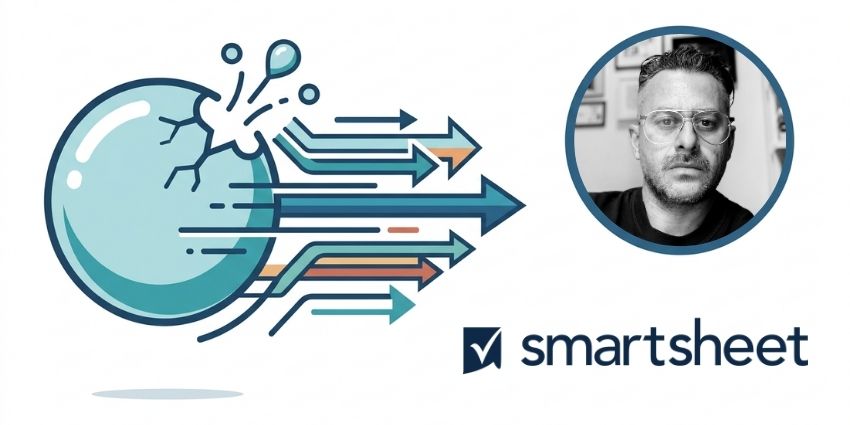

There’s a word Sarkis Kalashian keeps coming back to: visibility.
As the executive overseeing applied AI and core product at Smartsheet, he’s watched organisations pour resource into tools, headcount, and digital transformation programmes, only to find their teams no more effective than before. The reason, he argues, isn’t effort. It’s measurement.
“We haven’t fully caught up to the technology. We haven’t organised our cultures, our incentive systems, our ways of measuring success. Sixty-eight percent of UK leaders still equate being busy with success, essentially.”
That figure comes from Smartsheet’s newly published research report, The Great British Productivity Paradox, which surveyed 500 UK business decision-makers. It found the average UK team loses a full working day every week, roughly ten full work weeks a year, to what the report calls “busy work”: low-value, repetitive tasks disconnected from meaningful outcomes. At current average labour costs, that amounts to around £12,000 in lost productive value per employee, per year.
It’s a finding that sits alongside a broader pattern. A 2025 LSE study found that professionals using AI save an average of 7.5 hours per week, yet most employees (68%) have received no AI training in the past 12 months. Meanwhile, EY’s 2025 Work Reimagined Survey found that while 83% of UK employees now use Gen AI at work, fewer than 5% are using it to fundamentally transform how they work. UK businesses, in other words, are sitting on unrealised potential, and Kalashian believes he knows why.
For Kalashian, none of this is surprising. Organisations have layered new tools on top of old ways of thinking. Something had to give.
The problem with looking productive
One anecdote from early in Kalashian’s career has stayed with him. A leader once told a junior hire: “You’re working for Sarkis, he’s such a taskmaster.” It was intended as a compliment.
“That was meant to be a really positive thing: saying ‘this guy really gets it done, he completes his tasks’,” he recalls. “But I’d say this is where businesses need to take a harder look. What is the incentive system, and how do you have the transparency and visibility into what people are doing that ladders up to the overarching goal you’re trying to drive?”
The report finds a disconnect between what leaders believe and how they actually behave. 63% of decision-makers agree that hours worked isn’t an effective productivity measure. Yet 26% admit it’s still how they assess performance. Kalashian calls this gap a “productivity tax”: one that quietly erodes competitive advantage while teams look, and feel, busy.
The report also names a related behaviour: “task masking.” This is where employees deliberately perform visible but low-value work to appear productive. Cultural pressure drives it. Six in ten leaders say they witness it frequently. IBM’s research from late 2025 adds weight to this picture: 67% of UK business leaders say internal resistance and cultural barriers are stalling AI rollouts, suggesting the problem runs deeper than technology access.
“You can’t easily fix what you can’t see. A lot of this is taken for normal, everyday things that people have to do — we just assume it needs to stay that way.”
From tasks to outcomes
So what should organisations measure instead? Kalashian argues leaders need to reframe the questions they ask entirely.
“If you’re in a one-on-one with your team and you ask, ‘What did we get done this week?’, that’s oriented around tasks. But if you pivot towards outcomes: what did you drive forward? What risks did you tackle? What did you unblock? You start to frame questions around the more complex issues that drive results.”
He describes it as a design question. It requires rethinking workflows from the top down. Are corporate goals clearly cascaded to team-level plans? Do individual projects connect visibly to those goals? And critically: do leaders track the things that prevent progress — not just the tasks themselves?
Technology has a role here. But Kalashian is careful. He positions it as an enabler of cultural change, not a replacement for it. This aligns with Smartsheet’s broader push into what it calls Intelligent Work Management: a platform philosophy unveiled at its 2025 ENGAGE conference that moves beyond task co-ordination toward AI that actively shapes work direction and surfaces insights in real time.
AI at the inflection point
Kalashian describes enterprise AI adoption as a spectrum. On one end, organisations cautiously experiment with co-pilots and summarisation tools. On the other, still relatively rare, businesses have fully rearchitected around agentic workflows, with AI running processes around the clock.
“I don’t think we’re at that turning point yet. We’re still at the inflection moment where there are varying degrees of maturity.”
The report backs this up: 80% of leaders say AI has already boosted their productivity. More than half expect it to be the top productivity driver within three to five years. Kalashian believes the real shift happens when AI stops being an add-on and starts integrating into how work actually flows. As UC Today’s comparison of the leading work management platforms noted earlier this year, this is precisely the battleground on which Smartsheet, monday.com, and Asana are now competing — and where Smartsheet’s deep enterprise penetration gives it a distinct advantage.
He points to Smartsheet’s own MCP (Model Context Protocol) server as an example. The team launched it around six weeks before our conversation. Adoption quickly outpaced expectations, driven not by a big marketing push, but by organic, word-of-mouth uptake.
“Someone told me their primary use case is summarising all the notifications and actions they have to handle within Smartsheet each morning. They’re tagged seventeen times an hour on something. So at the end of each day and every morning, they do a recap, know what to focus on, and ignore the rest.”
That individual productivity gain, he explains, then creates a ripple effect, drawing colleagues in and shifting collaboration patterns across teams.
Leadership as the lever
Kalashian’s most pointed message is for leaders themselves. Tools alone won’t burst the busy bubble. Leaders need to model different behaviour: visibly, and deliberately.
He shares a recent example. Rather than waiting for his team to produce a status report, he built it himself using Smartsheet and Claude. Then he shared it with the team, not to show off, but to demonstrate a faster way of working.
“I’m only as fast as maybe the slowest member of my team, even with all the tools, because I still have to catch them up. The point isn’t to leave people behind, it’s how do you raise everyone up?”
His advice to leaders reading the research is straightforward. First, ask whether every team member is doing something purposeful. Then check whether that purpose connects clearly to the company’s top-line goals. After that, look honestly at people, process, and technology. Do all three work together in a new way of working?
The wellbeing dimension matters here too. The report notes that 4 in 10 business leaders recognise employee wellbeing as a key productivity driver — and busy work actively undermines it, leaving people disengaged and at greater risk of burnout. Getting this right isn’t just a culture exercise; it has a direct line to performance.
“If you’re not addressing the organisational stuff on your side,” he says, “you’re still going to run into challenges.”