
There is a particular kind of exhaustion spreading through corporate offices that has nothing to do with overwork and everything to do with the tools meant to prevent it. Employees end the day having attended six meetings, answered hundreds of messages, and cleared a cascade of notifications – and yet the project that was supposed to ship last Tuesday still hasn’t moved. The problem is not effort. The problem is architecture.
The modern enterprise collaboration stack was built to maximise responsiveness. It has succeeded. What it was not designed to do – and what it is quietly failing at – is protect the conditions under which real work actually gets done.
What Does “Institutionalising Distraction” Look Like in Real Operations?
Call it what it is: institutionalised distraction. Not an accident, not a culture problem, not a generational complaint. A logical outcome of deploying tools that reward visible activity over measurable output.
Microsoft’s Work Trend Index has documented what many executives already sense: the digital workday has no edges. Message volumes are up. After-hours meetings have grown. The “always-on” expectation, once a badge of seniority, has become the baseline for everyone. That is not a wellbeing footnote. It is an operating model problem with a direct line to margin, cycle time, and competitive speed.
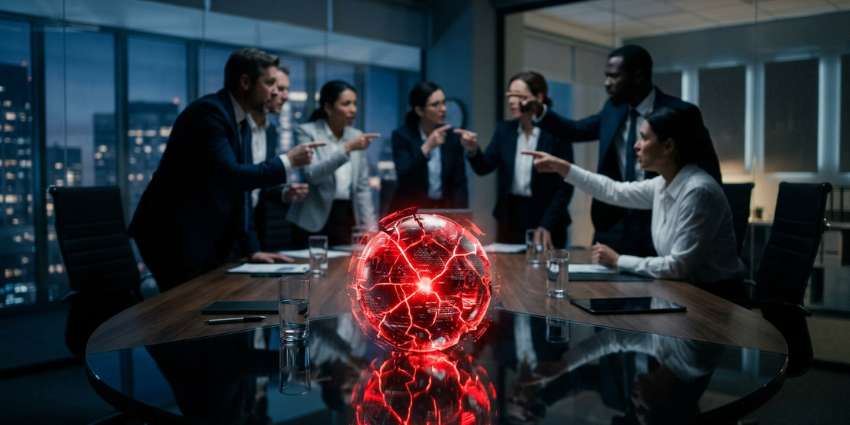
The COO symptom list is recognisable: teams respond quickly, but projects move slowly; people appear busy while priorities drift; decisions get made in one meeting and relitigated in the next. When collaboration becomes continuous, attention becomes the scarcest resource in the building – and nobody is managing it.
Why Does Increased Communication Reduce Output?
Interruptions are not neutral. Research from the University of California, Irvine found that people who are regularly interrupted adapt by working faster, but the trade-off is measurable: higher stress, greater frustration, and increased perceived time pressure. Output may hold in the short term. Judgment, creativity, and error rates tell a different story over time.
Then there is the compounding effect of task switching. The American Psychological Association has summarised the evidence clearly: switching between tasks incurs a cognitive cost that accumulates throughout the workday. What feels like multitasking is more accurately described as serial interruption – and it increases the likelihood of mistakes while slowing the completion of complex tasks.
The notification itself is enough. A field experiment examining communication-app alerts found that notification-driven interruptions are independently linked to strain and diminished performance – even when the message turns out to be trivial. The ping doesn’t need to be important. It just needs to arrive.
Where Do Collaboration Systems Disrupt Deep Work Most Often?
Deep work collapses in three predictable patterns. Mornings get fragmented by status messaging before most people have reached their first moment of real concentration. Peak cognitive hours are cannibalised by back-to-back meetings that leave no time for the follow-up work they generate. And the “quick question” – the lowest-friction interaction in any digital workspace – quietly transforms every person in the organisation into a shared dependency, slowing execution even as it makes the company feel intensely connected.
None of this requires poor performers or bad intentions. It only requires a system that makes interruption easier than focus.
How to Reduce Workplace Interruption Cost?
The answer is not a new platform. It is a redesign of the rules of engagement – treating focus as a default rather than a personal preference that individuals must carve out against institutional pressure.
The practical interventions are well within reach. Response-time tiers eliminate the fiction that every channel is equally urgent. Protected focus blocks on team calendars – defended as seriously as production windows – reduce the ambient sense that anyone can be interrupted at any time.
Requiring an agenda and a named decision owner before scheduling a meeting cuts meeting volume more reliably than any calendar policy. Shifting routine updates to asynchronous written formats means information gets consumed when people are ready for it, not when a notification decides they should be.
This is culture work, yes. But it is also systems work. Communication patterns are operations. They can be designed.
Protecting Focus in the Workplace
The executives who will move fastest over the next three years are not the ones deploying the most sophisticated collaboration tooling. They are the ones who understand that focus is a production input – and that protecting it is a leadership responsibility, not a wellness initiative.
When collaboration is designed to protect concentration rather than fill it, work finishes. Decisions hold. Cycles accelerate. The stack stops being the problem and starts being the infrastructure it was always supposed to be.
FAQs
What Is Collaboration Tool Overload?
Collaboration tool overload is when too many channels, pings, and meetings compete for attention. It creates noise that slows real work.
How Does Workplace Communication Disruption Show Up Day to Day?
Workplace communication disruption shows up as constant interruptions, repeated meetings, and fragmented task ownership. People stay available but struggle to complete priorities.
What Is Digital Collaboration Inefficiency?
Digital collaboration inefficiency happens when tools increase activity without increasing outcomes. More messages and meetings can still produce slower cycle times.
What Is Enterprise Attention Management in Practice?
Enterprise attention management is the deliberate design of communication rules, meeting norms, and notification standards. It protects deep work and improves decision quality.
What Is the Collaboration Productivity Impact Leaders Should Watch?
The collaboration productivity impact leaders should watch for is reduced throughput due to task switching, meeting spillover, and constant responsiveness. It often appears as slower delivery despite higher visible activity.