
Javed Khan knows the codec business from the inside. Before joining Neat as CEO in March, he ran Cisco Collaboration as SVP and General Manager, overseeing a multi-billion-dollar portfolio that included its room device line. Neat’s co-founder and CTO, Ivar Johnsrud, was one of the engineers behind the Tandberg C90, later the Cisco C90, still widely cited as the high point of codec design.
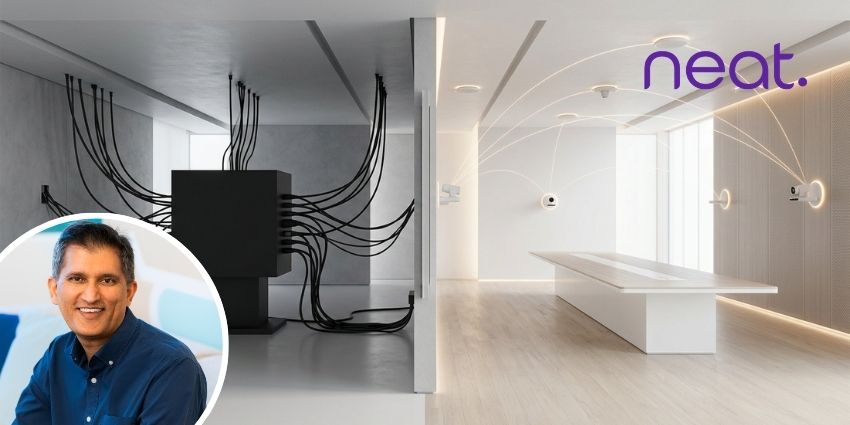
Neither is arguing those systems were poorly built. Khan’s argument, set out in a blog post this week, is that the model behind them has hit a ceiling. The industry’s response has been to scale the problem rather than solve it: more compute, more cabling, more sensors around the same central architecture. Costs and complexity grow. What the room can actually do does not.
“The best version of a legacy model is still the old model,” he writes. “The world has changed, and the potential of AI has shifted the goalposts.”
Why Distributed Architecture Works Better in Large Meeting Rooms
Khan’s proposed alternative draws on his time at Aptiv, where he ran Intelligent Systems and built distributed edge compute platforms for automotive, aerospace, and robotics. The comparison he reaches for is a self-driving car: cameras, sensors, and compute distributed across the vehicle, processing in real time, co-ordinating without routing everything through a single central unit.
Large conference rooms, he argues, have the same structural problem. People move. Conversations shift across a space. A centralised system was not designed to track that dynamism. Adding more hardware around it does not change that. “A centralized system can’t keep up,” he writes. “It wasn’t designed to.”
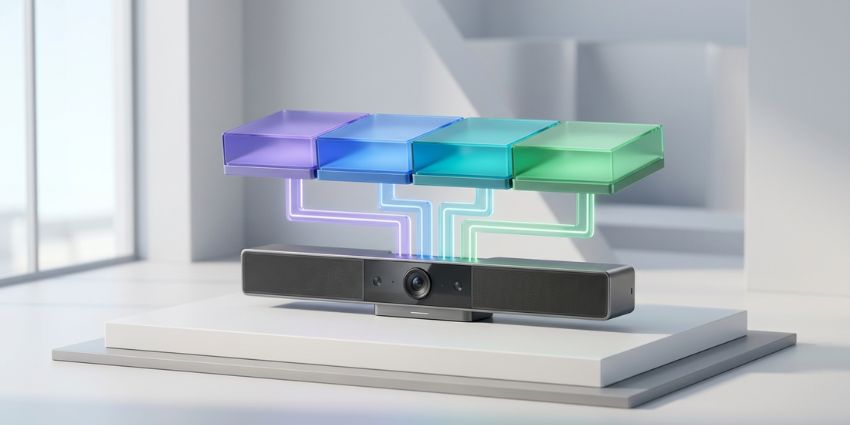
Neat’s answer is to distribute compute, sensing, and AI inference across every device in the room. Cameras, microphones, and companion units each process locally and co-ordinate over IP. Rooms scale by adding or removing devices rather than replacing core hardware. Khan frames this as evolution rather than rejection: “This isn’t abandoning the codec. It’s redefining what it becomes.”
He also distinguishes Neat’s approach from partial attempts by legacy vendors. Some distribute devices but still route processing back to a central unit. That, he argues, just recreates the bottleneck in a different form.
How Edge AI Changes What a Meeting Room Can Do
For Khan, AI is part of the architecture, not a feature on top of it. When inference runs on the device, latency drops to milliseconds, data stays in the room, and performance does not depend on network conditions. The direction he points toward is rooms that go beyond capturing meetings to understanding them: tracking who is speaking, where attention is shifting, how a conversation develops across a large space.
He signals a 2026 product roadmap without detailing it: “I can’t wait to share our roadmap for the rest of the year and some of the amazing new capabilities we have in the pipeline.”
Can Neat Take on Cisco and Poly in the Large Room Market?
Neat enters this argument from a strong position. The company reported $250 million in revenue ahead of Khan’s arrival, won the 2026 Google Cloud Partner of the Year Award for Google Workspace: Innovation in April, and supports Google Meet, Microsoft Teams, and Zoom natively. It has also joined the Microsoft Device Ecosystem Platform, aimed at improving security and manageability for enterprise workspace devices.
But Cisco, Poly, and others have deep incumbency in large rooms, and enterprise buyers move slowly. When Khan’s appointment was announced, Irwin Lazar, President and Principal Analyst at Metrigy, told UC Today the hire puts Neat “on a much higher level when they sell to larger companies,” while noting Khan “certainly has his work cut out for him in a highly competitive market.” Lazar also flagged the central tension in Khan’s argument: “there’s also the dynamic of how much will live in the hardware versus the software.”
That question gets answered by what Neat ships. The roadmap promised for later this year is the real test of whether this architecture has moved beyond a position into something enterprises can deploy at scale.