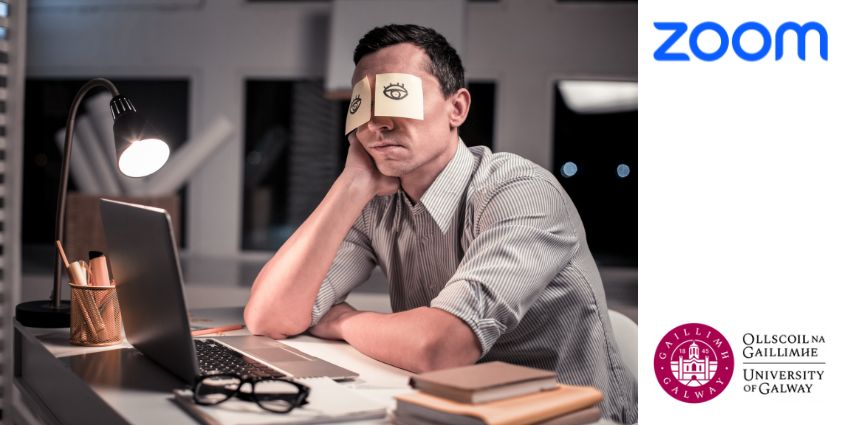

The University of Galway has released the findings from one study that show your own reflection on Zoom calls can contribute to feelings of fatigue.
- How to Use Zoom Breakout Rooms: The Simple Guide
- Managing Employee Wellbeing in the Hybrid Workplace
- How Yealink AI Features can Improve Participant Wellbeing in Hybrid Meetings
Ranked within the top one percent of universities in the world, the public research university located in Galway, Ireland, has evidence that both men and women find it equally as tiring to see themselves on video calls.
Previously, research indicated that women experienced greater levels of fatigue than men, but the results of this study appear to contradict this theory.
Turning off the self-view video could be a simple solution to help conserve energy.
Eoin Whelan, Professor of Business Analytics and Society at the University of Galway, commented on its findings: “The use of video conferencing platforms exploded during the lockdown.
“They continue to be heavily used in work and education today and offer some advantages over in-person meetings. But people often report feeling exhausted by video conference meetings.
“Our study shows that those feelings of fatigue you get during video calls are real, and seeing your own reflection makes it even more tiring.
“Simply turning off the mirror image can help offset fatigue in virtual meetings.”
Mirror Mirror on the Call
The university’s research team conducted the experiment using 16 male and 16 female volunteers.
It recorded the participants’ electrical activity using an electroencephalography (EEG) test while they switched the self-view feed on and off during live Zoom meetings.
The NHS UK website describes an EEG as a “painless test [whereby] small sensors are attached to the scalp to pick up the electrical signals produced by the brain”.
These signals can be used to identify the causes of symptoms and diagnose a number of conditions, like seizures, memory problems, brain tumours, sleep apnoea, and more.
According to the University of Galway, an EEG can also show how mentally fatigued a person is feeling at a neurophysiological level.
The results have now led the university to question the conclusion that women felt higher levels of fatigue in these situations due to having an ‘increased self-awareness when viewing themselves in a mirror’.
The study could be valuable to organisations looking for ways to safeguard the mental health of their employees. In an article published by the university’s marketing and communications office, it explains:
“The findings not only contribute to our understanding of fatigue incurred as a result of the dramatically increased use of video conferencing in the workplace but also offer practical insights for organisations aiming to protect employee well-being in the era of hybrid and remote work.”
Meeting fatigue is becoming a real problem for businesses, with it causing burnout, disengagement, and reduced productivity.
Last year, UC Today explored ways to help alleviate feelings of mental fatigue and improve meeting productivity. These included creating comprehensive agendas, decreasing meeting durations, inviting the right people, and making sure you have got the appropriate video technology.
From a tech perspective, cameras, AI technology, plug-and-play technology, noise cancellation, and visual controls can all play a part.