
A lot of CPaaS vendors have very similar websites these days. You see pages packed with partner logos, lists of impressive case studies, and an underlying promise that everything you connect will automatically talk to everything else everywhere.
But how far do those links really go? A logo tells you the partnership exists, but it doesn’t necessarily tell you if the integration is truly native or a supplement. It also won’t immediately tell you whether that integration survives a genuine support escalation, or the vendor owns the part of the stack doing the most work.
Vonage is an interesting test case, and not just because it’s one of the biggest names in CPaaS and programmable communications right now. It’s actually had an extremely busy few months spent naming exactly which systems it’s plugging into, how far, and how.
Related Articles
- Programmable Communications Are the Future of Work
- The Top CPaaS Providers for Next-Gen Communications Flexibility
- The Practical Side of CPaaS Implementation: Overcoming Deployment Challenges
TL;DR: Why Vonage’s Ecosystem Matters
- Vonage integrations have moved fast: ServiceNow Voice, Salesforce Agentforce updates, vertical AI agents, and AWS agentic IDE access all landed within six months.
- Gartner’s view helps the case: Vonage is a CPaaS Leader, ranked #1 for Video at 4.8/5, and recognized across CPaaS, UCaaS, and CCaaS.
- Network APIs add real proof: Lydia gives the Network API story some proof, cutting authentication latency by up to 50% with Silent Authentication.
- Customer proof is the gap: ServiceNow Voice and the vertical AI agents are too new to have named customer outcomes yet; buyers should treat them as pilots, not proven deployments.
What Does “Integrated” Mean for CPaaS Platforms in 2026?
Adoption numbers like Gartner’s measure whether companies are buying CPaaS somewhere in the business, not whether these platforms are actually connecting the dots like they’re supposed to. These days, the test for “integrated CPaaS” isn’t a long list of possible integrations. Everyone has that. What matters is whether the integration architecture works cohesively.
Programmable communications, in general, is what lets companies natively connect and automate voice, messaging, video, or even AI into their applications or workflows, through APIs that let the business decide what happens throughout the journey. But there’s more to integrated CPaaS than just APIs.
What businesses exploring Vonage integrations need to know is the answer to three questions: does the integration sit natively inside the system of record, or does it require a separate console the agent has to swivel into? Does the vendor own the technology doing the work, or is it a partner’s AI or underlying system wrapped in different branding? And is there any actual post-launch evidence yet? Vonage already clears parts of that bar.
What Is Vonage’s Ecosystem Bet, And Why Does “CPaaS Everywhere” Matter?
VBC is Vonage’s core cloud phone, meetings, and team messaging platform: the thing an employee logs into every day. The programmable communications story that follows isn’t a replacement for that product; it’s the argument for why VBC is a stronger platform than a standalone UCaaS suite. The same APIs powering Vonage’s CPaaS ecosystem are available to extend VBC itself. Custom call flows, embedded voice inside a company’s own apps, and programmable routing that a closed UCaaS competitor can’t offer without a separate developer platform bolted on.
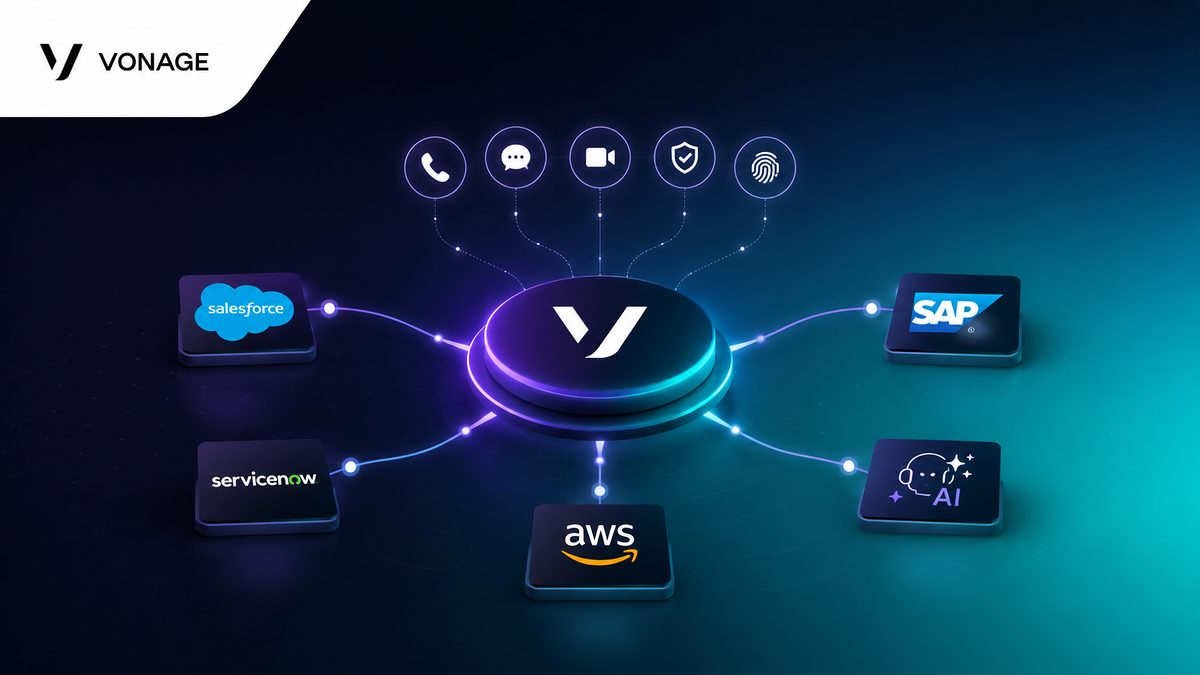
ServiceNow Voice went live in March 2026. Salesforce got a fresh round of Agentforce Voice and Agentforce Marketing integrations across December 2025 and January 2026. Vertical AI agents for healthcare, financial services, and retail arrived inside Vonage Contact Center in June. AWS got a CPaaS-first slot inside its new agentic IDE the same month. That’s five distinct moves in less than a year — more than enough to test the depth question around the promise of “CPaaS everywhere.”
Can Vonage Integrations Carry Context Into the Systems of Record?
Vonage carries context into systems of record through named integrations with Salesforce and ServiceNow, where communications data, transcripts, call outcomes, and fraud signals are written directly into the CRM or ITSM record instead of sitting in a separate console an agent has to check manually. This is the first proof Vonage is giving companies right now.
Salesforce is the deeper and older relationship in the Vonage integrations story. Vonage Contact Center and Agentforce Voice work together to keep AI agents and humans working the same case rather than passing a customer between disconnected consoles, and Vonage Conversations for Agentforce Marketing extends the idea into SMS, WhatsApp, and RCS.
Then there’s fraud and identity. Vonage Agentforce Identity Insights and Fraud Detection won Best Innovation for Security/Compliance at Enterprise Connect 2026: carrier-backed signals, including SIM-swap risk and number validity, can appear inside the Salesforce agent’s screen before the agent starts trusting the caller.
ServiceNow is testing the architecture from a different route. The ServiceNow Voice integration, launched natively on the ServiceNow AI Platform in March 2026, hits the swivel-chair problem straight away — a call can classify the incident, launch a Flow Designer subflow, update resolution details, and drop the transcript into the same record, instead of an agent re-keying what happened after the fact.
“Vonage is combating the traditional disconnect between digital and live interactions, ensuring that voice becomes a seamless continuation of the customer journey rather than a disruptive restart.”Mila D’Antonio, Principal Analyst, Customer Engagement, Omdia
UC Awards 2026 Categories Announced
UC Today has announced all 25 categories for the UC Awards 2026, recognizing excellence across workplace technology, collaboration, CX, AI, and employee experience.
Where Do Communications APIs End and Network APIs Begin?
Communications APIs are great for adding things like voice, RCS, WhatsApp, SMS, routing, verification, and anything else you need into an app. Vonage’s VBC APIs give a good example: a call can create a record, trigger a workflow, update reporting, or send event data into another system without forcing an agent to play copy-and-paste roulette. Still, network APIs add more depth.
They bring carrier-backed intelligence into the moment where risk is happening: has this number changed SIM recently, is the device reachable, is the number valid, can Silent Authentication verify the user without asking for another code?
In our Vonage and AT&T interview, Kunal Shukla described cybercrime as “a $10 trillion economy,” with businesses spending almost $6 recovering for every $1 lost to fraud once support time, compliance exposure, and operational mess are counted.
Then there’s the Lydia case. Using Vonage Verify with Silent Authentication helped the company protect tens of thousands of users daily, cut authentication latency by up to 50%, and virtually eliminate OTP-sharing social engineering. The AWS angle is worth acknowledging too: Vonage network-powered tools can work with Amazon Cognito, using mobile operator intelligence and Silent Authentication to verify users in under five seconds with no user input.
Ownership here splits cleanly. Cognito is AWS’s identity service, not Vonage’s; the verification signal doing the actual work is Vonage’s own network API, called into someone else’s identity layer rather than replacing it.
Vonage Integrations: Is Vonage’s AI Layer Native or Partner Built?
In June 2026, Vonage announced vertical-specific AI agents inside Vonage Contact Center for healthcare, financial services, and retail. The healthcare agents were built with a partner called Avaamo, and handle appointment scheduling, care navigation, billing questions, and access to test results, with live agents stepping in only for clinical or complex support. Financial services and retail get similar treatment through a partnership with Syndeo.
There’s absolute value in these AI agents, but it’s worth remembering that Avaamo and Syndeo are third-party agentic AI specialists, not Vonage-built technology. Vonage’s contribution is the plumbing underneath. The fact that these things are partner-built isn’t necessarily a weakness for companies exploring Vonage integrations.
A well-designed partner agent can be more useful than a native feature that sits outside the workflow. The issue is accountability. If a healthcare AI agent mishandles a patient question, does the buyer call Vonage, Avaamo, the systems integrator, or all three? That answer belongs in the buying process, not in the first incident review.
“The AI accountability challenge is difficult enough when you’re creating AI systems on your own. But the majority of companies today are partnering with third parties to develop and deploy AI, introducing vulnerability into the complex AI supply chain.”Brandon Purcell, Forrester
This isn’t a Vonage-specific wrinkle, in other words — it’s a named, industry-wide risk category that applies to any vendor embedding a partner’s AI inside its own branded product.
How are Vonage Integrations Bringing AI Inside of Workflows?
Beyond the vertical-specific agents, Vonage is making other AI moves within its CPaaS ecosystem. Salesforce Agentforce, ServiceNow’s AI Platform, and SAP Business Technology Platform all point toward the same pattern: AI is valuable when it can act inside a known process, respect the handoff rules, and give the human the context instead of dropping a half-finished transcript into a queue.
The developer angle matters too for Vonage integrations. Vonage API Power for Kiro brings voice, video, messaging, verification, Silent Authentication, SIM Swap detection, and Identity Insights into AWS’s agentic IDE through MCP servers. Worth applying the same ownership test here: Kiro is AWS’s own IDE, not Vonage’s.
What Vonage owns is the communications and network APIs themselves, exposed as MCP tools inside someone else’s development environment. The Amazon Nova Sonic work adds another useful test: a voice agent sounding natural isn’t enough, and IT teams need to check latency, interruption handling, multilingual support, and escalation.
Then there’s the SAP partnership, which points to the same bigger issue: agentic AI has to work inside enterprise systems and bring a human in when the process demands it. Worth flagging, though, this one is thinner than the others. It was announced in March 2025, more than a year before Vonage’s ServiceNow and Salesforce moves, and it’s still framed around pilot use cases and proof-of-concept demonstrations shown alongside Accenture at Mobile World Congress 2025.
The buyer test is simple to ask and hard to answer well: is the AI native, partner-built, or just well integrated? Each answer can be fine. The risky answer is the vague one.
Where Are the Gaps in Vonage’s CPaaS Ecosystem Story?
On the one hand, the 2026 analyst proof is strong enough to take seriously. Vonage was named a Leader in Gartner’s 2026 Magic Quadrant for CPaaS, ranked #1 for Video with a 4.8 out of 5 Video Use Case score, and received a 4.7 Advanced Security score, one of only two vendors recognized across Gartner’s CPaaS, UCaaS, and CCaaS Magic Quadrants.
Still, big ecosystem stories can get complicated and expensive fast. The first gap is the current lack of customer evidence: ServiceNow Voice and the vertical AI agents are recent launches, and the mechanics look sensible, but there aren’t yet any named customer outcomes showing wrap-up reduction, faster resolution, lower fraud losses, or better agent adoption. The second gap is accountability, especially with AI.
Buyers need to know who’s responsible for model behavior, workflow designs, and how data moves.
Then there’s platform overlap. Salesforce’s native contact center roadmap is already pushing voice deeper into the CRM. That doesn’t weaken Vonage’s network-level differentiation overnight: fraud signals, SIM-swap checks, Silent Authentication, and global carrier reach won’t be easy for Salesforce to recreate. But it’s something worth thinking about.
There’s also the Ericsson ownership story behind Vonage: it gives the company a stronger network story than many CPaaS rivals, but buyers comparing platform independence and roadmap control should ask how Ericsson’s priorities shape Vonage’s product direction.
Who Should Care About Vonage’s Integration Architecture?
Vonage integrations and the “CPaaS everywhere” angle are exciting, but that doesn’t automatically make it the ultimate CPaaS provider for everyone. Right now, Vonage has the strongest case for enterprises already working with tools like Salesforce and ServiceNow, where the integration work can be evaluated against a real system of record. It also fits contact centers where identity, fraud, authentication, and customer trust are part of the live interaction, not a compliance task that happens later. There’s appeal too for teams building custom AI agents or workflow automation in AWS, where Communications APIs and Network APIs living in the same build environment can become part of the build path.
On the other hand, if you’re looking for a sealed UCaaS and CX suite with fewer dependencies, Vonage loses its appeal.
The Vonage integrations story is about plugging communications into other people’s systems of record, not replacing every system around it. The same caution applies to buyers mostly drawn in by the June 2026 vertical AI launches: pilot them, but do it with clear responsibility lines, named fallback paths, data rules, and success measures. If Vonage can help a live customer interaction move across channel, workflow, AI, identity, and record without dropping context, while keeping the governance story solid, its ecosystem story will be more interesting. If it ends up relying just on logos, it might be time to keep pressing.
Explore the Best UC Platform Awards
The UC Awards 2026 will recognize the platforms shaping the future of UC platforms, collaboration tools, and CPaaS suites.
FAQs
How can a buyer tell if a CPaaS integration is native or bolted on?
Ask what happens to the data while the interaction is happening. A deeper integration updates the system of record in real time, without a separate console, manual note transfer, or delayed sync job. Then ask who owns the technology doing the work.
Why does programmable communications matter for integration architecture?
APIs turn communications from a channel into a workflow event. A call, message, verification, or AI handoff can trigger routing, update a record, check risk, or start a service process. Vonage's VBC APIs illustrate this directly, with call recording, provisioning, and real-time call events available through webhooks. Without that architecture, CPaaS becomes channel access with extra dashboards.
Where do Network APIs fit in a CPaaS platform?
Communications APIs move the call, message, or verification request. Network APIs bring in carrier data that helps decide whether the person behind it should be trusted, including recent SIM changes, number status, device reachability, and Silent Authentication. Lydia gives that distinction some weight. Its use of Silent Authentication reduced authentication latency by as much as 50% and almost wiped out social engineering based on shared one-time passwords.
Does it matter if an AI feature is partner-built rather than Vonage-built?
It matters for accountability more than day-one usefulness. Partner AI can be valuable when it is properly embedded into the contact center or workflow. Vonage's healthcare and financial services AI agents, built with Avaamo and Syndeo, are a live example: Vonage owns the plumbing, while the partner owns the model. Buyers still need to know who owns model behavior, support, data handling, escalation, and compliance when something goes wrong.
Should buyers wait for more proof before trusting Vonage's newest integrations?
Not necessarily. They should weight the evidence properly. Salesforce-related work has more history and clearer recognition. Vonage's Enterprise Connect 2026 award for fraud detection adds independent weight to that side of the story. ServiceNow Voice and the vertical AI agents are newer, so they need pilots with named success metrics instead of assumptions borrowed from older integrations.