
For much of the last decade, customer-facing automation in enterprise communications was defined by narrow, isolated touchpoints. A chat widget on a website. An IVR tree designed to route callers without tying up human agents. These tools reduced workload, but they were typically limited to a single channel and built on rigid logic rather than genuine conversation.
That model is now being challenged.
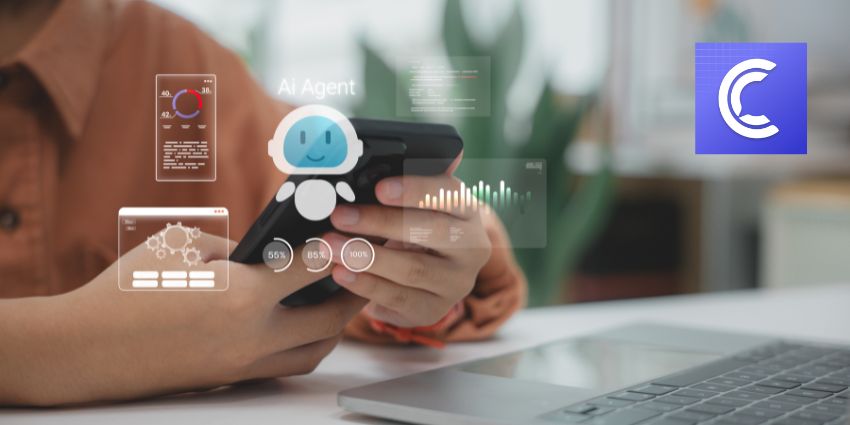
A new deployment pattern is emerging: AI agents moving directly onto the business phone number itself, spanning both voice and messaging, and increasingly delivered through UCaaS platforms such as Microsoft Teams, Zoom Phone, and Webex Calling.
Instead of existing as a bolt-on tool in a separate interface, the agent becomes part of the organisation’s core communications layer – accessible through the same numbers customers already use and embedded into the systems employees open every day.
William Bowen, AI Implementation Specialist at Clerk Chat, describes the shift as a move away from brittle, rule-based automation.
“These kinds of chatbots and IVRs were just over one medium,” he said.
“They lived in the corner of a website, and most of the time, they couldn’t hold a real conversation – they only followed rigid rules.”
In newer systems, the promise is something fundamentally different. Rather than following predefined branches, AI agents are designed to generate responses dynamically and take action across business systems.
“It’s an LLM that’s actually generating a conversational response,” Bowen said. “It’s not a logic tree. And it can go beyond answering questions – integrating back into systems like a CRM to update customer information.”
Why UCaaS Is Becoming the AI Delivery Layer
As AI agents become more capable, expectations around continuity have risen. Customers no longer interact through a single channel. A conversation might start over messaging and continue later by phone, often because the customer wants to resolve an issue faster.
“I message in on my phone, but then the next day I call in because I want to get to the solution quicker,” Bowen said. “And the AI still has that knowledge over both of those mediums. It knows I messaged in yesterday.”
Preserving that context across channels is difficult when automation lives in siloed systems. This is where UCaaS platforms are starting to play a central role.
Unified communications platforms already function as the daily work hub for many enterprises. Employees open Teams, Zoom, or Webex at the start of the day and stay there. The argument increasingly being made is that if an AI agent is not embedded into that environment, it risks being ignored or underutilised.
“Enterprises live in these UCaaS platforms,” he added.
“They open their laptop and they open Teams, or Zoom, or Webex. You can think of your AI agent as doing the same.”
From this perspective, UCaaS is not just a convenient integration point – it is the practical delivery layer for AI. Agents that live outside of that environment introduce yet another system to manage, monitor, and train.
“If it’s on another platform, it’s practically useless,” Bowen said. “It’s where you work. And the AI agent can help do that work and amplify what humans are doing.”
Omnichannel Continuity and the End of Siloed Bots
The enterprise value of this model is most visible in customer service and sales, where significant time is spent gathering information before meaningful progress can be made.
Support teams often need account identifiers, context around the issue, and basic diagnostics. Sales teams need qualifying information to determine whether a lead is worth pursuing. When that intake happens over email or across disconnected tools, delays accumulate quickly.
“A lot of the time you have to ask qualifying questions,” Bowen said. “And gathering that information can take a few hours. If it’s email back and forth, it could take a day.”
Always-on AI agents operating through existing voice and messaging channels can compress that process. They can collect information immediately, regardless of time of day, and pass it to a human with context already captured.
As organisations push toward this model, demand is rising for agents that operate across channels rather than being confined to one. Bowen likens it to human capability.
“If you had a human who could only send text messages, and another who could send texts and make calls, the one who can do both is going to outperform the siloed one.”
Memory, Governance, and What Comes Next
Deploying AI agents on business phone numbers introduces new technical and organisational challenges. Chief among them is ensuring that voice and messaging interactions share the same memory and context. Without that continuity, customers are forced to repeat themselves and much of the promised efficiency is lost.
“The main challenge is making sure those two things have the same context,” Bowen said. “Customers are going to interact with both. Having the knowledge and memory to tie them together makes the experience way better.”
Governance sits alongside those technical concerns. An AI agent that is always on, handling voice and messaging under a business identity, is continuously representing the brand and potentially handling sensitive information. That makes control, auditability, and trust critical.
Looking ahead, the “agent on the business number” pattern is likely to become a foundation for more specialised, vertical-specific applications. Regulated industries such as financial services, healthcare, and insurance have unique language, workflow, and compliance requirements that generic AI deployments struggle to meet.
“Different verticals have their own set of regulations,” Bowen said.
“Over time, you’ll see companies built purely to solve AI for those regulations or that industry.”
What is becoming clear is that AI’s role in enterprise communications is no longer peripheral. As agents move onto business phone numbers and into UCaaS platforms, they are shifting from experimental tools to core infrastructure – reshaping how organisations connect with customers and how work gets done.