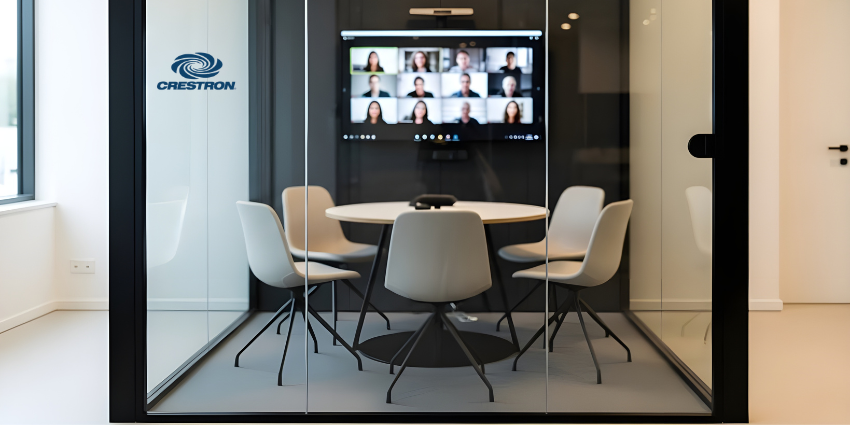

Hybrid meetings may be the backbone of modern business, but their success hinges on one elusive factor: consistency. For IT and AV leaders, ensuring that every room, campus, and region delivers the same seamless experience can feel like trying to tune an orchestra scattered across continents. A microphone misconfigured here, a firmware mismatch there, and abruptly, collaboration grinds to a halt.
“Frictionless deployment is mostly a scale problem,” said Joel Mulpeter, Senior Director of Product Marketing at Crestron. “How do you scale globally while managing multiple vendors and maintaining a consistent experience, from an office in New York to one in Bengaluru? That’s a major challenge for IT teams.”
The true source of the problem isn’t just technical. Five years into hybrid work as the new normal, it’s also cultural and operational. Users expect every meeting room to “just work,” regardless of size, layout, or location. Yet for IT teams, sustaining that expectation over months or years, amid evolving standards, platform updates, and diverse endpoints, can be daunting.
Crestron’s answer is a design philosophy rooted in simplicity, scalability, and integration. Its solutions are handcrafted to remove friction at every stage, from the first design sketch to the final firmware update.
Designing Rooms with Drag-and-Drop Precision
Before a single cable is laid, the complexity of hybrid collaboration begins with room design. Historically, planning multi-camera or multi-mic setups has been a complex process involving spreadsheets, CAD files, and vendor consultations. Crestron’s Room Designer radically simplifies that.
“Room Designer helps deploy multi-camera setups in all types of spaces,” explained Mulpeter. “You can adjust cameras, systems, layouts; it helps you visualise the room, understand mic placement, and manage telemetry. It’s a full design, deployment, and monitoring tool.”
For IT and AV teams tasked with global rollouts, that drag-and-drop simplicity elevates how spaces are planned and standardised. The tool enables designers to simulate audio pickup ranges and sight lines before purchasing hardware, thereby reducing errors and saving time. The end product is a faster, smarter path to deployment that aligns technical design with user experience from day one.
Intelligent Automation That Feels Human
Even the best-designed spaces can fall flat if the in-room experience feels awkward or artificial. That’s where Automate VX, Crestron’s multi-camera intelligence solution, makes a difference.
In hybrid meetings, eye contact and body language are just as important as audio quality. Yet traditional single-camera systems often flatten nuance and disengage remote participants. Automate VX utilizes voice and motion cues to frame speakers naturally, producing a fluid, broadcast-quality experience that mimics in-person conversation.
Crestron’s commitment to realism extends beyond optics. As meetings evolve toward AI-powered transcription, translation, and summarisation, audio quality becomes mission-critical. “We design with AI and for AI,” Mulpeter outlined. “At the DSP layer, we apply AI for noise cancellation, speaker identification, and directional processing, all to ensure crystal-clear audio. That clarity is what enables AI tools to be effective, whether it’s transcription, translation, or real-time processing.”
By building intelligence into the signal chain itself, Crestron future-proofs the meeting experience, ensuring every room is not just compatible with today’s platforms but ready for tomorrow’s AI copilots and assistants.
Managing Complexity with XiO Cloud
As deployments scale, the real test of a collaboration strategy begins in the form of lifecycle management. Firmware updates, device monitoring, and room analytics often become a full-time job. Crestron XiO Cloud is tailored to bring order to that chaos.
The cloud-based platform enables IT teams to replicate configurations across rooms, monitor performance in real time, and push updates globally, all via a single interface. “XiO Cloud helps teams deploy efficiently, replicate settings from one device or room to another for consistency, and monitor everything proactively,” Mulpeter highlighted. “It even helps uncover insights at scale to make future deployments smarter.”
By capturing room usage data, such as the frequency of specific inputs or layouts, IT leaders can make informed, evidence-based design decisions for future rollouts. The platform turns data into strategy, replacing reactive troubleshooting with proactive optimization.
Just as importantly, XiO Cloud is part of a broader Crestron ecosystem that enables customers to use one vendor across multiple room types.
“Our portfolio lets IT teams mix and match within one ecosystem,” explained Brad Hintze, EVP of Global Marketing. “If users know that every time they walk into a room, they see the same interface and hit the same button, that’s hugely valuable. It reduces friction, simplifies management, and gives users confidence.”
Scalable Intelligence That Builds IT Confidence
In the hybrid era, the distinction between AV and IT has become increasingly blurred. Audio, video, data, and automation are now inseparable layers of the same user experience. Crestron’s strength lies in its ability to scale those layers consistently, across huddle rooms, boardrooms, campuses, and continents.
“We don’t design for one room; we design for entire facilities,” said Mulpeter. “That means ensuring products and tools can scale easily, giving IT teams a consistent deployment experience and users a consistent in-room experience.”
That philosophy extends into the future. As AI becomes a key player in AV management, automating room calibration, setup, and diagnostics, Crestron is already applying machine learning and computer vision to simplify deployment itself. From analyzing usage patterns to predicting maintenance needs, the next generation of Crestron systems aspires to remove friction even before IT teams encounter it.
The Future of Frictionless Collaboration
Hybrid work has transformed what it means to connect in the workplace. The conference room is now the digital handshake of modern business, the interface through which trust, perception, and culture are conveyed. However, for that handshake to feel natural, the tech behind it must blend seamlessly into the background.
Crestron’s ecosystem fulfils exactly that remit. With intuitive tools like Room Designer, intelligent automation through Automate VX, and lifecycle management via XiO Cloud, organizations can deploy, scale, and manage collaboration experiences that simply work, every time, everywhere.
Find out how Crestron can help your organization build culture through collaboration here.