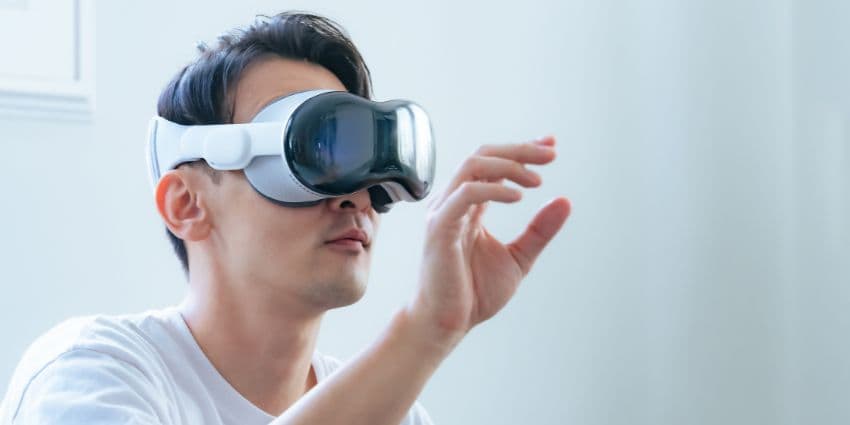
Apple has reportedly decided to discontinue development of an affordable XR headset, in what could mark a significant strategic pivot away from spatial computing and toward AI-powered wearables.
The claim originates from South Korean publication TheElec, which reported that Samsung has decided to terminate its G-VR project – a glass-substrate-based micro-OLED display initiative developed for Apple's planned lower-cost XR device.
According to the report, the project is expected to be officially wound down in September 2026, ahead of its original schedule.
What Was the G-VR Project?
The G-VR display was understood to be a more affordable alternative to the OLED-on-Silicon (OLEDoS) technology used in Apple's Vision Pro headset.
Rather than forming OLED layers on a silicon wafer, the technology placed them on a glass substrate – a manufacturing approach that could have significantly reduced costs.
Samsung Display was reportedly developing panels with a pixel density of around 1,600–1,700 PPI, compared to the Vision Pro's 3,386 PPI. Mass production had originally been targeted for sometime after 2028.
The Vision Pro currently starts at $3,499, and a lower-cost successor had been widely anticipated as the key to bringing spatial computing to a broader audience.
A Shift Toward AI Smart Glasses
According to TheElec's industry sources, the cancellation reflects a broader change in direction at Apple.
"As Apple shifts its focus from XR headsets to AI smart glasses, momentum behind the development of glass-substrate VR displays has disappeared," one source told the publication.
Apple has not publicly commented on the reports, but the move would place the company in more direct competition with Meta, Google, and Samsung in the emerging AI smart glasses category – a market centred on lighter, more practical everyday wearables rather than immersive headsets.
Samsung Continues Its Own XR Push
Despite reportedly halting the Apple-focused project, Samsung Display appears to be pressing ahead with XR display development for its own devices. The company is said to be continuing work on OLEDoS technology for Samsung Electronics' XR products, as well as next-generation RGB OLEDoS – a streamlined panel architecture that places OLED pixels directly onto a wafer and could simplify the optical systems used in future smart glasses.
Samsung Display also recently showcased its latest XR display technologies at AWE USA 2026 in June, where it unveiled a 1.3-inch RGB OLEDoS panel capable of 40,000 nits peak brightness, alongside a smart glasses demonstration featuring a 0.62-inch RGB OLEDoS display.
What It Could Mean for the Market
If Apple has indeed stepped back from affordable XR, it raises serious questions about the near-term trajectory of the headset market.
The Vision Pro, while technically impressive, has struggled to achieve mainstream adoption, and hopes for a more accessible follow-up now appear to be on hold.
For the enterprise and unified communications sector, the potential shift is worth monitoring. Headset-based platforms had been building momentum as immersive collaboration tools.
A broader industry move toward smart glasses could reshape how those tools are developed – and which hardware they ultimately run on.
UC Today has contacted Apple for comment.