
Ukraine’s battlefield realities are forcing a rethink of how modern militaries prepare personnel for combat.
With armoured vehicles and critical equipment almost constantly deployed to the front lines, access to hardware for training has become a serious bottleneck.
But a new Nordic defence technology initiative is stepping in with a solution that would have sounded experimental only a few years ago: immersive extended reality training.
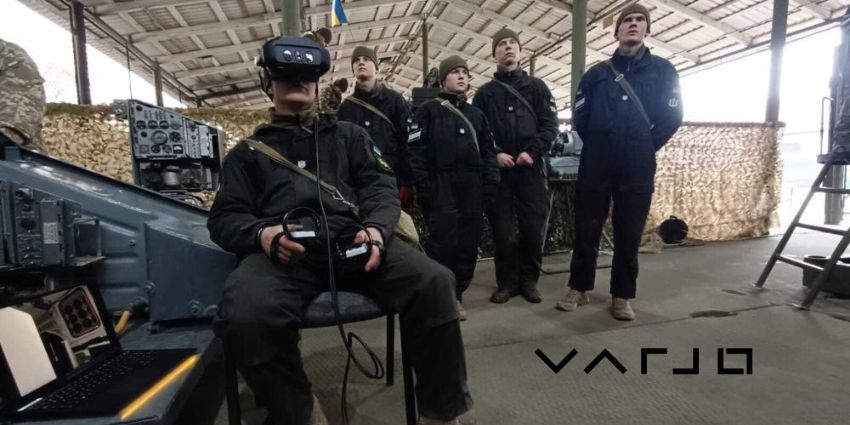
Finnish XR manufacturer Varjo and Norwegian simulation specialist Fynd Reality are delivering virtual training systems to the Ukrainian Armed Forces, funded through Norway’s Nansen Program and contracted by the Norwegian Defence Material Agency.
The project is valued at NOK 82.5 million (US$8.7 million) and will begin with an initial rollout of 39 XR training systems.
“XR training is solving a real operational challenge in Ukraine, where access to vehicles and safe training environments is severely limited,” said Timo Toikkanen, CEO of Varjo.
“Varjo’s technology is built for mission-critical training use cases where security, reliability, and visual accuracy are paramount. Together with Fynd Reality, we can actively help accelerate and scale training for Ukrainian soldiers heading to the front lines.”
Behind the funding announcement lies a simple operational reality: Ukraine needs to train soldiers on equipment it cannot spare.
From Pilot Projects To Battlefield Infrastructure
The Nordic initiative aims to close that gap with immersive simulation.
Soldiers can familiarise themselves with vehicle interiors, learn procedures, and practise maintenance tasks without requiring physical access to equipment.
Training is already being deployed across multiple vehicle types, including Western-supplied armoured platforms such as the Leopard 2 A4.
The move reflects a broader shift in how defence organisations view immersive technology.
Virtual and mixed reality have long existed on the edges of military experimentation, but the urgency of Ukraine’s situation is accelerating their transition into operational infrastructure.
Military training has always been resource-intensive.
Every hour spent running a vehicle requires fuel, maintenance, logistics, and risk management. XR shifts the economics of repetition. Complex scenarios can be replayed endlessly without physical wear and tear, enabling faster iteration and broader access to training.
NATO Validation And Nordic Defence Collaboration
Fynd Reality says its platform has already been validated in NATO environments, signalling that the Ukrainian rollout is part of a larger evolution in allied training methods.
Ukraine is effectively becoming a proving ground for new defence technologies, and lessons learned in this deployment are likely to influence procurement and training strategies across Europe.
“Our collaboration with Varjo brings together the most advanced Nordic simulation technologies,” said Knut Henrik Aas, CEO of Fynd Reality.
“We are providing Ukraine with a novel training capability that has already been validated in NATO environments and adapted to meet Ukraine’s operational requirements.
“We are building a global pathway from zero baseline knowledge to advanced simulator-ready performance.”
The partnership also highlights the growing role of Nordic defence technology companies in supporting Ukraine. Smaller, specialised vendors are finding opportunities to contribute in areas where agility and niche expertise matter. XR training fits squarely into that category.
Local Content Creation
One of the most significant aspects of the project lies beyond the initial delivery. Ukrainian partners are expected to develop additional training content locally once the systems are deployed.
This transition from vendor-provided scenarios to locally created simulations marks an important shift. It turns XR from a delivered product into a long-term capability.
Instead of relying solely on external suppliers, Ukrainian forces will be able to create and adapt training scenarios to reflect evolving battlefield realities.
That flexibility could prove more valuable than the initial hardware shipment. Warfare changes quickly, and training systems must evolve just as fast.
The deployment also reflects a broader trend across the XR industry.
Enterprise adoption has often struggled with slow decision-making and unclear return on investment.
Defence environments operate differently. The benefits of immersive training – faster learning and reduced risk – are easier to quantify when lives are at stake.
Ukraine’s situation compresses those benefits into sharp focus. The country must train large numbers of personnel quickly while preserving scarce equipment for active operations. XR offers a way to scale training without scaling risk.
And the ability to train soldiers without waiting for equipment may prove as strategically important as the equipment itself.