
When enterprises explore extended reality (XR), they often make one critical mistake: they start with the technology instead of the business problem.
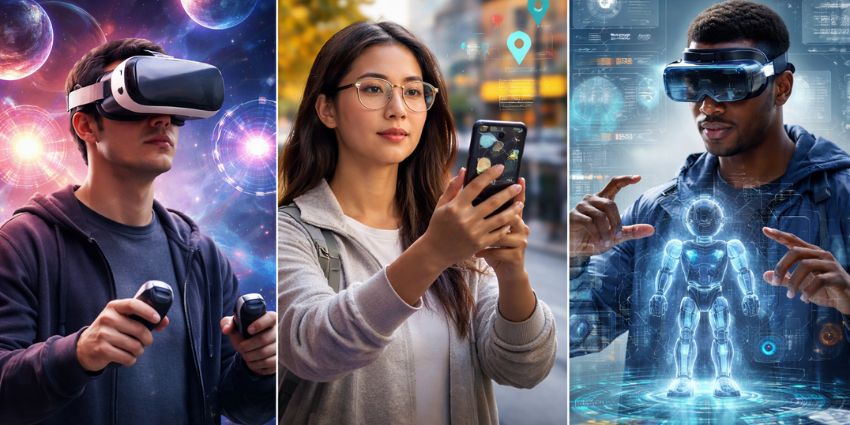
Virtual reality (VR), augmented reality (AR), and mixed reality (MR) don’t “compete” in the way most buyers assume. Instead, each supports different workflows, solves different operational constraints, and delivers value at different stages of digital maturity. Therefore, the right question isn’t “Which XR modality is most advanced?” It’s “Which one fits how work actually happens?”
To stay grounded, start here: Extended Reality for Business.
What Business Problems Is XR Designed to Solve?
At the enterprise level, XR investments typically align to three outcomes. Once you choose your primary outcome, the “VR vs AR vs MR” decision becomes much clearer.
- Improve learning and preparedness (reduce time-to-competency, standardise training)
- Enhance execution and productivity (reduce errors, speed up task completion)
- Enable collaboration and spatial understanding (improve 3D comprehension, reduce rework)
In other words, XR is less about immersion and more about performance. Consequently, the best modality is the one that moves a KPI you already track.
When Is Virtual Reality (VR) the Right Choice?
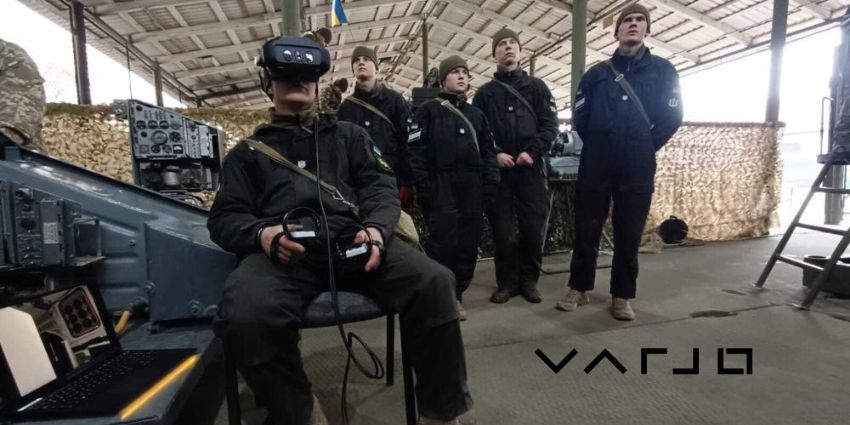
Virtual reality places users inside a fully digital environment. Because it removes real-world distractions, VR works best for learning and rehearsal—especially when real-world practice would be risky, expensive, or impractical.
For example, healthcare organisations use VR to practise complex procedures without putting patients at risk. Similarly, manufacturers and energy providers use VR simulations to prepare employees for hazardous environments. Increasingly, enterprises also adopt VR for behavioural and soft-skills training, where controlled scenarios enable consistent assessment.
However, VR delivers the strongest returns only when it is embedded into structured programmes with clear objectives, repeatable content, and measurable outcomes. It is not designed for live operational work or continuous daily use.
VR works best for:
- Safety and compliance training
- High-risk or high-cost simulations
- Procedural rehearsal and certification
- Leadership and soft-skills development
More detail: The role of VR in the workplace.
Where Does Augmented Reality (AR) Deliver the Most Value?
Augmented reality overlays digital information—such as instructions, diagrams, or live data—onto the physical world. Unlike VR, AR supports employees during work rather than before it.
Because of that, AR fits naturally into frontline and field operations. In maintenance, logistics, and inspections, AR reduces cognitive load by delivering contextual guidance at the point of work. As a result, workers don’t need to pause tasks to consult manuals or switch systems, which can improve speed, accuracy, and first-time fix rates.
That said, AR is not designed to replace immersive simulation or advanced spatial modelling. Instead, it plays a practical operational role: improving execution, not redesigning training and design workflows from scratch.
AR works best for:
- Task guidance and step-by-step workflows
- Inspections and quality checks
- Maintenance and field service
- Logistics and frontline operations
More detail: How to bring augmented reality into your business.
What Makes Mixed Reality (MR) Different?
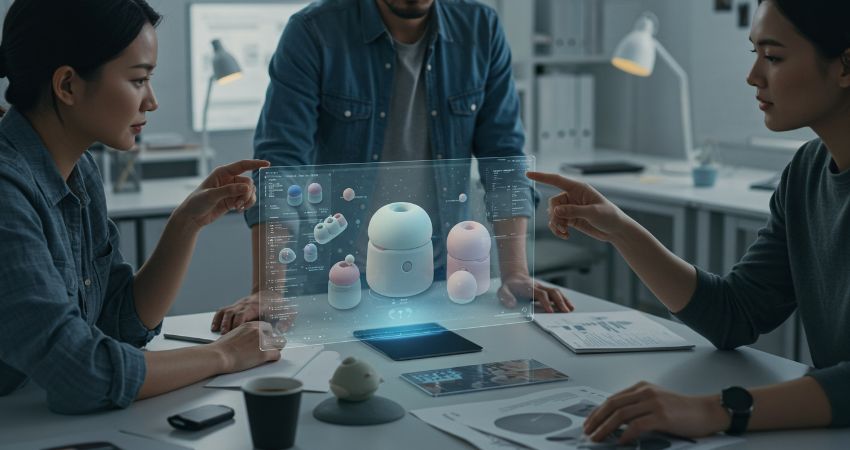
Mixed reality blends physical and digital worlds by anchoring interactive 3D objects—such as digital twins—into real environments. Unlike simple AR overlays, these objects can be manipulated, viewed from multiple angles, and shared in real time.
Because of that capability, MR excels at spatial collaboration. Engineering, construction, and product teams use MR for design reviews, layout planning, and remote problem-solving. In these settings, digital twins become shared working assets rather than static models locked to screens.
However, MR typically brings higher hardware costs, more complex setup, and greater organisational change. Therefore, enterprises new to XR often see more success by adopting MR in a second or third phase—once foundational use cases (like training or guided work) are already proving value.
MR works best for:
- Collaborative design and planning
- Digital twin visualisation
- Spatial workflows and 3D reviews
- Remote expert collaboration for complex systems
How Should Enterprises Choose Between VR, AR, and MR?
The decision should always start with the problem, not the platform. In practice, this simple framework helps:
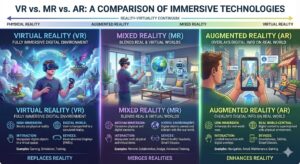
- VR supports learning and rehearsal
- AR improves execution and operational efficiency
- MR enables collaboration and spatial understanding
Most successful XR programmes begin with one clearly defined use case, backed by KPIs and shared ownership across IT, operations, and the business. From there, teams can expand once they prove value.
What Does a Successful XR Strategy Look Like?
When organisations deploy XR well, it does not feel disruptive or experimental. Instead, it blends into workflows and improves outcomes without adding friction. For example, VR should sit inside a training programme with assessment criteria. Likewise, AR should connect to work orders and support tools. Meanwhile, MR should be reserved for workflows where 3D understanding reduces rework and improves decisions.
Ultimately, enterprise leaders don’t need every XR modality. They need the one that aligns with operational reality, workforce readiness, and measurable impact. The strongest returns come from solving specific problems—one focused use case at a time.
FAQs
What is the difference between VR, AR, and MR in the workplace?
VR is best for immersive training and simulation. AR overlays guidance into real work to improve execution. MR anchors interactive 3D objects into physical space to enable spatial collaboration and digital twin workflows.
Which XR modality delivers the fastest ROI?
In many enterprises, VR shows fast ROI in training where time-to-competency and safety outcomes can be measured. Meanwhile, AR often delivers operational ROI quickly in maintenance and frontline work by reducing errors and downtime. MR tends to pay off where 3D collaboration reduces rework and speeds approvals.
Should we start with VR, AR, or MR?
Start with the outcome. Choose VR for training, AR for frontline guidance, or MR for complex 3D collaboration. Then run a focused pilot with KPIs before scaling.
Do we need special XR hardware for business?
Usually, yes. Enterprise deployments should prioritise device management, security, lifecycle support, and workflow fit. In other words, treat XR as a governed endpoint, not a standalone gadget.