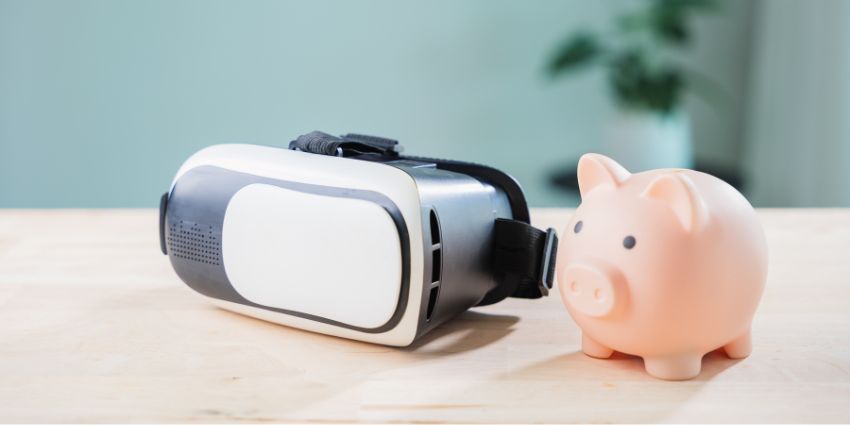

Cost is always one of the biggest hurdles in gaining approval for any technology. For XR, the tricky part is usually estimating how much you’re going to spend accurately. A lot of leaders look for the most affordable headset, buy a couple of software licenses, and assume they’re done. The pain points show up when they eventually discover all the “extras” they’ve missed.
Devices need support, content needs updating, IT wants control, frontline teams want reliability, and suddenly, nobody can explain why XR program costs are rising without a matching line item in the original plan.
What gets missed is how fast this adds up. PwC’s widely cited VR training study found that XR becomes cost-competitive only when programs are reused at scale. At around 3,000 learners, VR training was 52% cheaper than classroom delivery. Below that, the economics look very different. Scale changes everything, and so does poor planning.
That’s why enterprise XR budgeting fails when it treats XR like a single purchase instead of an operating model. Headsets are the smallest decision. Ownership is the hard one.
Further Reading:
- What Can the XR Market Promise Before 2030?
- What is Extended Reality?
- The Business Case: Is XR Worth It?
Why XR TCO Is Harder Than It Looks
XR TCO seems so simple at first, that’s the problem. One of the reasons adoption rates went up in the last few years is that headsets themselves are getting cheaper. Unfortunately, buying headsets doesn’t mean you have an XR program.
Extended reality rarely behaves like a single piece of software. It acts more like a system that spreads fast. It touches devices, logins, content updates, physical routines, and how much people trust what they’re being asked to wear or use. Ignore any one of those, and the Cost of XR stops being predictable almost immediately.
The friction isn’t adoption curiosity, it’s operational readiness. Device management, integration with existing platforms, content lifecycle ownership, and support expectations all surface at the same time once XR leaves the lab and enters day-to-day work. That convergence is what most enterprise XR budgeting models fail to anticipate.
The workforce context makes this harder. 73% of employees already feel change fatigue. That matters, because XR introduces new workflows, new rules, and new expectations. When those changes aren’t supported properly, support tickets replace enthusiasm.
This is why XR program costs spike after pilots succeed. Not because XR suddenly gets expensive, but because the operating model wasn’t funded. Software tiers change. Content updates pile up. Devices need lifecycle management. Someone has to own the experience when something fails mid-task.
XR TCO isn’t confusing. It’s inconvenient. It forces organizations to budget for ownership instead of optimism.
What is the Total Cost of Ownership for XR?
Hardware controls a lot of early enterprise XR budgeting conversations because it’s the only part that behaves like a normal purchase. There’s a unit cost. There’s a SKU. Someone can put it in a spreadsheet and move on.
First of all, the hardware spectrum is huge. Standalone VR headsets show up in training. Smart glasses land in field service and logistics. Mixed reality devices get pulled into design, engineering, and simulation. Different jobs, different form factors, wildly different expectations.
None of that explains the real cost of XR.
The cost curve bends when devices stop being “new” and start being depended on.
74% of employees say a minor technical issue can derail their workday. XR introduces more chances for “minor” problems: battery failures, sign-in issues, outdated apps, broken peripherals. Clorox reduced audit time to one-tenth of previous workflows, saving roughly $949 per person, once capture, storage, and verification rules were operationalized.
The common thread is tolerance for failure. Once XR touches live work, expectations snap into place. A device that works “most of the time” stops being acceptable. Support delays stop being abstract. Updates can’t break things mid-shift.
XR TCO doesn’t hide in the device spec. It hides in everything that has to work when the device stops being optional.
What Hidden Costs Exist in XR Programs? Software Costs
Software rarely scares anyone during an XR pilot. Licenses look manageable. Features seem bundled. The assumption is that software behaves like it does everywhere else: buy access, deploy, move on.
But when XR moves beyond a single team, software stops being “the app” and starts behaving like infrastructure. Identity matters. Access control matters. Analytics matter. So does support, uptime, and what happens when something fails mid-task.
Common pressure points that show up immediately:
- Licensing models change at scale: Pilot-friendly licenses often shift once devices are shared, users rotate, or multiple sites come online. Per-device models break in shared environments. Per-user models balloon in frontline roles with turnover.
- Identity and access controls become mandatory: Single sign-on, role-based access, and audit trails move from “nice to have” to non-negotiable once XR touches compliance, safety, or regulated work.
- Analytics stop being optional: Leaders want proof that XR is being used correctly. That means session data, completion tracking, error capture, and usage patterns. Those features rarely live in base tiers.
- Support tiers quietly expand: When XR supports live work, “best effort” support isn’t enough. Faster response times, escalation paths, and dedicated support start showing up in contracts.
This is where XR program costs start to feel unpredictable. Not because vendors are hiding anything, but because early budgets assumed XR software would behave like consumer apps.
Once XR becomes part of how work gets done, software stops being a line item and starts behaving like a recurring obligation.
Discover:
Is XR Cheaper than Traditional Training? Content Costs for XR Programs
Whether you build or buy XR content, it won’t age gracefully.
XR content doesn’t sit still once it’s shipped. It shifts the same way real work does, unevenly and usually at the worst possible moment. Procedures get tweaked. Compliance wording changes. Equipment gets swapped out. Local teams want their own versions. Then a headset update rolls through, and something that worked yesterday suddenly doesn’t.
The maintenance work adds up fast:
- Updating scenarios when SOPs change
- Retesting after device or OS updates
- Localizing language, signage, or compliance cues
- Keeping assessments aligned with real-world standards
- Managing version sprawl across sites
AI is starting to change how fast content can be adapted, but it doesn’t remove ownership. XR training paired with AI can cut skill development time by as much as 75%, which is powerful. It also means content changes more often, not less.
The bigger costs of XR don’t come from building content once. It’s keeping content correct while work keeps moving.
XR TCO and the Cost of Device Management
Device management, security, and long-term support are where programs either stabilize or break down. A few hard realities show up fast:
- Shared devices break simple assumptions: Training rooms, frontline shifts, and rotating users don’t map cleanly to personal-device models. Sign-in friction alone accounts for a meaningful share of XR adoption resistance, especially in hourly and frontline roles.
- Updates are essential: XR hardware and operating systems update frequently. When updates aren’t staged, tested, and controlled, content breaks mid-rollout. That’s not a nuisance. It’s downtime.
- Break/fix becomes urgent, not administrative: A broken laptop is annoying. A broken headset during live work stops the job. Response time suddenly matters.
- Security and privacy stop being abstract: Stanford researchers demonstrated that VR motion data could identify 95% of users from a pool of 511 people using under five minutes of tracking data. Once devices capture spatial and behavioral data, governance becomes work, not theory.
This is also where the cost of XR accelerates without warning. Support labor increases. Spare devices get added. IT teams build new processes on the fly. Most of that isn’t mentioned in pilot budgets.
Hygiene, Accessories, and the Physical Reality of XR
XR lives on faces, heads, and bodies. Once devices are shared, the physical side of XR program costs becomes unavoidable. Here’s where costs start stacking up:
- Cleaning and hygiene protocols: Shared headsets need cleaning between uses. Not occasionally. Every time. That means wipes, replacement face interfaces, time between sessions, and clear rules about who is responsible.
- Accessories wear out faster than devices: Straps stretch. Face cushions degrade. Nose pads disappear. These are small items, but they’re replaced often.
- Charging and storage become operational tasks: Headsets don’t magically recharge themselves. Someone has to manage batteries, docks, cabinets, and availability, especially in multi-shift environments.
- Scheduling friction creeps in: When devices are scarce or unavailable, people wait. Waiting kills momentum and quietly undermines adoption.
There’s also a comfort problem that turns into a cost problem. A 2024 Industrial Ergonomics study showed 50–80% of users experience some level of cybersickness in VR. Even mild discomfort shortens sessions, limits frequency, and forces redesigns.
This is why Enterprise XR budgeting needs to account for the physical lifecycle of devices, not just the digital one. Hygiene, storage, and comfort decide whether XR fits into real work or stays on a shelf.
Enablement: The Hidden Labor Cost in XR TCO
Environments already stretched by constant change feel friction faster. XR piles on new workflows, new rules, and new dependencies all at once. When enablement isn’t properly funded, the work doesn’t disappear. It lands on managers, IT teams, and frontline staff who are already carrying more than their share.
- Enablement costs show in places budgets rarely track:
- Facilitators and supervisors spending extra time troubleshooting
- IT teams handling “how do I” tickets instead of infrastructure work
- Managers acting as informal trainers and policy interpreters
- Re-training cycles when early rollout mistakes undermine confidence
This is why enterprise XR budgeting that stops at hardware, software, and content always comes up short. The real cost of XR includes the human effort required to make new ways of working feel normal.
When enablement is treated as optional, XR program costs don’t disappear. They just surface as lost time, stalled adoption, and quiet resistance.
How Do Enterprises Budget for XR?
All of this probably seems complicated. Really, though, it doesn’t take too much to get your head around XR TCO, just a broader view. Think about:
- Devices and spares: Not just initial units. Refresh cycles, lost devices, and a realistic spare ratio once XR is used across shifts.
- Software and platform layers: Licenses that change once identity, analytics, and admin controls become mandatory. Support tiers that matter when XR supports live work.
- Content and maintenance: Initial builds plus an annual allowance for updates, localization, testing, and version control as work changes.
- Device management and support labor: Enrollment, updates, break/fix, resets, and the people required to keep XR boring and reliable.
- Physical operations: Cleaning supplies, replacement accessories, charging, storage, and scheduling overhead for shared fleets.
- Enablement and governance: Training, manager support, policy work, and the ongoing effort to keep trust intact.
Then ask a few questions:
- What breaks when device count doubles?
- Who owns this when the pilot ends?
- What changes every quarter that forces content updates?
This approach aligns with what PwC observed in large-scale VR training programs: XR only becomes cost-efficient when reuse and operational stability kick in. Scale rewards preparation.
Why XR TCO Protects Executive Confidence More Than ROI
ROI gets attention early because it’s familiar. Executives know how to ask for it. Teams know how to frame it. The problem is that ROI rarely explains why XR programs stall after promising starts.
XR TCO does.
Programs lose executive confidence when costs appear late, feel unmanaged, or land on the wrong teams. That erosion doesn’t happen because XR underperforms. It happens because leaders feel surprised.
When enterprise XR budgeting accounts for lifecycle costs upfront, conversations change. Support teams know what they own. IT knows what standards apply. Ops knows what “good” looks like. When budgets skip those details, XR becomes fragile, political, and easy to deprioritize.
Headsets will keep improving. Software will keep shifting. Expectations will keep rising. The only constant is whether ownership was designed early or discovered late.
For teams still sorting that out, our guide to extended reality for business offers a clear view of how enterprise XR is evolving and where programs tend to break first.
FAQs
How much does XR cost to implement in a business?
It depends on scale. A small pilot might only involve a few headsets and a training module. Once XR becomes part of everyday work, costs usually expand to include device support, content updates, management software, and IT oversight. The hardware is rarely the biggest expense.
What is the total cost of ownership for XR?
The total cost usually includes several layers: devices, software platforms, content development, updates to keep content accurate, device management, and the people required to support the system. When companies only budget for hardware, the real cost appears later.
Why do XR costs increase after the pilot stage?
Pilots often run with limited users and minimal infrastructure. As adoption grows, organizations have to manage more devices, maintain content, and provide technical support. Those operational pieces are what turn XR from an experiment into something reliable.
What hidden costs do companies miss when budgeting for XR?
A few things tend to appear later: device maintenance, content updates when procedures change, hygiene and replacement parts for shared headsets, and the time staff spend supporting the system.
What makes XR programs financially sustainable?
Reuse is the big one. When the same content, devices, and workflows support many teams or locations, the cost per use drops quickly. Programs that stay limited to a single department rarely reach that point.