
Picture the scene. You’re at your desk, deadline looming, and you decide to let AI handle the first draft. You type a prompt. The result is wrong. You try again. Still not right. Ten minutes later you’re no closer, and the clock is ticking. Eventually you close Copilot and do it the old way, the way that takes longer, but at least you know it works.
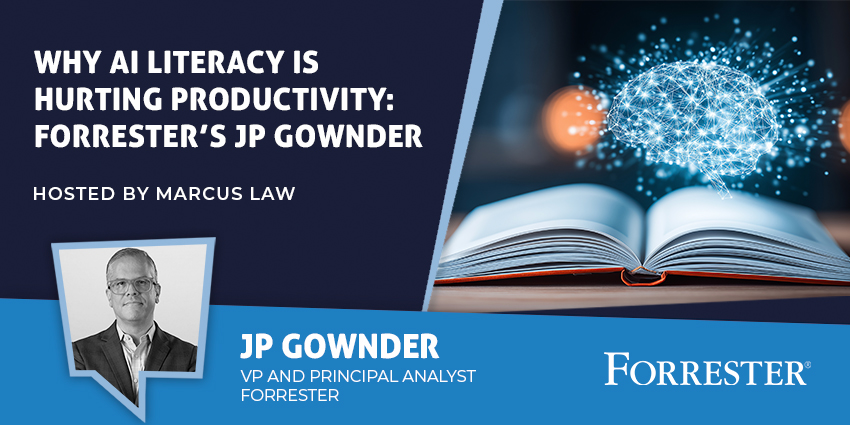
If that sounds familiar, you’re not alone. And according to Forrester VP and Principal Analyst JP Gownder, it’s becoming one of the main productivity problems in the modern workplace.
“I want you to put yourself into the position, I know I have personally, of: I try a prompt and it fails. I try another prompt and it fails,” he told UC Today. “At that moment, I have a decision to make. Either I can keep messing around with Copilot with no actual guarantee that I’m going to get it to do what I want, or I can give up and do it the old way. What we’re seeing is a lot of abandonment behaviour, because people are either wasting time and never getting an answer, or simply abandoning the tool. And when they abandon the tool, they fall off the learning curve entirely.”
Watch the full interview: Why AI Literacy Is Hurting Productivity: Forrester’s JP Gownder
The numbers behind the problem
Gownder’s comments come alongside Forrester’s second AIQ report. AIQ stands for Artificial Intelligence Quotient, a measure of employee readiness to succeed with AI tools at work. The findings make uncomfortable reading for any organisation that has invested heavily in enterprise AI.
Despite more than 80% of companies having deployed at least some AI tools, just 16% of employees across the US, UK, Germany, France and Australia achieved a high AIQ score in 2025, up from 12% in 2024. Gownder is clear that the pace of progress is nowhere near matching the pace of deployment.
Only 51% of organisations train non-technical staff on generative AI at all. Just 23% teach prompt engineering. And only 37% of employees feel confident adapting to AI-driven ways of working, a figure that has barely shifted year on year. As UC Today has previously reported, nearly half of all AI licences go unused, costing large enterprises an average of $80.6 million annually — and the AIQ data helps explain why.
“For most employees, the cost to that individual of using a tool like Copilot or Gemini is often higher than the time savings they receive on the other end,” Gownder explains. “Because they are learning by doing, and that learning is slow, painful, and happening without nearly enough support.”
A new problem: AI slop
Beyond the abandonment cycle, Gownder identifies a second productivity drain emerging in workplaces. He calls it AI slop.
“Work slop, AI slop that people send around at work is becoming a big problem,” he says. “People don’t want to read it, so they don’t read it. It’s all these people generating all this content that is filling people’s inboxes and then they don’t read it. That is negative productivity right there.”
The picture is one of technology creating new inefficiencies as fast as it promises to remove old ones, not because the tools are bad, but because the people using them have not been given what they need to use them well.
The responsibility gap
This is where organisations are fundamentally getting it wrong. There is a widespread assumption in enterprise AI rollout that the tools will largely speak for themselves, that employees will explore, experiment, and naturally improve. Forrester’s research suggests otherwise, and the consequences are falling on the workforce.
“Employees are not responsible for acquiring these skills on their own,” Gownder says. “You as the employer are responsible for cultivating a learning and engagement environment that will equip them with the skills, understanding and ethics they need to succeed. This is your responsibility as a leader. It is not something you just push down to the employees and say, good luck.”
The solution, he argues, is not more online training modules. Organisations need to rethink how they support AI adoption, building continuous, hands-on, peer-based learning that puts the employee rather than the technology at the centre. Forrester’s research found that social learning is at least twice as effective as formal training when it comes to raising AIQ in practice.
“This seems like a very techno-focused exercise,” he says. “It’s a human-focused exercise. We need to invest more in people as we roll out AI, not less.”
For the organisations still waiting to see a return on their AI investment, that may be the most important line in the whole report.