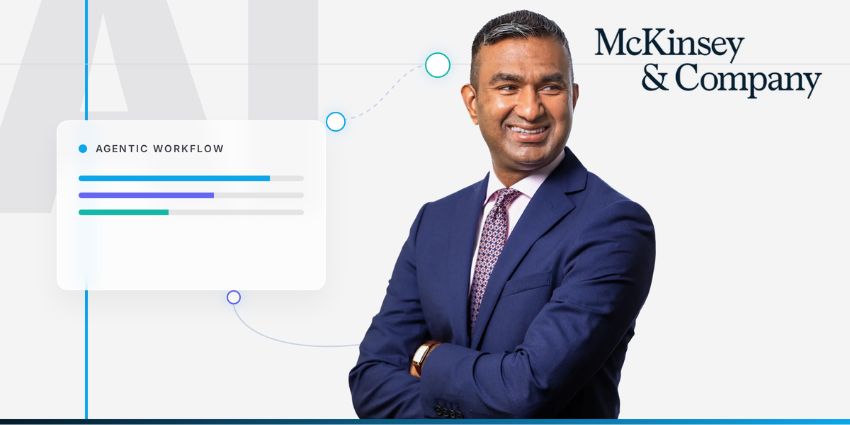

Two-thirds of organisations running agentic AI projects haven’t moved beyond pilots. That number tends to surprise people until you hear Senthil Muthiah, Senior Partner at McKinsey & Company, explain why. The stall, he argues, isn’t a technology problem. It’s a strategy problem. What’s more, most companies are making the same two mistakes.
The first is treating all work the same, Muthiah explains.
“Service workflows fall in a spectrum, from highly structured, rules-based work to work that requires human judgment. Many companies treat work like they’re all the same and use a one-size-fits-all approach, layering agentic AI across the board. While agentic AI moves quickly in the structured areas, it tends to slow down in human decision-making where change management is key.”
The second mistake is spreading investment too thin. Rather than identifying where AI will create the most value and concentrating effort there, companies deploy and hope results follow. “Each enterprise has a set of economic leverage points that create disproportionate value when AI is applied,” Muthiah says. “Many enterprises take a more organic, inclusive approach — applying AI everywhere — and do not have a clear linkage to value.”
Both failures are compounded by impatience. There is a tendency, he says, to load AI deployments with requirements far more stringent than those applied to humans, then assess them against that inflated standard.
“The goal shouldn’t be AI for everything. It’s AI for the right things, so people are free to focus on high-value work in a coordinated manner.”
Related stories from UC Today:
- Are AI Copilots Failing to Deliver Real Productivity?
- Digital Labor in 2026: Why Agentic AI Automation Isn’t a Slam Dunk
- Beyond Copilots: Why Autonomous AI Is Becoming The New Foundation For UC
Getting the handoff right
Once an organisation knows where to focus, the next challenge is designing the boundary between what AI handles and what humans handle.
“The best handoffs happen when each side is doing the part of the job they’re best at,” he says.
“AI can take on structured, rules-based tasks, while people step in where nuance, judgment, and real-time decisions are needed. When workflows are designed with that in mind, the transition between AI and humans starts to feel much more natural.”
In order-to-cash processes, for example, multiple agents can work across invoicing, collections, and dispute resolution before passing exceptions to human operators. The work moves end-to-end rather than sitting with one team waiting to be triaged. But Muthiah is quick to separate the technical question from the human one.
“The real challenge we’re seeing is not the seamlessness of the handoff itself, but the usage and change management required. Offering humans seamless AI has not yet proven that they will necessarily use it.”
This gap between deployment and adoption is something organisations consistently underestimate. A well-designed agent workflow means little if the people it’s built for don’t trust it, understand it, or have any reason to change how they currently work.
What changes for employees
Much of the conversation about agentic AI focuses on what gets automated. Muthiah shifts the frame to what gets freed up. McKinsey’s research finds that 70% of human skills remain essential even in heavily AI-augmented environments, and that when the balance is right, the effect on day-to-day work is genuinely positive.
“AI means people spend less time on repetitive mundane tasks that can be automated with high integrity, allowing them to focus on work that actually requires their judgment and expertise. Over time, that shift makes work feel more meaningful and focused on higher-value moments.”
Getting there, though, requires a level of investment that most business cases don’t account for. “Our research shows that for every dollar spent on technology, organisations need to invest roughly two dollars in change management, capability building, and adoption to fully realise the benefits.”
That 1:2 ratio reframes the ROI conversation considerably. McKinsey’s broader workplace AI research puts the long-term productivity opportunity at $4.4 trillion — but only for organisations that treat the people side of transformation with the same seriousness as the technology side. For IT and operations leaders building internal business cases, it’s a number worth keeping front of mind.
A governance gap nobody has solved yet
The most candid moment in Muthiah’s assessment comes when the conversation turns to governance. Organisations are deploying agents without any clear function responsible for managing them over time, and he doesn’t dress that up.
“Currently, there is no function within an organisation that creates, tunes, performance manages, orchestrates, and sunsets agents,” he says. “This will become a new organisational capability in the future. As of now, there is no clear view on who should own this within an organisation.”
The comparison to managing people is intentional. Agent governance will need to sit alongside workforce planning and performance management, following similar principles even if the metrics look different. For UC platforms evolving into workflow execution layers, where agents are triggering actions across systems, routing tasks, and managing escalations, the absence of ownership is a real operational risk. The McKinsey State of AI 2025 report finds that agentic AI proliferation is already outpacing the governance structures organisations have in place to oversee it.
Where to start
For leaders who want to move past the pilot stage, Muthiah’s advice is deliberately unglamorous. Pick the economic leverage points where AI delivers the most concentrated value, give them proper management attention, and start with the rules-based end of the workflow spectrum where early wins are more predictable.
“We are already seeing this approach deliver impact,” he says, pointing to Digital Twin deployments that simulate and optimise operations, and service transformation programmes that have rebuilt customer operations around AI-enabled workflows.
The productivity upside McKinsey projects is significant. But it accrues to organisations that treat agentic AI as an operations discipline rather than a technology experiment. Getting out of the pilot trap, Muthiah suggests, starts with a more honest answer to a straightforward question: not where can we apply AI, but where will it actually matter?