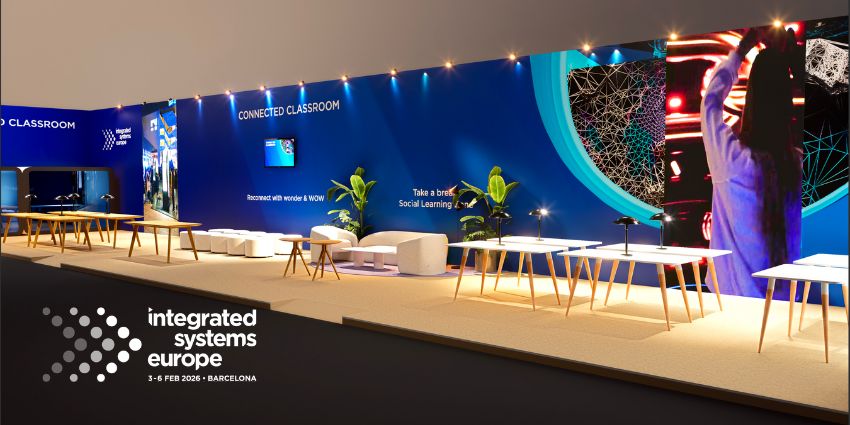

The Connected Classroom returned to ISE 2026 in Barcelona with a clear message: education technology is no longer about choosing between formats. It’s about supporting synchronous and asynchronous, in-person and remote, lecture and active learning, often simultaneously, while keeping it simple enough that any instructor can walk in and teach without a technical degree.
Powered and sponsored by Logitech, the Connected Classroom showcased how lecture capture, active learning software, and AI-powered cameras are converging to address a reality higher education institutions face daily: students expect content delivered in whatever format fits their schedule, and faculty expect technology that doesn’t require laminated instruction sheets.
From HyFlex Hype to “Learning Everywhere”
The terminology around flexible learning is evolving, according to Jay Lyons from Logitech.
“The term HyFlex was such a heavy word the last few years, whereas everybody has a different version of it now,” Lyons explained.
“We’re seeing it as different ways of learning everywhere. The biggest thing over the next year is going to be how well institutes—and even K-12—adapt to this Learning Everywhere concept.”
That shift from standardized HyFlex models to institution-specific approaches reflects what recent research shows: there’s no one-size-fits-all solution. The challenge, Lyons noted, is that adaptation differs dramatically between students and instructors.
The Retention Problem: Why Schools Are Reconsidering Hybrid
One of the more surprising revelations came from Ian Wright of T1V, who explained why some institutions are reconsidering their hybrid investments.
“A lot of schools, similar to corporations, are starting to move away from that hybrid offering,” Wright said.
“One customer told me that one of the disadvantages of hybrid is that students can move from school to school very easily, so retention is lost. When they come into the classroom and have a good experience, retention goes up and they’re able to keep those students.”
This creates a tension education technology providers are navigating: students demand more technology and flexibility, but institutions recognize that unlimited flexibility can undermine the cohort experience and institutional loyalty that drive completion rates.
The solution isn’t abandoning technology—it’s using it to make in-person experiences compelling enough that students choose to show up.
AI Transforms Content Production, Not Just Capture
The technology enabling flexible learning is increasingly AI-driven, but not in the ways many expected. Pam Taggart, VP of Content Creation at AVIXA, described how higher education institutions are using AI to compress content production cycles.
“They’re taking video snippets, anything you can create fast on information that is current right now, and using tools to quickly make it available in lots of different formats,” Taggart explained.
“We’re taking transcripts via AI, making them into summaries, making them available to people, making them into derivative content to be delivered by podcasts or AI interviews. They’re doing the same thing in higher ed.”
This “create once, publish everywhere” approach addresses a fundamental challenge: students expect content in multiple formats—video, transcript, summary, podcast—delivered quickly. AI transcription and summarization tools are making that economically feasible for the first time.
The shift transforms classrooms into content production environments where workflow matters as much as capture quality.
Simplicity Wins: Preset Buttons Over AI Auto-Tracking
The Connected Classroom showcased Logitech’s Rally Camera Streamline Kit with a feature that sounds almost too simple to matter: preset buttons.
According to Lyons:
“In environments like education, they don’t want the camera following automatically. It’s too dizzy for people on the far end.”
“It’s better for the teacher. They can be sure: ‘I’m going to move to the whiteboard, I click the button, now it’s only going to be on the whiteboard.’ They have the confidence that they don’t have to keep looking at the monitor.”
The preset approach—supporting up to five camera positions—addresses a fundamental problem: instructors need predictable control, not AI that might guess wrong during a lesson.
T1V’s Wright emphasized the same principle from a software perspective. T1V delivers interactive display software for active learning spaces, integrating with Teams, Zoom, Webex, and Google Meet so remote students can contribute content and control elements rather than just watching.
“We fit well in active learning spaces where you’re trying to get students to collaborate and work together in groups, but also allow the professor to easily manage what’s going on at each table and with each student.”
The Hidden Driver: Cybersecurity Forcing Upgrades
Education institutions face a less visible pressure: cybersecurity requirements are forcing technology refreshes even on relatively new systems.
“When it comes to education now, you have so many different possible inputs and what that does to your network and security,” Taggart said. “There’s a lot of upgrades happening because of this. We’re seeing a lot of people upgrade just on cybersecurity reasons alone—even something you put in three years ago.”
The proliferation of connected devices, cloud services, and AI-powered tools expands the attack surface in ways older AV installations weren’t designed to handle. For institutions, cybersecurity is increasingly a capital expenditure driver alongside pedagogical improvements.
What This Means for Education Technology
The Connected Classroom at ISE 2026 demonstrated three strategic directions:
- Multi-modal by default. Technology must support synchronous and asynchronous, in-person and remote, lecture and active learning—often simultaneously.
- Simplicity as a feature. The most sophisticated systems feel simple to use. Preset buttons and one-touch capture matter more than feature lists.
- Content as infrastructure. Lecture capture isn’t a special project anymore—it’s baseline infrastructure. The question isn’t whether to capture, but how quickly content can be transcribed, summarized, and redistributed.
The technology is ready. The remaining challenge, as Lyons noted, is making it “effective and easy to do for both” students and teachers. That’s the conversation education technology will be having over the next year—not what’s possible, but what actually works when real instructors and real students use it every day.
Related: