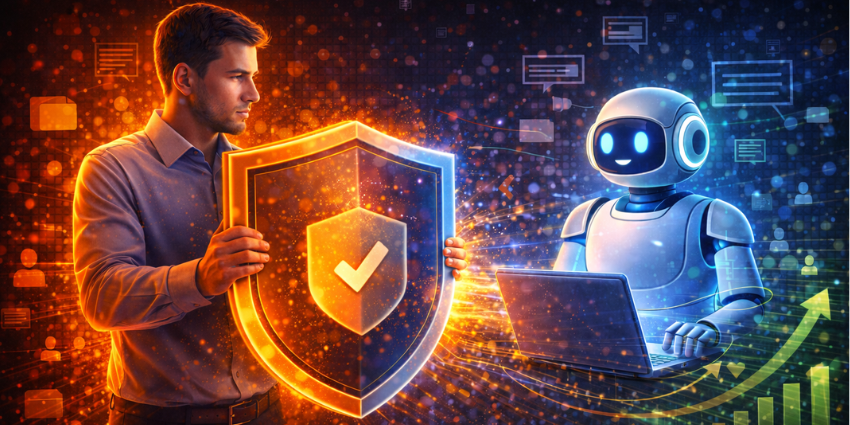

The mix of attendees in the average meeting or collaboration session has changed. You’ve still got one person that always joins on mute, a few with their cameras off, and maybe one using an avatar. Now, though, you’ve also got at least one AI colleague in the mix, taking notes, summarizing, transcribing, or translating.
We’re inviting machine workers into our UC and collaboration apps at scale, using them to improve communication, productivity, and even accessibility.
“But we don’t always think about the AI colleague risks we’re introducing at the same time.”
Those threats aren’t just reserved for shadow AI tools. Even the approved copilots and assistants in Microsoft Teams, Zoom, and Webex create issues when they’re constantly listening, collecting data, and even taking action without human input.
Related Articles
- UC Identity Risks are Evolving: Deepfakes, Impersonation, and UC-Based Fraud
- Why Unified Communications Is Your Next Big Security Blind Spot
- The Ultimate Guide to UC Security, Compliance, and Risk
AI Colleague Risks: What Are AI Colleagues in the Workplace?
“There’s a lot of variety in the ‘machine coworker’ landscape today.”
Inside collaboration platforms, AI colleagues usually fall into a few buckets. Meeting agents that record, transcribe, summarize, and assign action items. Chat assistants and copilots that draft messages, summarize threads, or search conversation history. Workflow and orchestration agents that kick off tickets, update CRM records, or trigger follow-on actions. Then there are embedded bots and integrations living inside channels, often added months ago and mostly forgotten.
Of course, we can’t forget about shadow AI either. About 73% of knowledge workers are using AI tools daily, even when only 39% of companies have governance strategies in place. Chances are, your teams are using browser copilots, consumer note-takers, and GenAI tools you don’t know about.
Here’s the detail that changes the risk conversation: many of these tools don’t act as “users.” They operate as service accounts, OAuth apps, or API tokens. Non-human identities. In many organizations, those identities already outnumber humans, and a disturbing number of them don’t have a clear owner.
That’s where non-human insider risk starts to form. Not from bad intent, but from ambiguity. You can’t govern what you haven’t named. Clear definitions create visibility. Visibility makes ownership possible. Ownership makes intentional use realistic. This is why collaboration security starts with something almost boring: agreeing on what counts as an AI colleague in the first place.
If it can read collaboration content and act on it, treat it like an insider.
Why Do AI Assistants Pose New Risks in Collaboration Platforms?
If you’re wondering why AI colleague risks feel so slippery, it’s because they’re showing up in the messiest place we have: collaboration.
Chat threads, meetings, and messy conversations that shape decisions. AI colleagues are everywhere. That’s what makes collaboration platforms different. They hold strategy, people issues, customer details, incident response chatter: the stuff no one ever labels “sensitive” until it suddenly is. When AI gets involved, those conversations turn into durable artifacts. Transcripts. Summaries. Follow-ups. Action items. All neat, searchable, and easy to forward somewhere they were never meant to go.
This is the quiet shift most organizations miss. Risk used to live in files. Then endpoints. Now it lives in participants. Once AI colleagues join the room, they don’t just listen. They remember, redistribute, and trigger actions elsewhere.
This creates a brand-new risk space for teams: non-human insider risks. Not hackers. Not rogue employees. Systems that have legitimate access, act on that access, and hang around indefinitely, without fitting any of the accountability models we built for people.
Traditional insider risk assumes motive: negligence, coercion, or resentment. AI doesn’t have any of that. It just has permissions, and permissions scale beautifully.
This risk grows out of a few very human habits.
Over-permissioning because access reviews are tedious. Vague ownership because “IT set it up.” Invisible sprawl because bots don’t complain when they’re forgotten. Add autonomy on top, and you get systems making choices in contexts they don’t fully understand, inside spaces that were never meant to be recorded so precisely.
What Types of Insider Threats Can AI Introduce in Unified Communications?
Companies often struggle with minimizing AI risks when the threats seem small. We assume nothing catastrophic can happen when a bot takes a few notes in a meeting. Realistically, the small mistakes can build up a lot faster than you’d think. A few examples:
The note-taker becomes a data distributor
A meeting copilot joins a Microsoft Teams conference automatically. It captures everything, including the awkward five minutes where someone vents about a customer or floats an idea they explicitly say isn’t ready. The call ends. A clean summary gets posted to a shared channel. Now a private conversation has legs. This is how confidentiality erodes quietly, and how non-human insider risk shows up without anyone noticing until it’s too late.
Shadow copilots bypass safeguards
People copy chunks of chat, transcripts, or plans into consumer AI tools like ChatGPT because it’s faster. Gartner says nearly seven in ten organizations suspect this is already happening. Prompt-based sharing doesn’t look like file exfiltration, so it slips through the cracks. The trouble is, you have no idea where that data ends up, how it’s used, or whether it’s going to come back to haunt you.
Agent-to-agent automation sprawl
A bot updates a ticket. That triggers another bot. That pushes a notification into Teams. No one remembers setting it up, but now decisions are happening across systems with no clear line back to a human. This is where collaboration security teams start seeing behavior they can’t explain. That immediately puts you in contradiction of emerging AI governance regulations.
Autonomy meets the wrong context
AI Agents optimize for goals, not judgment. Give them just enough autonomy, and they’ll act confidently in situations a human would pause on. The result looks eerily like insider behavior, minus malicious intent. No one meant to do something unethical or dangerous, but the fallout is still the same.
The Moment AI Colleague Risks Become Visible
The thing about AI colleague risks is that by the time most teams argue about policy, the risk has already shown itself in places no one was really watching.
It usually starts small. A bot joins a meeting, and no one’s sure who added it. A “temporary” transcription tool becomes permanent because it’s useful. Someone mentions, offhand, that they paste notes into a browser AI because it’s faster. Service accounts get broad access because a workflow kept failing, and everyone wanted the tickets to stop.
None of this looks like a security incident. That’s why it’s dangerous.
These aren’t failures of technology; they’re governance gaps. Signals that AI participation has outpaced clarity. This is the moment where organizations often reach for heavier controls. That instinct usually backfires. It pushes people toward more shadow behavior, not less.
The smarter move is simpler: accountability. When these signals appear, it’s a cue to pause and ask who’s responsible for this AI colleague, what it’s meant to do, and where it should absolutely not operate.
What Governance Policies Should Apply to AI Assistants in The Workplace?
The worst problem you can have right now is a lack of insight. When something feels off, nobody can answer a very simple question:
Who owns this AI?
Accountability breaks down fast with AI colleagues. Permissions get delegated and then forgotten. Service identities do the work, so authorship disappears. Outputs sound confident, so people trust them. Meanwhile, ownership is scattered across IT, security, workplace teams, and the business.
You fix this with minimum viable accountability.
That means every AI colleague needs:
- A named human sponsor: Not a steering group. Not “IT.” One person who can say, yes, this bot belongs here.
- A clear scope: What it’s meant to do, and just as importantly, what it should never touch.
- A known escalation path: When behavior feels wrong, people need to know who to call, without starting a Slack archaeology project.
- An obvious off-switch: If something crosses a line, stopping it shouldn’t require three approvals and a change request.
Ask: If this AI colleague made a mistake in front of a regulator, a customer, or an employee, who would be expected to explain it? If there’s no answer, you’ve found your non-human insider risk.
How Can Companies Prevent Data Leakage Through AI Tools?
This is the part that sneaks up on teams. AI colleague risks aren’t limited to what bots do in meetings; they’re about what gets left behind afterward. AI colleagues create records. A lot of them. And those records don’t always behave the way people expect.
In UC and collaboration platforms, that usually means:
- Transcripts that capture side comments, speculation, and emotion alongside decisions
- Summaries that read authoritative, even when the conversation was anything but settled
- Auto-generated follow-ups that look like commitments, even when they were just brainstorming
Once those artifacts exist, they can be forwarded, stored, searched, and, depending on the industry, requested later. That’s where non-human insider risk turns into a compliance and trust problem.
The fix is setting shared expectations early.
- What counts as a draft vs. a record: Not every summary deserves the same weight as an approved document.
- Where AI-generated content can live: A private meeting recap doesn’t belong in a wide-open channel by default.
- Who’s responsible for review: Someone should sanity-check what gets preserved, especially in regulated or sensitive workflows.
This only works once AI colleagues are treated as insider-class participants. Until then, records feel accidental. After that shift, they become manageable.
Want to know if your machines and humans are working effectively together? Explore our guide to human-AI collaboration metrics.
The Human Layer: Why Clarity Beats Control Every Time
Most AI colleague risks don’t start with bad decisions. They start with people trying to move faster than the system around them.
Someone’s in back-to-back meetings. Notes need to be shared. A summary needs to go out. The approved tool is slow, unclear, or locked down in ways no one fully understands. So they paste the conversation into whatever AI is already open in their browser and move on.
You see the same pressures over and over again:
- Nobody can clearly explain what’s allowed
- People worry more about slowing the team down than doing something “wrong.”
- Output gets rewarded long before the process ever does
When that’s the environment, controls don’t fix much. They just create workarounds. Shadow AI isn’t rebellion. It’s friction avoidance.
The teams that handle this better don’t obsess over locking everything down. They just make expectations obvious.
That usually means spelling out, in normal language, where AI is welcome and where it’s not. Showing examples that reflect real meetings and real work, not edge cases. Making sure the sanctioned path inside collaboration tools is actually easier than jumping outside them.
From Unmanaged Automation to Supervised AI Colleagues
AI colleague risks aren’t emerging because AI agents are reckless. They’re emerging because we’ve been treating AI like background software in places where it’s clearly acting like a participant.
Once an AI can sit in a meeting, read the room through transcripts, summarize decisions, and trigger actions elsewhere, it’s already crossed the line into insider territory. Ignoring that doesn’t reduce risk. It just makes it harder to see.
This is why non-human insider risk matters as a framing. It pulls the conversation out of hype cycles and ethics debates and drops it back into familiar ground: access, accountability, and supervision. The same fundamentals still apply. Who’s in the room? What are they allowed to do? Who answers when something feels wrong?
Getting ahead of this is easier than it seems. Identify your AI colleagues, assign ownership, and set expectations that make sense in the UC and collaboration environment. Also, accept that supervision (not restriction) is essential to safe automation.
If you need help building a collaborative, innovative workplace that actually stays safe in the age of AI colleagues, our guide can help. Read the ultimate guide to UC security compliance and risk, and make sure you’re ready to handle even the most complicated threats head-on.
FAQs
How can AI tools create insider security risks?
Most AI assistants don’t behave like normal users. They operate as service accounts or API integrations, often with broad permissions and very little visibility. That means they can read conversations, summarize them, and sometimes trigger actions elsewhere. The risk isn’t intent. It’s access combined with automation.
How can organizations monitor AI activity in collaboration tools?
The first step is simply knowing which AI systems are present. Many companies discover bots, meeting agents, and OAuth apps that no one remembers adding. Once those identities are visible, monitoring usually focuses on what they can read, what they generate, and where their outputs travel.
What security controls reduce AI-related insider threats?
The same controls used for human insiders start to matter again. Clear ownership of each AI assistant. Defined permissions instead of blanket access. Regular reviews of what those systems can see or trigger. None of it is complicated, but it does require treating AI like a participant rather than background software.
How should organizations audit AI activity in UC environments?
AI systems leave a trail in the artifacts they create. Meeting transcripts. Summaries. Auto-generated follow-ups. Looking at those outputs over time usually tells you two things pretty quickly: what information the AI had access to, and how that information is being reused across the organization.
What risks arise when employees rely heavily on AI assistants?
Conversations get summarized automatically. Drafts get generated without much review. Decisions start moving faster than the context around them. AI can accelerate collaboration, but it can also turn messy conversations into durable records that travel further than anyone expected.