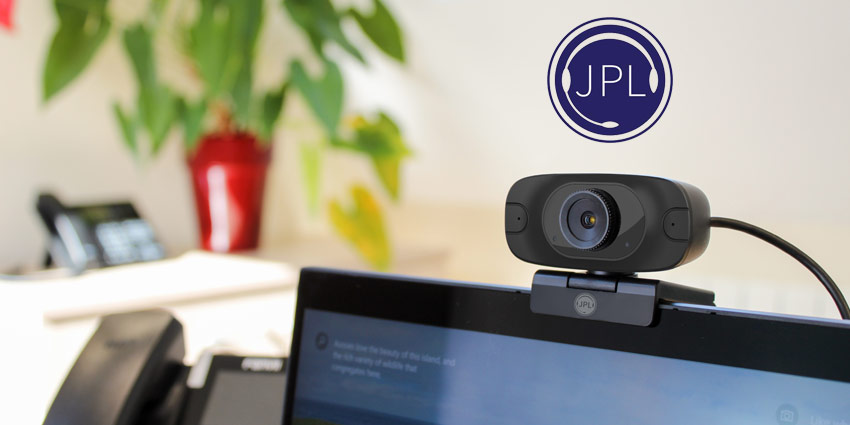

JPL Telecom has been in the headset business for 17 happy years now. It has recently decided to broaden its reach and take its ample endpoint experience to the conferencing solutions field. The company’s recent development – a compact, go-anywhere webcam called the Vision Mini – was originally aimed at the education field. Much to JPL’s surprise, it was actually received with an overwhelmingly-warm embrace by the company’s largest target audience – the contact centre industry.
“We’ve officially put it on sale and had some huge orders. That’s taken me by surprise,” says James Clarke, JPL Telecom CEO.
“I guess it was just right for the market. One of the largest contact centres globally have knocked us over sideways with the quantity they asked for. We’ve actually rolled out 80,000 units between now and Christmas and will potentially roll out 300,000 units next year. In addition, we have seen a significant demand in both advance orders, sample requests and demonstrations in the USA, Canada, Europe, Russia and the UK.”
From Education to Contact Centers
As Clarke puts it: the Vision Mini is a “no-nonsense” product. As far as its specs go – it’s definitely well-suited for large rollouts in today’s remote learning and working environments.
A quick look at the Vision Mini’s key features:
It’s Plug-and-Play and platform-agnostic; It has a tri-fold hinged bracket, dual microphone, a 1080p lens, a 67° viewing angle and a power-on indication; It comes with a privacy cover and its very own carrying case; and on top of all that, it’s delivered at the highly-affordable end-user price point of £45.90 apiece.
The compact webcam’s bracket is simple but also a highly important feature.
It’s built in such a way that not only allows complete left-to-right manoeuvrability and fits on screens of all sizes – but also enables one to tilt their camera in order to show the other person what’s happening on their desk.
So, how did a product developed for the education industry turn out to be a classic contact centre solution?
“It fits exactly what the contact centre industry is asking for” explains Clarke.
“Agents need to know if the camera’s active so they know when to perform. They want to be able to cover the lens up. And when it comes to large contact centres with multiple agents working from home, supervisors need to be able to look at agents’ working environment – so that’s where the tri-fold bracket comes in. We unintentionally walked straight into our main market as a company.”
The Vision Mini seems to fit right into today’s current COVID reality, where many contact centres are transitioning to homeworking, possibly for good.
“The large contact centre that I mentioned earlier, they’re moving to a model where approximately 60% of their global contact centre workforce will be working from home permanently as of January 2021. This was previously unthought-of”
Software Last – Plug & Play Solution
Other than its attractive price point, the Vision Mini has another interesting market differentiator: its “software last” policy. This means that using the Vision Mini, one doesn’t have to download even the tiniest bit of software – it’s a pure Plug-and-Play solution.
“If a company has hundreds or thousands of users potentially using a product, and they are in charge of that rollout – thinking about sending all those people to a website that’s outside your control, to download some software that’s outside your control, is extremely intimidating,” explains Clarke. “The other thing is it often makes people fiddle rather than work. When you multiply that through a large number of people, the downtime is significant.”
“So we flipped it on its head completely. It’s much easier said than done to go for a software last (‘Plug-and-Play’) solution – you need to have it working on both Apple and Microsoft, which is not an easy task. And we’ve done it. It’s not because we haven’t got the other route – we have it.” He concluded:
“We’re just trying to make things as easy as possible for the customer”