
There’s a sort of love-hate relationship building between employees and their emerging machine colleagues these days. On the one hand, the rapid introduction of bot workers is causing serious headaches for teams. Psychological safety is dissolving, and human stress is increasing as people struggle to keep up with their algorithmic associates.
On the other hand, most employees know the only way they can survive is with a little AI support. 77% of staff members already use AI agents, and most view them as a transformative tool. Adoption is climbing, but not always in the way that leaders would like.
Instead of embracing the “official” AI tools baked into existing UC and collaboration tools, a lot of team members are taking a “bring your own bot” approach. Microsoft found 71% of employees are using unapproved consumer AI tech at work, often every week.
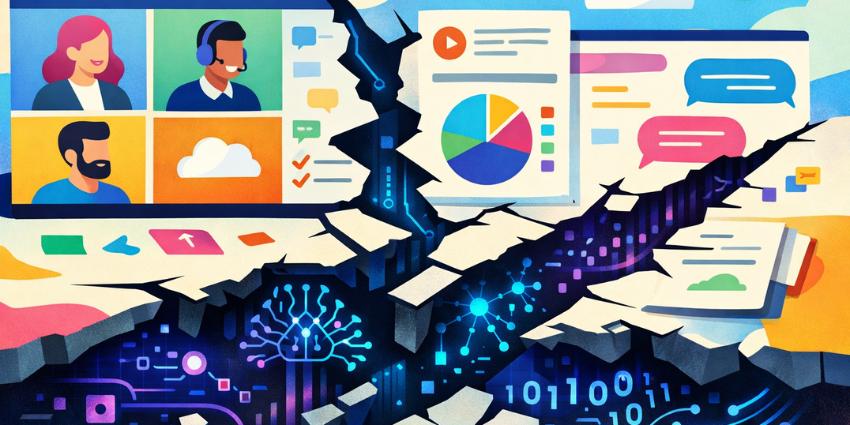
The AI itself isn’t the problem; it’s the fact that these machine colleagues are ungoverned, untracked, and unseen entities shaping how relationships are built and decisions are made.
Further reading:
- Are Your AI Meeting Tools Breaking Compliance Rules?
- Your UC Strategy is Broken, Governance is Why
- AI Colleague Risks: The Hidden Insider Threat in UC
What is Shadow AI in the Workplace?
Shadow AI in collaboration isn’t really a mystery. We’ve been here before, just in a slightly different way. Every company has dealt with staff using their own devices, apps, and tools at work. The trouble is, shadow IT was (usually) a lot easier to spot.
Someone downloaded an unapproved app, bought a tool on a credit card, or spent too much time on their phone in the office. You could see the issue.
Shadow AI in collaboration and communication is a bit different. First, companies tend to automatically assume that teams will just use the tools they give them without complaint. Why bother with unsanctioned tools when we already have AI assistants built into Microsoft Teams, Webex, Slack, and Zoom?
But even if staff do embrace those tools, how they use them can be a risk in itself. AI can slip into the workflow in the wrong places without leaving fingerprints. It can shape work before anyone else sees it. Before a message is sent, a document is shared, or a meeting summary becomes “the record.” By the time the output shows up in Teams or Slack, it looks completely ordinary.
That’s why this matters so much in collaboration environments. Collaboration platforms capture outcomes, not how those outcomes were produced. They preserve what was said or shared, not the quiet AI assistance that shaped it.
How Does Shadow AI Affect Meetings, Chat, Documents, and Decision-Making?
People don’t try to sneak around policy; they try to keep up. Meeting overload is just getting worse in the age of the infinite workday. Companies try to help with sanctioned tools, but the guidance on how to use them is too vague. Employees decide they need to use AI quietly, faster, and without drawing attention, particularly in collaboration apps and UC platforms.
There’s also a trust gap. Research from CIPD shows people are uncomfortable with AI making decisions, but far more comfortable with AI assisting their own work. That difference matters. It’s why shadow AI in collaboration feels safer than visible automation.
The paradox is brutal. AI helps. Talking about AI feels risky. So experimentation happens alone, not out loud. What should be shared learning turns into private advantage.
The problems start to build up through:
Shadow AI in Chat
People draft messages in a browser AI, paste them into Teams or Slack, and hit send. Others summarize long threads privately, so they don’t have to scroll. Tone and context change when that happens. Sometimes language gets translated or rewritten, so it sounds more confident than the sender feels.
Once that message lands in the channel, none of that is visible. To everyone else, it just looks like a well-written reply. Managers see speed. Teammates see clarity. No one sees the AI influence behind it. That’s dangerous when the messages in today’s platforms shape so much.
Shadow AI in Meetings
Personal AI note-takers join calls. Transcripts get downloaded. Summaries get pasted into external tools to “clean them up.” Action items are generated privately and sent onward as if they were settled decisions. Meeting content doesn’t stay in the meeting anymore. It turns into artifacts: summaries, follow-ups, and tasks that travel faster than context.
Here’s the problem: participants often don’t know who used AI, what got summarized, or what nuance was lost. Yet those artifacts are what shape next steps.
Shadow AI in Documents & Knowledge Work
Documents are where AI influence becomes durable.
Drafts get shaped through unseen AI iteration. Strategy language gets tightened. Ideas get reorganized. Knowledge is reused without clear provenance. By the time something lands in a shared doc, it feels authoritative.
But when decisions are questioned later, explaining why something was written becomes harder. The collaboration record shows the outcome, not the influence.
Worried about data risks in UC? Explore how AI data issues are creating new compliance nightmares.
What Risks Does Shadow AI Create For Governance, Trust, and Compliance?
It’s easy to panic here. Someone brings up worst-case security scenarios. Another person starts talking about bans. That misses the real damage Shadow AI in collaboration causes day to day.
Collaboration platforms have become two things at once: the primary surface for decision-making, and the main interface between humans and AI. If AI usage happens unchecked in these spaces, we end up with:
- Operational Drift: When hidden AI usage becomes normal, teams stop operating on the same footing. Some people are quietly accelerating their work with AI. Others aren’t. Output starts to vary in tone, speed, and confidence, and nobody can quite explain why.
- Trust & Accountability Gaps: Collaboration platforms are good at showing what. They’re terrible at showing how. That’s a real problem when important decisions are made about which work to prioritize, which tasks to assign, and how teams are shaped.
- Accidental Governance Failure: Most organizations do have AI policies. The problem is that AI governance in collaboration often lives outside the tools where work actually happens. AI use shows up in meetings, chat, and docs, where people bypass governance standards without thinking, just to preserve speed.
What we end up with, in the worst-case scenario, is a hybrid human/AI workforce, where AI ends up determining more than people.
How Can IT Teams Reduce Shadow AI Without Blocking Productivity?
It’s easy to assume there’s an easy fix here: just ban people from using unapproved tools. Lock down anything you haven’t double-checked and tailored specifically for your teams. That didn’t work with BYOD policies or UC platforms. It’s not going to work with AI.
Blanket bans don’t stop people from using AI. They just stop people from talking about it. Work doesn’t slow down because policy says it should. Deadlines don’t disappear. Inbox pressure doesn’t ease up. So employees adapt, under the radar.
Bans create fear, then silence. Silence fragments AI adoption into private, inconsistent workflows that leadership can’t see or learn from. One team uses AI carefully and quietly. Another avoids it completely. A third goes all in, underground. Now you’ve got three different operating models and no shared rules.
The hard truth is this: AI governance in collaboration can’t be enforced through prohibition alone. You can’t govern what people are afraid to admit using. The moment AI becomes something employees feel they need to conceal, you’ve already lost visibility, which is the one thing governance actually depends on.
The Real Strategy: Reducing Shadow AI in Collaboration
People aren’t hiding AI to be slick. It’s usually way more boring than that. They don’t really know where the line is, they don’t want a whole conversation about it, and they definitely don’t want to be the person who gets called out for “using it wrong.”
So the strategy can’t start with rules. It has to start with how work actually feels.
Shift from Permission to Psychological Safety
In teams where hidden AI usage drops, the change usually starts with a sentence from a manager, not a policy. “If AI helps you clean up notes, drafts, or follow-ups, that’s fine. If it’s making decisions for you, we need to talk.”
That line does a lot of work. It draws a boundary that people understand. It also removes the fear that admitting AI use is some kind of confession. Once people feel safe saying, “I ran this through AI to tighten it up,” the secrecy stops pulling the strings.
Bring AI Into the Collaboration Flow
Where shadow behavior explodes is where sanctioned tools feel clumsy. Teams copy transcripts into consumer AI tools because they don’t like what Copilot generates, or they don’t have access to certain features. Nobody thinks they’re doing anything risky.
Ensuring everyone has fair access to the right AI tools within the flow of work fixes that. The incentive to go elsewhere feels smaller.
Design for Visibility, Not Surveillance
There’s a huge difference between visibility and watching over someone’s shoulder. Consider making simple changes to how teams share AI content. For instance, if your staff members are using AI-generated summaries, get them to post them in a shared channel, with a note on the tool used.
Once you see which tools teams are using, give them shared prompts and tips on how to work with them safely. If possible, show them how they can get the same outputs from the tools you’d prefer they were using with less work.
Make AI Use Discussable
Shadow AI in collaboration sticks around when nobody talks about it.
Teams that handle this well treat AI like any other work tool. They swap tips in standups. Managers admit when they’ve used it themselves. People compare what helped and what didn’t. That’s when shadow AI stops being shadowy, just because it doesn’t need to hide anymore.
What This Means for UC & Collaboration Leaders
If you’re buying or running collaboration platforms right now, shadow AI in collaboration isn’t a future risk. It’s already shaping how work happens, whether you’ve acknowledged it or not.
Our buyer research has been pointing in the same direction for two years now. Buyers aren’t obsessing over feature checklists anymore. They’re asking harder questions. Where do decisions actually happen? What gets recorded? What quietly influences outcomes before anything is logged?
Collaboration platforms are turning into AI interfaces by default. Meetings generate summaries. Conversations trigger tasks. Docs turn into action plans. That means AI governance in collaboration has to live inside the flow of work, or it won’t exist at all.
It’s also worth remembering that hidden AI usage is a valuable signal in its own way. It shows you if access is uneven, tools aren’t working as well as they should, or expectations are unclear. You can learn from that feedback, and you should.
Shadow AI in Collaboration Is a Design Problem
Most employees aren’t trying to hide anything.
They’re trying to keep up. They’re trying to reduce the drag of meetings, messages, and documents that never seem to slow down. When collaboration systems don’t support transparent AI use, shadow AI in collaboration fills the gap.
Trying to “catch people out” for using unsanctioned tools isn’t the answer. It never has been. If anything’s going to change, companies need to start paying attention. Look at how people actually get their work done when no one’s hovering around. Listen to the feedback when “official” AI tools get added to workplaces. Be ready to adapt.
AI keeps nudging risk in strange directions, so right now it helps to step back and look at the bigger picture. Our complete guide to unified communications is a good place to start. Once you see how work happens today, it becomes much easier to notice where risky habits start and why they stick.
Frequently Asked Questions
What is shadow AI at work?
Shadow AI refers to employees using AI tools or AI features without approval from IT or security teams, often to automate tasks or boost productivity. It happens more than you think, now that teams are becoming more reliant on AI tools.
Why is shadow AI becoming more common?
AI tools are easy to access and powerful, encouraging employees to experiment independently when official tools are unavailable or slow to deploy. Employees are also under more pressure to keep up with rising expectations in the AI era.
What risks does shadow AI create for businesses?
The biggest risks include data leakage, compliance violations, inaccurate outputs, and the exposure of sensitive company information to external AI systems.
How can companies detect shadow AI usage?
Organizations can monitor SaaS activity, implement AI governance frameworks, and establish approved AI tool policies for collaboration platforms.
Is shadow AI always bad?
Not necessarily. It often reveals unmet productivity needs. Many companies use shadow AI insights to guide official AI adoption strategies.