
Remote and hybrid work didn’t “break” communication – it exposed the cracks that were already there. When people aren’t sharing the same hallway, whiteboard, or time zone, small misunderstandings scale fast.
For executives, the key to managing hybrid teams isn’t simply adding more meetings or tools. It’s about building a communication system that keeps hybrid teams aligned, accountable, and moving at the same pace, without turning every update into a calendar invite.
Miscommunication is predictable. It tends to cluster in a handful of repeatable gaps, and those gaps can be fixed with the right mix of process and platform design.
Related Stories:
- Is Poor Communication Costing You More Than You Think?
- Your UC Strategy Is Broken – Governance Is Why
- Are Your UC Tools Secure? – 10 Essentials For Every IT Leader
Gap 1: Channel sprawl
Hybrid teams often inherit a patchwork of communication tools – email for formal updates, Slack or Teams for quick questions, Zoom for meetings, and sometimes even WhatsApp for urgent messages. But fragmentation isn’t just inconvenient – it’s measurable.
According to hybrid workplace research, 87% of employees say good workplace technology is essential for hybrid success, yet only 32% of companies invest adequately in collaboration tools. That gap between expectation and investment helps explain why so many hybrid environments feel chaotic rather than coordinated.
How to fix it:
Standardise “where work happens.” It’s important the below are clearly defined for your team.
- One primary async channel for updates (e.g., team channel + threaded posts)
- One source of truth for projects and decisions (e.g., a shared workspace)
- Rules for urgency (what deserves a call vs. a message)
This is the simplest way to start reducing miscommunication without adding overhead.
Gap 2: Asynchronous drift
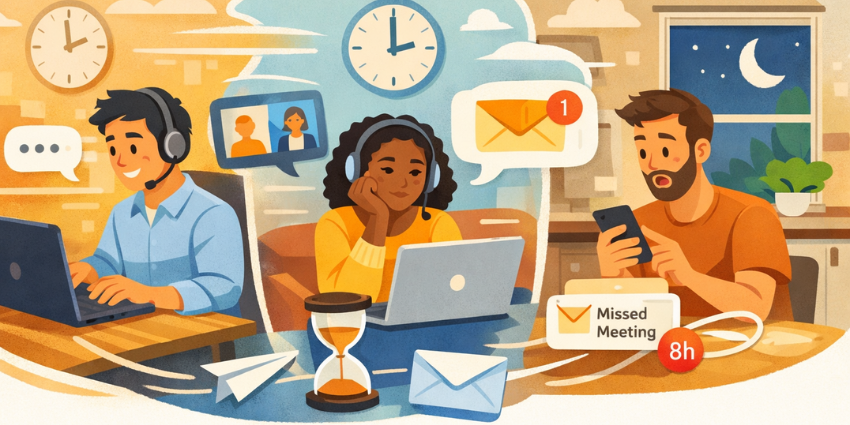
Asynchronous work promises flexibility, but without clear guardrails it can quickly become a bottleneck. Questions stall, approvals drag, and teams lose momentum waiting for responses across time zones. This challenge shows up clearly in the data: 36% of employees say remote or hybrid work has negatively impacted collaboration, according to Zoom. The issue isn’t remote work itself – it’s unclear response expectations and inconsistent communication norms that slow decision-making.
How to fix it:
- Require clear owners and decision deadlines in messages (For example, “Need approval by Thursday 3pm”)
- Use structured updates (weekly priorities, blockers, risks)
- Adopt response-time norms by channel
Executives managing hybrid teams should treat this like an operating model, not etiquette.
Gap 3: Meeting inequality
When some participants are in the room and others join remotely, meetings can easily become two-tier experiences. Side conversations, poor audio quality, and limited camera visibility make it harder for remote employees to contribute. The productivity impact is significant: nearly 75% of professionals say virtual meetings reduce productivity, and more than half report frequent workflow interruptions, according to research from Robert Walters.
Without intentional structure and inclusive meeting design, hybrid meetings can widen communication gaps rather than close them.
How to fix it:
- Default to everyone using their own device for key discussions (yes, even in the office).
- Use shared agendas and live notes so decisions are visible.
- Assign a facilitator to pull in remote voices and manage pacing. This supports a healthier hybrid work culture and improves employee communication in hybrid workplace settings.
Gap 4: Knowledge fragmentation
Most of us know how hard it is to keep track of documents, meeting notes, and spreadsheets. When time is spent searching for context instead of getting work done, productivity takes a hit.
How to fix it:
- Create decision logs (what, why, who, when)
- Use recordings + searchable transcripts for key meetings
- Build templates for repeatable work (launches, incidents, procurement)
Gap 5: Tool complexity
Even strong teams struggle if the stack is hard to manage, poorly integrated, or unreliable. As hybrid work becomes the norm, many firms are modernising to improve resilience and agility – signalling that communications upgrades are now a strategic priority, not a nice-to-have.
How to fix it:
Evaluate platforms through a “friction lens.”
- Consolidation: fewer tools, clearer workflows (chat/voice/video/content)
- Interoperability: integrations with CRM, ticketing, identity, project tools
- Governance: policy controls, retention, compliance, admin visibility
- Quality + analytics: call quality insights, adoption dashboards, real user telemetry
A Simple Executive Checklist:
If you’re managing hybrid teams and considering an update to how your team works, sanity-check your current environment with these questions:
- Can teams find decisions in under 60 seconds?
- Are response-time expectations explicit and realistic?
- Do meetings produce visible outcomes (owners, dates, next steps)?
- Is the experience equitable for remote and in-office staff?
- Does the platform reduce steps – or add them?
If you answered “no” more than once, your biggest issue may not be behaviour, it may be system design.
Building Better Communication
Hybrid teams don’t need more communication. They need better pathways for it: clear norms, fewer fragmented channels, and a platform that makes good communication the default.
FAQs
Why do hybrid teams struggle with communication?
Hybrid teams often rely on multiple tools and asynchronous workflows, which can lead to fragmented conversations, missed information, and reduced alignment between remote and in-office staff.
What are the biggest communication gaps in hybrid teams?
The biggest gaps include tool fragmentation, delayed asynchronous responses, meeting inequality between remote and in-office staff, and knowledge silos that reduce visibility and accountability.
Why does hybrid work create collaboration problems?
Hybrid work introduces complexity in communication channels, time zones, and meeting formats. Without structured processes and unified collaboration tools, teams experience delays, misalignment, and reduced engagement.
How can leaders improve communication in hybrid teams?
Leaders can standardise collaboration tools, define response-time expectations, redesign hybrid meetings for inclusion, and implement shared knowledge repositories to prevent information silos.
Do hybrid communication gaps affect employee retention?
Yes. Research shows well-structured hybrid work models improve engagement and can significantly reduce employee turnover, highlighting the importance of strong communication design.
What technology helps close hybrid communication gaps?
Unified communications platforms, collaboration software, meeting room technology, AI-powered transcription, and centralised knowledge management systems all help create more equitable and efficient hybrid environments.
What tools support hybrid team communication?
Platforms like Microsoft Teams, Zoom, Slack, and integrated UCaaS solutions help unify messaging, meetings, and collaboration.