Let’s be honest: many enterprises are excellent at collecting employee experience data — and poor at acting on it.
Dashboards multiply. Heatmaps glow. Pulse surveys roll out quarterly.
Yet engagement drops. Attrition rises. Productivity stalls.
Why?
Because insights without execution are just data visualisations.
Today, however, modern EX analytics platforms – including Qualtrics, Culture Amp, Microsoft Viva Glint, and Webex Control Hub – are reshaping how organisations connect employee sentiment to profitability, retention, and operational performance.
The difference is not measurement.
It’s activation.
Suggested Articles:
How Employee Experience Data Becomes a Measurable Business KPI
How to Use Employee Recognition Platforms to Turn Kudos into Culture and ROI
9 Employee Experience Platforms Enterprise Leaders Should Know in 2026
What Is Employee Experience (EX) Data?
Employee experience data captures how employees feel, function, and perform at work — across engagement, wellbeing, enablement, and culture.
Unlike traditional HR metrics, EX data combines:
- Sentiment (surveys, pulse checks)
- Behaviour (collaboration patterns, workload signals)
- Outcomes (retention, productivity, performance)
The challenge for enterprises isn’t collecting this data.
It’s turning it into action that improves business results.
What Is the Business Impact of Employee Experience?
Most organisations now track engagement scores, wellbeing metrics, and culture indicators. Yet performance gaps remain.
Why?
Because EX data is often:
- Reviewed quarterly instead of acted on weekly
- Owned by HR but disconnected from operations
- Reported without clear links to KPIs
In practice, this turns EX into a soft signal, not a management tool.
Research highlights the disconnect, with 87% of EX leaders say experience impacts retention, and only 51% of employees believe their employer delivers a strong experience
Furthermore, Cerkl notes that too many firms collect metrics without defining why they matter, leading to misaligned EX programs stuck in the “nice-to-have” corner
The data exists – the operating model does not.
Gartner confirms that
“When taken together, the behaviours of highly engaged business units result in a 23% increase in profitability, 78% less absenteeism and 21% lower turnover.”
Read more on the ROI of Employee Engagement here
How Do EX Analytics Platforms Turn Data Into Action?
Let’s zoom in on how analytics platforms make measuring employee experience a revenue conversation, not a HR one.
Qualtrics:
Pairs VoE (voice of employee) data with predictive models to identify turnover risk months before a resignation lands.
Culture Amp:
Maps engagement drivers to outcomes like speed-to-productivity, manager effectiveness, and team performance.
Microsoft Viva Glint:
Connects sentiment to collaboration data (like meeting overload and manager check-ins) to reveal the real causes behind dips in morale.
Webex Control Hub:
Links wellbeing signals to operational performance – think focus time vs. task completion or meeting load vs. burnout indicators.
Together, these tools make EX measurable, monitorable, and monetizable.
In terms of which areas of your organization and processes you should be measuring; the following are the best bits to solidify – if your goal is to transform your overall business performance!
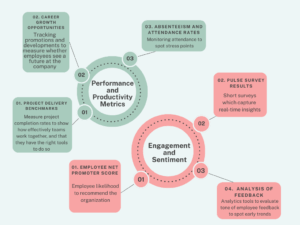
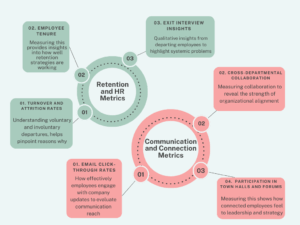
What Should Enterprises Measure in EX?
- Treat EX Data with the Same Urgency as CX Data
If you’d act on a drop in NPS within hours, but wait six months to address declining engagement scores… your priorities are showing.
- Link EX Metrics Explicitly to KPIs
Define thresholds:
- Engagement → retention
- Wellbeing → productivity
- Enablement → speed-to-output
- Sentiment → customer satisfaction
- Use Real-Time Dashboards, Not Quarterly Archaeology
Webex Control Hub and Viva Glint both offer live alerts. When collaboration or wellbeing dips, leaders should intervene that week, not “next quarter’s business review.”
In Conclusion, EX Isn’t Soft – It’s Strategic
If your approach to measuring employee experience doesn’t change how you run the business, it’s not analytics — it’s decoration.
The enterprises winning in 2025 aren’t the ones collecting EX data. They’re the ones using it to make real-time operational decisions. They’re the ones where HR and IT partner to leverage platforms like Viva Glint, Culture Amp and Control Hub as engines of productivity, retention and revenue.
As Gartner reminds us:
“Organizations that focus on employee experience can achieve up to 40% better performance than those that do not.”
That’s not a warm and fuzzy metric – that’s a competitive advantage
FAQ
What is employee experience analytics?
It is the process of collecting and analyzing employee data to understand engagement, satisfaction, and productivity.
Why is employee experience important for business performance?
Organizations with strong employee experience see higher productivity, retention, and customer satisfaction.
What metrics measure employee experience?
Engagement scores, retention rates, productivity metrics, and employee feedback.
What tools analyze employee experience data?
Platforms like Qualtrics, Workday, SAP SuccessFactors, and Microsoft Viva.
How can HR teams act on employee experience insights?
By using analytics dashboards to identify trends and implement targeted engagement initiatives.
Ready to unlock engagement at scale?
Explore AI and Collaboration: The New Power Duo Transforming Employee Engagement – your 2026 UC guide to trust, purpose, and productivity.