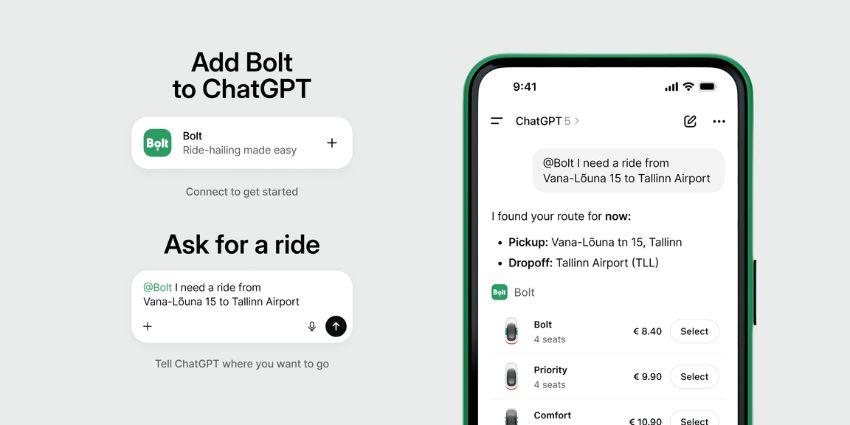

Bolt has launched a ride-hailing integration for ChatGPT, making its service available through OpenAI’s app catalogue across every Bolt market at once. Users can ask ChatGPT about a journey, compare route options, view an upfront price estimate, check a driver’s expected arrival time and identify a suggested pickup point before being transferred to the Bolt app to complete the booking.
The integration is not yet an end-to-end transaction inside ChatGPT. Payments continue in the Bolt app at launch, although Bolt says direct payment through the AI assistant is planned for later in 2026. That distinction matters: this is currently an AI-led discovery and planning experience, rather than a fully agentic ride-hailing workflow.
Paddy Partridge, Senior Vice President, Bolt, said:
“For years, booking a ride meant opening a dedicated ride-hailing app. As more everyday interactions take place through AI, we think requesting a ride should be just as straightforward: ask, see the price, and go.”
Bolt says the rollout makes it the first ride-hailing platform available through ChatGPT across the EU, UK, Switzerland, Norway, Ukraine and Azerbaijan. The service appears in the ChatGPT app store and requires users to connect the Bolt integration manually.
Related Articles
- OpenAI’s ChatGPT Work Promises Enterprise Automation – But Will IT Leaders Trust It?
- OpenAI Snaps Up Slack CEO Denise Dresser as New CRO
TL;DR — What Productivity Leaders Need to Know
- Bolt is now accessible through ChatGPT across its markets, including the UK and EU.
- Users can estimate fares, compare routes, check driver ETAs and discuss pickup points within an AI conversation.
- Booking and payment are not fully embedded yet: users transfer to the Bolt app to complete the trip.
- The strategic shift is from app-first to conversation-first service discovery, with ChatGPT becoming another customer interface.
- For enterprise automation teams, it is an early example of how AI assistants may orchestrate travel, expense and employee services across multiple vendors.
Could ChatGPT Become the New Front Door for Travel Services?
Direct answer: Bolt’s integration suggests that AI assistants are evolving from search and planning tools into service-discovery layers. The immediate opportunity is reducing the friction of moving between travel planning, route comparison and ride-hailing; the longer-term question is whether assistants can safely complete transactions and coordinate multiple suppliers.
The direction of travel is clear. Bolt cites Accenture’s Consumer Pulse Research 2025, which surveyed 18,214 consumers across 14 countries and found that 80% of travellers use AI tools for travel purposes, while more than half would allow AI to manage their travel arrangements completely.
For employees organising a business trip, the workflow is familiar: research a destination, compare transport options, check a meeting location, arrange a ride, file an expense and communicate an ETA. These activities usually occur across separate apps. Bolt’s move makes the AI assistant a layer above one part of that stack — but only one part, for now.
Partridge later added:
“People don’t plan their evening in five different apps anymore. A lot of that planning happens in one conversation with AI now.”
What Does the Integration Actually Automate?
The current version automates information retrieval and decision support rather than the entire booking flow. It can surface the fare, routes, driver arrival estimate and pickup guidance, then hand the user off to Bolt for confirmation and payment.
That hand-off is likely to be a deliberate control point. Ride-hailing transactions involve live location, fare acceptance, payment, safety and driver availability. Retaining final booking in Bolt’s own environment gives the company control over those core operational elements while it tests demand for conversational access.
The friction is also the limitation. Users must manually find and connect the Bolt app in ChatGPT before using it, then leave the conversation to complete payment. Whether that is sufficiently seamless for travellers — particularly people rushing between meetings, airports and stations — will determine whether the integration becomes a durable behaviour or a novelty.
Why It Matters for Productivity and Automation
The bigger enterprise implication is not simply that an employee can order a car through ChatGPT. It is that service providers are beginning to expose their workflows to AI assistants, creating the potential for a conversational layer that can connect travel, calendars, collaboration platforms, employee expense systems and mobility providers.
For corporate travel and workplace teams, the next phase will bring harder questions: can an AI assistant apply travel policy, select preferred suppliers, use a corporate payment method, obtain approvals, protect location data and create an expense record automatically? Bolt’s integration does not yet answer those questions, but it demonstrates the user-interface shift that will make them unavoidable.
Bottom line: Bolt has not replaced its ride-hailing app with ChatGPT. It has added ChatGPT as a conversational entry point. That is a small product change with a larger strategic signal: as AI assistants become the place where people plan work and travel, service providers will need to decide whether they remain destination apps or become tools an AI can call on.
Frequently Asked Questions: Bolt and ChatGPT Ride-Hailing
Can you book a Bolt ride through ChatGPT?
Users can use ChatGPT to plan a Bolt journey, see an upfront price estimate, compare route options, check the driver's estimated arrival time and identify a pickup point. The final booking and payment currently transfer to the Bolt app, rather than being completed entirely inside ChatGPT.
Where is Bolt available through ChatGPT?
Bolt says its ChatGPT integration is available across every market where it operates. This includes the EU, UK, Switzerland, Norway, Ukraine and Azerbaijan. Users must connect Bolt through the ChatGPT app store before using the service.
Can users pay for Bolt through ChatGPT?
Not at launch. Bolt says users will currently be transferred to the Bolt app to complete booking and payment. The company plans to add payment inside ChatGPT later in 2026.
Why is Bolt integrating with ChatGPT?
Bolt is responding to the growing use of AI assistants for travel planning and service discovery. The company says users increasingly organise activities through a single AI conversation rather than navigating multiple apps. The integration allows Bolt to become part of that conversational planning flow.
What does conversational AI mean for corporate travel?
Conversational AI could eventually connect travel planning, preferred-supplier selection, ride-hailing, calendar context, approvals and expenses into one workflow. Bolt's current integration is an early example: it handles planning and journey information, but does not yet apply corporate travel policy or complete an end-to-end managed booking.
About the Author
Alex Cole is a Technology Journalist and Videographer at UC Today. He has experience reporting on productivity and automation, human capital management and extended reality. Connect with Alex on LinkedIn.