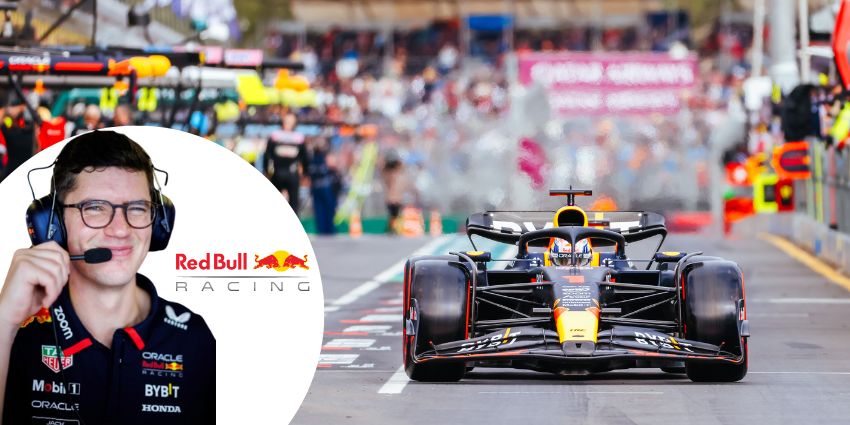

Formula 1 teams understand the importance of small enhancements. They know that a slight improvement in tires, a fractionally lighter frame, and a small reshaping of the wing mirrors – when taken together – can make a big difference.
That’s why Oracle Red Bull Racing came to the decision that improving its AV could deliver incremental efficiencies that pay dividends far beyond the pit stop.
After evaluating all the options, the Formula 1 team decided that one AV vendor stood above the others in its offering: Neat.
As Jack Harrington, Partnerships Group Lead at Red Bull Racing & Red Bull Technology, says, the team’s evaluation process focused on finding partners who could do more than deliver equipment. “It wasn’t about finding someone who already understood our inner workings,” he explains, but about “people who know their craft and can challenge our way of thinking, rather than just deliver hardware.”
Red Bull Racing sought technology that could complement its engineering mindset and challenge assumptions, not merely serve as a tool. But what exactly put the AV vendor in pole position ahead of its competitors?
Standardizing AV for Seamless Collaboration
Before implementing Neat, Oracle Red Bull Racing’s video systems were inconsistent. Audio and video often fell out of sync, creating friction during critical meetings.
“Formula 1 moves fast, and our previous setup didn’t meet the standard we expected,”
Harrington says.
For the team, Neat’s devices offered reliable audio and video quality that made them an attractive option. Their certification with leading UC providers like Microsoft Teams gave Oracle Red Bull Racing confidence that the AV would work seamlessly with its systems after the transition.
Combined with minimal setup requirements and interfaces that worked across multiple spaces, from engineering centers to boardrooms, Neat’s devices proved capable of supporting every environment Oracle Red Bull Racing operates in.
This standardization of communication technology meant teams could focus on performance-critical tasks while maintaining alignment across engineering, strategy, and executive decision-making.
Now, Oracle Red Bull Racing has embedded Neat devices across its operations, including at its British HQ.
Featuring Neat Bar Pros, Neat Centers, and Neat Pads in meeting rooms, Neat Board Pros in collaborative spaces, and Neat Frames in executive offices, the team runs all its Neat devices on its Microsoft Teams UC platform.
This compatibility with the organization’s setup was a key factor in Neat taking the lead in the procurement process. When comparing rival video solutions, Harrington highlighted Neat’s ability for its “systems to connect every layer of our organization, from engineering and control rooms to partners and leadership teams,” which he described as crucial.
Ensuring Reliability Under Pressure
Rolling out new AV systems in any company that relies on communication is never a low-stress scenario. In a high-pressure environment like Oracle Red Bull Racing, that stress is only amplified. Harrington notes that a primary concern during the transition was avoiding distraction:
“Staff needed to focus on performance, not managing technology.”
But the challenge wasn’t just swapping hardware. It was doing so in an environment where delays have real operational consequences. Race preparation runs on tightly choreographed schedules, from morning engineering briefings to late-night debriefs after practice sessions. If a meeting overruns because of poor audio, or if remote engineers drop from a call, it isn’t a minor inconvenience—it can derail a day’s development cycle.
Neat’s systems helped mitigate this risk by removing friction from those high-pressure moments. Instead of engineers spending time recalibrating devices or troubleshooting sync issues, the hardware simply worked. For any issues that did arise, Neat Pulse’s cloud-based device management service gave the IT team complete remote control over every Neat device, regardless of where it was installed. This meant that issues could be resolved as soon as they occurred, without delays waiting for onsite support.
When teams collaborate across continents, seconds genuinely count. Having out-of-the-box functionality and a streamlined management system meant that every second could be capitalized on.
Driving Continuous Improvement and Future Growth
Despite the rollout going smoothly, Oracle Red Bull Racing would not be the team it is today if it weren’t constantly looking for ways to improve.
One takeaway from the deployment was the importance of empowering teams to adapt quickly. Harrington says that securing staff buy-in was crucial. Early adoption allowed employees to experiment and integrate the technology into daily workflows, leading to faster optimization than a rigid, step-by-step rollout could achieve.
“When you empower teams to experiment and take ownership, they’ll make it work at a higher level than any instruction manual could advise,”
He adds.
Looking forward, Neat is expected to support broader Oracle Red Bull Racing initiatives, with plans to extend its solution trackside at Formula 1 races around the world.
For the Formula 1 organization, which continues to embrace AI and data, “the more our world blends the physical and digital, the more valuable partners like Neat become.”
Technology alone isn’t transformative. Its value comes from how it is implemented, integrated, and adopted by the people who rely on it every day. A well-chosen AV system can accelerate workflows, reduce friction, and help teams perform closer to their full potential.
After all, for Formula 1, race day is only half the picture. It’s the day-to-day operations that build the strategy, relay it to the engineers, and feed back to the team—translating minutes saved in the office into seconds gained on the track.