
The car doesn’t ask if I’ve arrived.
It tells me.
“We are three minutes from your destination,” the voice says calmly, like it’s narrating something inevitable.
Outside the window, the city moves with the quiet precision of a system that has solved most of its old problems. No traffic lights. No horns. No sudden braking waves. Just lanes of autonomous vehicles moving like a well-rehearsed orchestra.
The strange thing about a world with less friction is that everything starts to feel… predetermined.
The car slows as it approaches the office district. It already knows which entrance I prefer. It knows which side of the building gets the morning sun. It knows the exact minute I usually arrive.
Because by now, patterns are more reliable than people.
The car stops.
The door opens.
And the building is already waiting.
The Building That Recognises You
As I step onto the pavement, my wrist vibrates once.
A small confirmation pulse.
Not a notification. More like a handshake.
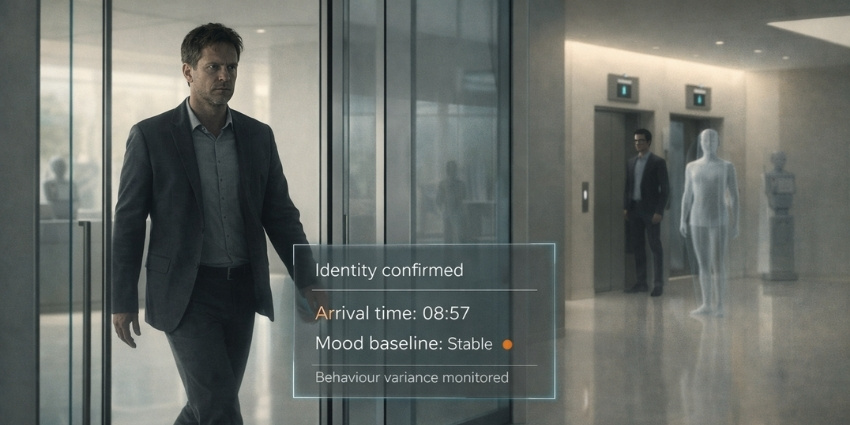
The glass doors slide open before I’m within touching distance. No badge tap. No receptionist desk. No “good morning.”
Just quiet acknowledgement.
A soft panel flickers into existence near the entrance.
Identity confirmed
Arrival time: 08:57
Mood baseline: Stable
Mood baseline.
I glance around instinctively, as if someone might be watching.
But the system isn’t watching the way people used to watch.
It’s simply… observing everything.
The office doesn’t greet you anymore. It just recognises you.
Inside, the lobby is calm, almost silent. Not empty — people are here — but the noise of workplaces has changed.
- Fewer conversations
- More murmurs
- More pauses while people listen to voices only they can hear
Wearables. Ear agents. Ambient assistants.
The building hums with quiet intelligence.
Colleagues, But Not Quite
I spot two colleagues near the elevators.
Or at least I think I do.
One is definitely real — leaning slightly against the wall, scrolling through something invisible in mid-air.
The other is… slightly sharper than reality. Posture too perfect. Movements a fraction too smooth.
An avatar.
Agent-attended presence.
People do that now.
If your schedule is tight, your assistant attends the meeting for you. Your likeness. Your voice model. Your usual talking points.
Technically, you’re there.
Just not physically.
“Morning, Rob,” one of them says.
It takes me a moment to realise the greeting came from the avatar.
In 2030, attendance doesn’t always mean presence.
The elevator doors open.
No one presses a button.
The building already knows where we’re going.
The Lift That Knows Your Day
The elevator moves before anyone speaks.
A small translucent display appears on the wall.
Floor: 12
First interaction: 09:20
Preparation window: 17 minutes
Preparation window.
Even thinking time has become scheduled infrastructure.
One of my colleagues exhales slowly.
“Did your agent already summarise the meeting?” she asks.
“Three versions,” I reply.
“Same,” she says.
Neither of us laughs.
Because this isn’t new anymore.
Agents now exchange information before humans do.
- Agendas are negotiated
- Documents are summarised
- Risks are flagged
- Talking points are prepared
By the time people enter the room, half the meeting has already happened.
The Floor That’s Already Started Working
The doors slide open onto the twelfth floor.
The office feels familiar, but subtly different from the workplaces I remember.
- Fewer desks
- More quiet zones
- More small rooms designed for conversations with machines
Large windows flood the space with soft daylight, but the most active things in the room aren’t people.
They’re the systems.
A wall-sized ambient display shifts gently as people move past it. Market signals. Industry news. Team metrics. Context-aware information adjusting itself depending on who’s looking.
My wearable vibrates again.
A floating prompt appears near my desk.
Morning briefing ready.
I sit down.
The chair adjusts itself slightly, recalibrating posture.
Another panel opens.
Three sections appear:
- Overnight signals
- Today’s priorities
- Suggested responses
The system has already read my inbox.
Already analysed sentiment.
Already drafted replies.
The modern workday doesn’t start when you arrive. It starts when your agent does.
Across the room, someone is speaking quietly.
But they’re not talking to another person.
They’re talking to their assistant.
I catch fragments of the conversation.
“Summarise the key risks.”
“Shorter.”
“Less formal.”
Their voice trails off as the assistant refines the message in real time.
On another desk, someone waves a hand gently in mid-air, rearranging invisible documents like a conductor adjusting an orchestra.
The strange thing is how normal it all feels.
A New Kind of Morning Routine
Ten years ago, the start of the workday meant coffee, emails, and small talk.
Now it’s something else.
Calibration.
You review what your agent has done overnight.
You approve the messages it drafted.
You tweak the tone of replies you didn’t write.
You scan the signals it thinks matter.
Work hasn’t disappeared.
But the relationship to it has changed.
Instead of producing the first version of things…
You approve them.
Across the office, someone laughs — a real laugh.
It sounds louder than it should.
Human noise stands out now.
The Meeting That Already Started
My wearable pulses again.
A small line appears in the corner of my view.
Meeting begins in 4 minutes
Beneath it:
Agent preparation: complete
Which means my assistant has already exchanged context with the other participants’ agents.
- The agenda is set
- Negotiation boundaries are understood
- Risks are identified
- The most likely outcome has been predicted
All before anyone sits down.
In 2030, the meeting doesn’t start when people enter the room. It starts when their agents start talking.
I stand up and walk toward the meeting space.
The door slides open quietly.
Inside, the room is already alive with floating summaries and contextual data.
Two colleagues are seated.
A third appears as a projection — perfect lighting, perfect posture.
Agent-assisted presence again.
Everyone glances at the same invisible briefing hovering over the table.
No one asks, “What’s this meeting about?”
Because we already know.
Or more accurately…
Our agents do.
I take a seat.
And for a moment, before anyone speaks, I notice something strange.
The room feels calm.
Prepared.
Predictable.
Like every possible outcome has already been rehearsed.
Which raises a quiet question in the back of my mind.
If the system already knows how the meeting will go…
What exactly are we here for?
Next Chapter
Part 3: The Meeting Where Agents Speak First
Because in 2030, introductions are optional.
Your assistant already knows everyone in the room.
Previous Chapter
One Day in 2030 — Part 1: The Morning That Starts Without You