
A year in review
If unified communications had a highlight reel for 2025, it would feature less talk about virtual backgrounds and more about who owns the risk, where the data lives, and how work really gets done.
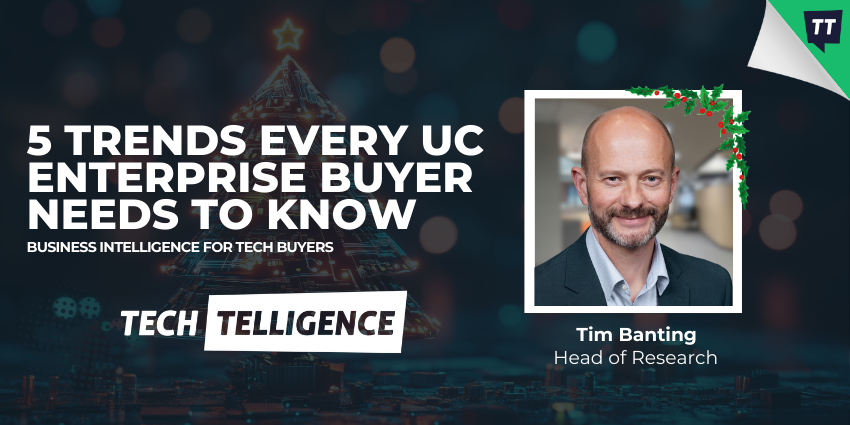
Tim Banting, Head of Research at Techtelligence, says:
“What we’ve seen is a big shift away from the typical stuff with unified communications…things that are now becoming table stakes, such as meeting translation, transcription, summaries.”
Techtelligence buyer intent data, drawn from thousands of enterprise domains, points to “perhaps the most substantial realignment of priorities in almost a decade.”
Categories tied to Workplace Management & Analytics and Productivity & Automation have surged, highlighting that buyers now view UC as part of the enterprise productivity stack, not an isolated collaboration tool.
As part of this dramatic shift, here are the top five UC trends of 2025, as revealed by Techtelligence data and Banting’s analysis, and what they mean for buyers planning 2026 and beyond.
Trend 1: Why Enterprises Are Shifting Away From Conventional Collaboration Tools
The first big shift is a mindset change. Buyers are no longer impressed by incremental meeting features. Those are simply expected.
Techtelligence intent data shows a sharp redirection of interest “towards governance, security and workforce optimization.” The attention has moved to how those capabilities are controlled, audited and aligned with organizational policy.
The organization’s research found that the category of Security, Compliance, & Risk was the #1 area of buyer interest in the past 30 days.
Banting notes:
“AI related risk and governance topics, agentic AI, responsible AI, AI risk management. They are the top across all of those data sets.”
UC platforms are being assessed as part of a broader digital control system that must manage:
- How conversations are captured and stored
- Who can access transcripts and summaries
- How AI powered features behave and are monitored
This is less about choosing between tools and more about deciding what role UC plays in an enterprise’s governance and productivity architecture.
Trend 2: The Specific Industries Rethinking UC First, And Why
While the governance shift is universal, Techtelligence data shows some sectors leaning in faster than others. Banting explains that “large enterprises like manufacturing, education, healthcare, financial services are really driving the majority of that intent.”
These organizations tend to share four critical characteristics:
- High regulatory oversight
- Distributed or shift based workforces
- Strong requirements for communication security and auditability
- Tight coupling between digital workflows and physical operations
But these sectors can be described as the “canaries in the coal mine” as the UC questions they are asking today about observability, compliance, and data location will soon be asked in less regulated sectors too.
For buyers outside these industries, the lesson is simple. Use their requirements as a preview of your own future UC checklist.
Trend 3: UC Role’s in A Changing Workforce And Workplace Strategy
Hybrid work and more fluid workplace strategies are reshaping UC decisions. The buying committee is no longer dominated by IT leaders, as “risk officers, HR leaders, operations executives, workplace strategists and facility managers are all involved in this platform selection process now”, Banting points out.
Techtelligence research shows rising interest in workplace analytics and hybrid work design. Banting highlights that this “suggests UC decisions are now interwoven with things like space planning in the office.” Offices are starting to monitor utilization “in the same way that hotels are looking at occupancy levels.”
At the same time, enterprises are recognizing that “productivity isn’t just tied to the tools, it’s also tied to the processes and also to the people.” That drives more nuanced choices about:
- When a meeting is necessary, and when async updates are better
- How to reach frontline workers who cannot join long live sessions
- How sentiment, engagement and space usage data feed back into UC design
UC is becoming part of a feedback loop between people, places and processes, not just a way to host calls.
Trend 4: The Opportunity Of Agent Driven Collaboration And Training
AI in UC is moving from noise to nuance. Banting is frank about the limitations of first-generation features. “I’m sick to death of summaries, meeting summaries. They’re very useful. They have their point. But if that’s the extent to which AI is going to impact productivity in the workforce, then I think that bubble is going to burst pretty quickly.”
Techtelligence data reflects Banting’s view, as buyers are more interested in Agentic AI and automation, as opposed to generative features.
Looking across this research, Banting expects “a lot more tools and technology that are silently sitting behind the scenes.” He cites AI coaching features in Microsoft Teams and imagines them extending into one-to-one and manager conversations.
Potential use cases include:
- Real-time coaching for managers on talk time and listening
- Suggestions to adjust tone, phrasing, or questioning technique
- Support to reduce filler words and improve clarity when giving feedback
For buyers, this introduces a new evaluation area – considering not just what AI can generate, but how it can shape behaviour and skills on the job.
Trend 5: The Metaverse And Where It Will Be Most Effective
Metaverse-style experiences are starting to appear in UC suites, such as with the recent launch of Microsoft Teams’ immersive events feature.
Banting is realistic about where that fits, citing that its strongest growth appears not in routine collaboration, but in specific contexts. “Every tool has its place,” Banting notes. The value lies in training, events and simulations – not necessarily everyday meetings.
Techtelligence data reinforces that immersive tech is adjacent to mainstream UC adoption, not replacing it. The winning UC strategies will treat immersive environments as one option in a broader communications palette.
Conclusion: UC’s 2025 Top 5, From Features To Foundations
Techtelligence buyer intent data paints 2025 as a pivotal year for unified communications. Collaboration features are no longer the main story. The top trends highlight UC as a strategic foundation for governance, highly regulated industries, workplace strategy, agent driven collaboration and selective use of immersive experiences.
As Banting puts it, “collaboration platforms are now viewed as part of the organization’s compliance infrastructure as well as communications infrastructure.” For UC buyers, that means:
- Involving risk, HR, operations and facilities leaders in platform choices
- Prioritizing governance, AI risk and compliance capabilities over surface features
- Evaluating how UC supports hybrid work, frontline communication and space planning
- Exploring AI and metaverse tools where they genuinely enhance training and engagement
These are the five trends that defined UC in 2025. Furthermore, they are also a roadmap for the questions every buyer should be asking vendors as they plan the next wave of investment.
- For more business intelligence about the innovation that drives workplace productivity, follow Techtelligence on LinkedIn here.
- To find Tim Banting’s expert perspective on building an effective enterprise communications fabric, check out his blog post on Techtelligence.