
Hybrid working has redrawn the boundaries of the meeting space. What used to be the reserve of offices has since spilled out across coffee shops, train carriages, and packed conference floors. Although this has broken down the barriers to where collaboration takes place, it has not come without its issues.
Employees are navigating full working days in busy, noisy environments where call quality is the number one pain point. Yet enterprise-grade headsets and the best tools for the job are not always the ones being used.
Richard Trestain, Product Marketing Manager at Jabra, says:
“The industry has been tracking the shift to working from anywhere for years. What has taken longer to solve is the friction between enterprise-grade performance and the headsets people actually want to wear.”
The way we work is driving demand for headsets that deliver professional sound and call quality, while also offering a design and style that is comfortable for wearing outside the office.
Audio and AI: The Challenges of Modern Work
Professional headsets, which are certified for UC platforms like Microsoft Teams and Zoom and guarantee high-quality audio, tend to share one visible feature: a boom arm. While this serves those in the office perfectly well, wearing a headset with a boom arm can be less appealing for workers who want to prioritise comfort and personal style when they are on a train, in a coffee shop, or working on the go.
It is for reasons like this that employees leave their company-supplied headsets at the desk. Jabra estimates around 46% of workers globally reach for consumer headsets on professional calls, a figure that varies significantly in some regions.
Consumer headsets, however, are not an adequate substitute. While they may perform well for playing music or taking personal calls, they were not engineered to suppress a coffee shop’s clatter, cut through airport noise, or isolate a voice on a busy trade show floor.
“When the world first shifted to hybrid and mobile work, audio issues during meetings were forgivable. Five years later, sympathy has worn off now,” Trestain notes.
“If someone is calling from a noisy environment with poor quality sound, this disrupts the meeting and becomes a distraction. Most people are going to have a negative experience if you don’t sound good and they are struggling to hear you.”
That cost extends further still: as AI transcription becomes standard in enterprise workflows, poor audio produces poor output. Inaccurate data fed into tools that generate notes, inform decisions, or receive voice instructions is not a minor inconvenience, it hinders productivity and impacts the ability to get the most from AI tools.
Purpose-Built to Work From Anywhere
To bridge the gap between professional performance and personal preference, a headset needs to earn its place not just on the desk but on the commute, in the café, and through the weekend playlist. That is the design challenge Jabra set out to solve with the new Evolve3 85 and Evolve3 75.
According to Trestain:
“Our job is to make a product that people really want to wear throughout their day wherever they are, one that is as good for music as it is for calls.”
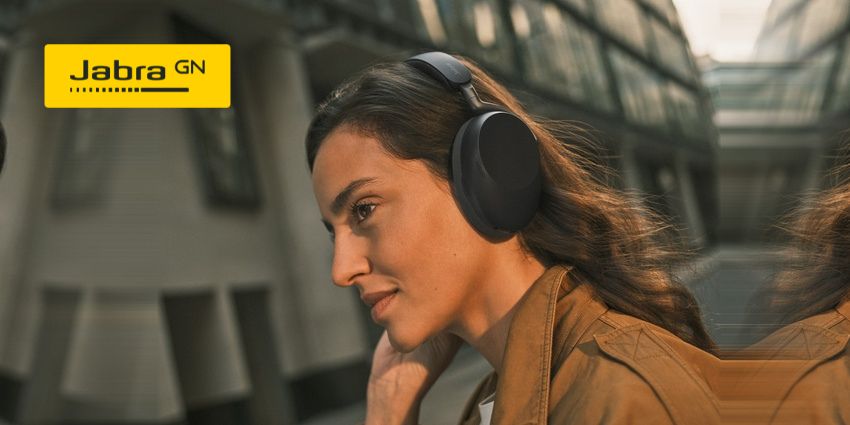
Jabra’s Evolve3 headsets combines enterprise-grade performance with the comfort and style users want. The result: a headset that weighs just 220 grams and fits in a travel case slimmer than a paperback. Crucially, this lightweight design has done away with the boom arm entirely.
Removing the boom arm while stepping up the audio quality is where Jabra’s engineering comes into play. The Evolve3 uses deep neural network technology, trained on 60 million sentence examples, to identify and isolate the human voice regardless of surroundings. Language-agnostic and accent-agnostic, it uses AI to understand the acoustic shape of speech and filters everything else.
“We tested this to the extreme at ISE a few weeks ago. We had someone on the show floor talking to someone in a soundproof booth, and people were blown away by how they couldn’t hear the background noise,” explains Trestain.
Crucially, staying connected does not come at the cost of style or comfort or high-quality sound for music and calls. This makes the Jabra’s Evolve3 series headsets ideal for both work and personal use, and means you will not have to force staff to wear it; they will actively ask for it.
Closing the Gap Between Consumer Appeal and Performance
The business case for professional headsets has never been stronger: more calls, more locations, and more AI tools dependent on accurate input. What has not kept pace is the assumption that issuing the professional equipment is enough.
If the headsets companies are providing do not fit the lives employees are living throughout the day, chances are it will not be on their head when the meeting starts. That is the gap Evolve3 is built to close without compromising between consumer appeal and performance.
Worn on the commute, used for music at the desk, packed into a bag without a second thought, the headset becomes habitual before the call even begins. For IT and procurement teams, that shift in thinking is the real key to unlocking productivity wherever work happens, whether in the office or on the go.
To find out more about Jabra’s Evolve3 professional headsets, Visit Jabra.