Galaxy XR’s Most Unexpected Enterprise Use Case? The Blood Donation Clinic

Samsung and Abbott are putting Galaxy XR headsets on blood donors – and it says more about enterprise XR's future than any boardroom demo

3
Immersive Workplace & XR TechNews

Published: June 11, 2026

Christopher Carey

Samsung’s Galaxy XR has been making a strong case for enterprise adoption since Android Enterprise support landed earlier this year.

But the company’s latest real-world deployment makes a different kind of argument – one built not on productivity dashboards or virtual meeting rooms, but on blood donation anxiety.

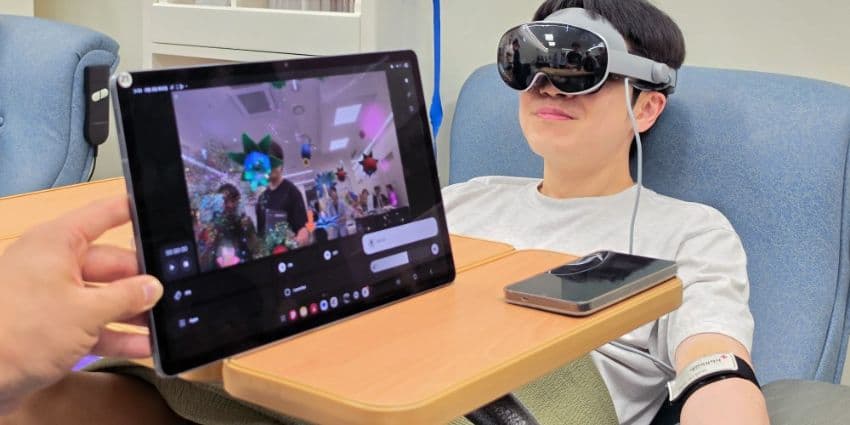
Samsung and global healthcare company Abbott partnered with the Korean Red Cross to run Korea’s first XR-powered blood donation campaign at Samsung Digital City in Suwon.

In recognition of World Blood Donor Day, Samsung employees donated blood while wearing Galaxy XR headsets, replacing the usual clinical ceiling-staring with immersive meditation content.

The experience is deliberately low-friction. Donors enter a Zen garden-inspired virtual environment and interact entirely through gaze – no controllers, no hand gestures.

Over three to five minutes, they plant virtual flower seeds simply by looking at them, watching flowers and trees bloom to a soundtrack created in collaboration with the Chicago Symphony Orchestra. The intent is straightforward: distraction and calm in equal measure.

β€œBlood donation may not be the first use case that comes to mind for XR,” Daniel Seung Lee, Global Head of B2B Wearable & XR PM, SamsungΒ posted on LinkedIn.

β€œ[This] demonstrates how immersive technology can create meaningful social impact beyond productivity and entertainment. Donors experience a calming XR environment during the donation process, helping transform anxiety into engagement.”

Why Healthcare Is the Right Proving Ground

For enterprise XR, healthcare settings present a specific and telling challenge.

Devices need to work in environments where hygiene, supervision, and simplicity aren’t optional – they’re baseline requirements. Galaxy XR clears those bars in ways that matter to the people running these programmes.

β€œSamsung Galaxy XR, powered by Android XR, represents a significant advancement for our mixed reality blood donation program,” said Miguel Carrazza of Abbott’s Transfusion Medicine division.

β€œIt is well-suited for healthcare settings, allowing medical staff to monitor donors more easily while helping them stay naturally engaged.”

That last point is worth unpacking. One of the persistent criticisms of immersive headsets in professional environments is that they isolate the user from their surroundings – a problem if you’re a nurse who needs to check a line or respond quickly.

Galaxy XR’s design and the Android XR platform apparently address this, keeping donors present enough to be monitored while still benefiting from the immersive content.

It’s a practical detail, but it’s exactly the kind of thing that determines whether enterprise deployments actually stick.

Abbott brings considerable weight to this partnership. Since 2016, the company and its Red Cross partners have run blood donation campaigns across nearly 30 countries.

This isn’t a pilot in search of a use case – it’s an established programme looking for a hardware upgrade. Samsung’s Galaxy XR, running on Android XR, is that upgrade.

The Scale Play

Korea was the starting point, but the roadmap makes the ambitions clear.

From June 15–18, Samsung and Abbott will host a four-day blood drive at the Augmented World Expo (AWE) in Long Beach, California – putting the Galaxy XR donation experience directly in front of thousands of XR developers, enterprise buyers, and industry decision-makers.

The timing is deliberate; AWE is where XR adoption decisions get shaped.

Later in June, the initiative moves to the International Society of Blood Transfusion Congress in Kuala Lumpur, Malaysia, where more than 100 blood bank decision-makers from around the world will get hands-on exposure to the technology.

If blood bank administrators leave that event convinced that XR meaningfully improves donor comfort and retention, the programme has a realistic path to rolling out well beyond Samsung-Abbott activations.

β€œAs the boundary between the physical and digital worlds continues to blur, blood donation no longer has to be a stressful experience,” said James Pak, VP of Samsung’s Global Mobile B2B Team.

β€œThrough this initiative, we hope to demonstrate how Galaxy XR can extend beyond entertainment and productivity to create lasting social value.”

The Bigger Picture for Enterprise XR

The blood donation campaign lands at a significant moment for Galaxy XR. Android Enterprise device management support arrived in April, bringing Knox security, fully managed device features, and a five-year update commitment – the infrastructure enterprises need before they’ll commit to fleet deployments.

Samsung is methodically building the case that Galaxy XR is a serious enterprise device, not a consumer gadget that occasionally wanders into the office.

The healthcare play adds a dimension that pure productivity use cases can’t: demonstrable social value in a highly regulated, operationally demanding environment.

If Galaxy XR can operate reliably inside a blood donation clinic – where simplicity, hygiene, and real-time staff oversight are non-negotiable – it strengthens the argument for deployment across a much wider range of enterprise environments.

Augmented RealityExtended RealityHeadsets & PeripheralsMixed RealitySpatial Computing & XR​Virtual Reality SoftwareVR Training & Simulation
Featured

Share This Post