Meeting rooms are quietly carrying a lot more weight than they used to.
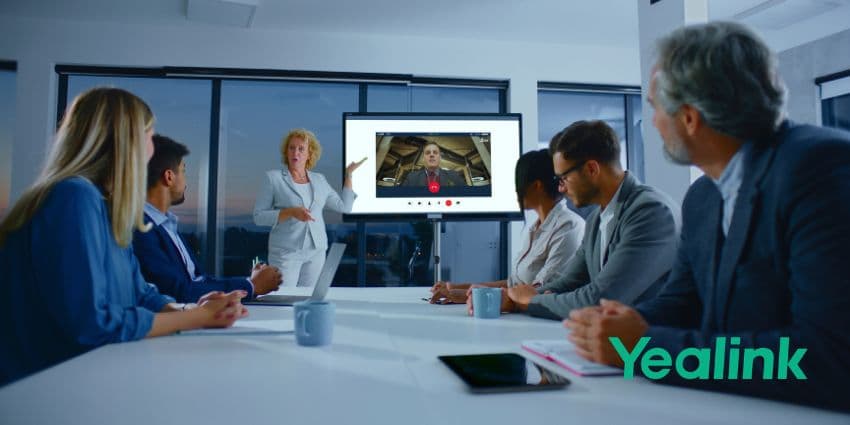
The same space that hosts an all-hands one day might need to split into two training rooms the next, then support a hybrid workshop with half the team joining remotely.
Users now expect all of that to “just work” – clear sound, clean video, simple controls – and they have far less patience for rooms that feel like a step backwards from their laptop experience.
Behind the scenes, that shift has made life more complicated for the teams responsible for designing and supporting those environments.
They are often combining audio, video, control, and sensing from multiple vendors, then trying to keep systems stable while expectations keep rising.
Yealink’s AV ONE concept sits in the middle of that tension.
Presented as a single ProAV architecture spanning audio, video, control, and sensing, it is aimed at organizations that want a repeatable way to build and maintain rooms – particularly where estates include a mix of room sizes and layouts.
As Logan Lu, Director of Yealink’s EMEA Sales Engineer Team, puts it:
“Technology changes so fast… Every day we have new technology, new ideas – but that means you need a lot of effort to learn new stuff, new vendor solutions, background technology, how it works.”
Related Stories:
Complexity is the Enemy of Scale: Yealink and DEKOM’s ProAV Strategy
Yealink Bets on One-Vendor Ecosystem to Cut EU Enterprise IT Complexity
From Occasional Video Meeting to Everyday Benchmark
The last few years have been a turning point.
Before the pandemic, many people’s only experience of video conferencing was an occasional boardroom call or webinar.
They had little frame of reference for what “good” looked like, and plenty of tolerance for clunky, technician-driven room setups.
That tolerance has largely disappeared.
Daily exposure to well-tuned desktop and mobile experiences has given users a clear sense of what they expect from audio, video, and joining workflows.
Acoustics, which used to receive relatively little attention, are now under much closer scrutiny.
People notice when rooms sound harsh or tiring, and they are quicker to complain when remote participants struggle to follow a meeting.
In that context, there is no going back to a world where complex ProAV environments can hide behind low expectations.
Organizations now expect large, multi-purpose rooms to deliver the same ease of use and clarity that employees experience on their personal devices – even as the underlying systems become more complicated.
AV ONE as a Response
AV ONE is Yealink’s response to that new reality.
Rather than treating audio, video, and control as separate islands, AV ONE is positioned as an integrated architecture that brings them together, with sensing layered in to enable more intelligence over time.
The pressure point is multi-purpose space.
These are the rooms that might host a town hall today, a training session tomorrow, and two independent meetings the day after, thanks to movable walls or reconfigurable seating.
Each mode brings its own routing, control, and user interface requirements. The more modes a room has, the more opportunity there is for inconsistency and error.
“If you just need a camera, you just need audio, that’s actually not that kind of complexity,” Lu explains. “But when it comes to real multi-purpose… I may need to divide this room into two individual rooms – that makes the room more complex.”
By designing audio, video, control, and sensing to work together from the outset, and by encapsulating that integration into AV ONE, the aim is to provide a more predictable foundation. Instead of starting from a blank page in every room, teams can move towards standard patterns that reduce bespoke decisions, simplify commissioning, and make ongoing support less reactive.
“So how to make the ProAV a little bit more simple?” Lu asks.
“Maybe some of the parts can be more standard, can be more intelligent, make things easier and simpler to make the room happen with a better experience.”
What A “Good” AI Experience Really Feels Like
AV ONE is also the vehicle for how Yealink is talking about AI in ProAV. The emphasis is less on AI as a headline feature and more on AI as a way to reduce effort and improve consistency – especially in areas that historically required specialist tuning.
In a well-implemented AI-driven room, people should not really think about AI at all.
They should be able to walk in, plug in, or join wirelessly, and find that everything behaves in familiar ways.
Cameras frame the right people automatically. Audio adapts to the room and maintains clarity even in challenging acoustic conditions. Control interfaces are obvious enough that nobody needs a manual.
To get there, Yealink is applying AI in several ways behind the scenes.
In the audio domain, models trained on a wide range of real-world environments can be used to adjust processing automatically for spaces that would previously have required intensive manual tuning.
“We can train the AI a lot to provide the best experience in the audio,” Lu explains. “No need every time to go outside to adjust step-by-step on the audio performance.”
In the design and commissioning phase, AI is also being woven into software tools to generate connection logic and control pages.
“Automatically generate our connection, automatically generate our control UI,” Lu notes.
“It still saves a lot of time and effort to learn programming to provide a better experience.”
Making Room Intelligence Feel Simple
Room intelligence has to translate into something tangible for participants.
The basics still matter more than any single headline feature. Lu says:
“When it comes to real experience, the audio should be clear – the remote side and the local side can hear clearly, and all the noise cancellation should work properly."
Visual experience comes next.
Traditional tracking systems that slowly pan between speakers or lose track of who is talking are increasingly out of step with users’ expectations.
Lu describes a more integrated approach, where microphones and cameras work in concert to identify speakers and frame them accurately in real time.
“What we call IntelliFrame, together with the camera AI but also with the audio AI, provides accurate tracking experience,” he says. “The microphones provide who is talking like real things, and also the camera is facing the right speakers.”
Stability And One-Stop Responsibility
Underpinning all of this is stability. No amount of intelligence or integration can compensate for systems that do not run reliably. When rooms fail, trust erodes quickly – and the cost shows up in both productivity and support effort.
That is why Yealink positions AV ONE as a long-term architecture rather than a short-term bundle.
New solutions still need to prove themselves over time, in real spaces, under real usage patterns.
The aim is to give organizations a more consistent foundation for multi-room deployments, without turning every new room into a bespoke project.
Yealink plans to bring AV ONE to a number of industry events over the coming months, giving practitioners the chance to see the architecture in action.