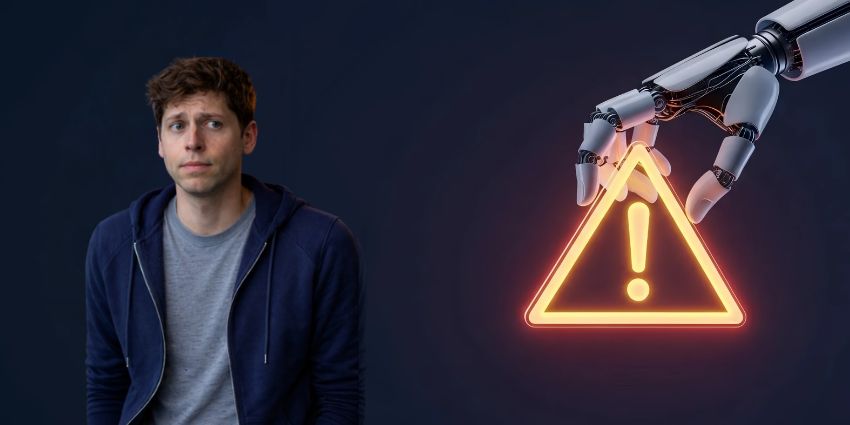

OpenAI CEO Sam Altman warned that AI agents are rapidly emerging as a double-edged technology. While the systems are becoming more capable of acting autonomously, he noted they also pose growing threats as their scale and sophistication make them more appealing to hackers.
According to Altman, models have improved rapidly over the past year, becoming “good enough at computer security that they are beginning to find critical vulnerabilities.”
This acknowledgment followed research from Stanford University last year, which found that an AI agent outperformed most human hackers.
Stanford Study Reveals AI’s Hacking Prowess
A Stanford University study highlighted both the potential and the current limitations of AI-powered cybersecurity agents. The research tested six AI agents and ten human testers during a 16-hour vulnerability assessment of the university’s 8,000-device network. It found that Stanford’s ARTEMIS AI agent outperformed nine out of ten human hackers, placing second overall in the competition.
ARTEMIS discovered nine vulnerabilities and submitted 82 percent of its findings as valid reports. Researchers described its performance as demonstrating “technical sophistication” comparable to top human participants, all while operating at just $18 per hour, compared to the $60 hourly rate of professional penetration testers.
The AI agent’s success stemmed from its ability to generate “sub-agents” that investigated vulnerabilities in the background while continuing to scan for additional threats, a parallel processing capability human testers cannot replicate.
The study’s release coincided with reports from Microsoft and OpenAI that hackers from Russia, North Korea, Iran, and China-backed groups are increasingly using large language models to refine cyberattacks.
Amid this evolving threat landscape, OpenAI has been recruiting for its new Head of Preparedness role. “This is a critical role at an important time,” Altman said. “Models are improving quickly and are now capable of many great things, but they are also starting to present some real challenges.”
However, the study also found that ARTEMIS missed some vulnerabilities identified by human participants and required hints to find others. It further noted that AI agents from companies such as OpenAI’s Codex and Anthropic’s Claude Code lacked “cybersecurity expertise in their design.” These models only outperformed two of the human testers, while agents from legacy companies either refused to look for vulnerabilities or stalled when prompted. This suggests that while the technology shows promise, a significant gap remains before it can match the capabilities of elite human experts.
The Road Ahead: Balancing Innovation with Security
The growing capabilities of AI agents represent both opportunity and responsibility for the tech industry. OpenAI’s creation of the Head of Preparedness role and Stanford’s research findings both underscore that the industry recognizes the dual nature of these powerful tools.
As AI agents become advanced enough to uncover vulnerabilities that could be exploited for harm, organizations must develop robust frameworks for responsible deployment. The underperformance of general-purpose AI systems compared to specialized ones like ARTEMIS highlights the need for security-focused AI solutions rather than repurposed models.
Looking ahead, the technology sector must balance optimism with caution in shaping its operational posture around AI. Reports from Google predict that AI agents will be increasingly weaponized by malicious actors to scale attacks throughout 2026, making proactive security measures essential.