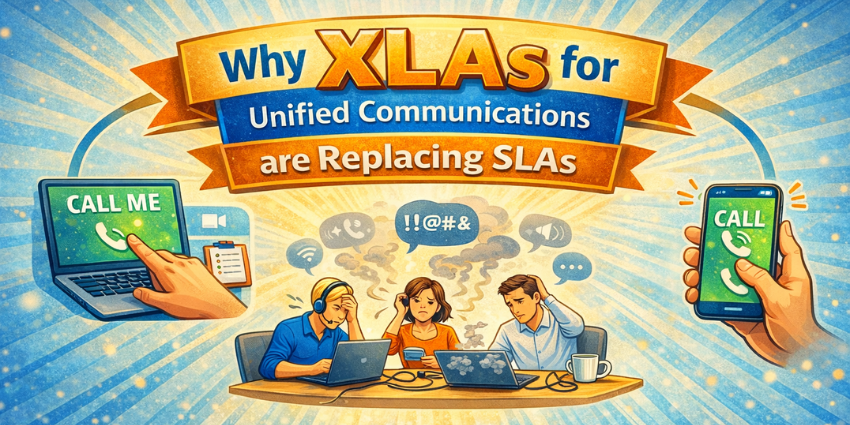

Unified communication and collaboration tech technically works most of the time. Meetings still exist, calendar invites go through, and the platform status page doesn’t show any major reports. Yet, on many occasions, someone still fails to join, audio crackles for half of the team, and a laptop drops Wi-Fi. You’re still spending the first five minutes of the conversation trying to fix things.
Eventually, someone says, “Just call me.” Then you know, something isn’t adding up.
Because when people abandon governed tools for personal mobiles or WhatsApp, the work still happens, but everything else takes a hit. Your customer experience slips, your compliance posture weakens, and your credibility starts to dip. All the while, vendors are still meeting SLAs.
This disconnect is everywhere. Internal Ivanti research shows 87% of IT teams say digital experience directly impacts productivity, 85% tie it to employee satisfaction, and 77% link it to retention.
This is why conversations around XLAs for Unified Communications are heating up fast. We’re measuring availability. The business is feeling friction.
Related Articles:
- Head-to-Head: The Tier 1 Vendors Leading The Service Management & Connectivity Market
- The 5 Verticals Where Service Management & Connectivity Are Having A Big Impact
- Cloud UC Resilience: Cloud Degradation is Inevitable, Can You Survive without Panic?
What Are Experience Level Agreements (XLAs)?
Experience Level Agreements (XLAs) are performance commitments made by vendors that focus on user outcomes, rather than just “system uptime”. They’re less about asking whether a platform can stay online, and more about seeing whether a user could have a good experience using it.
In unified communications, that means looking at signals closer to the work itself. Are meetings predictable to join? Do calls sound clear enough for customer conversations? Do recurring issues stay fixed after support closes the ticket?
The reason this matters is simple. Today’s UC experience doesn’t come from one platform. It’s the combined result of endpoints, Wi-Fi, office networks, home connectivity, ISPs, cloud edges, identity systems, and carriers all behaving at the same time. When one piece drifts, the whole experience falters, even if most tools are technically working.
How Do XLAs Differ From Service Level Agreements (SLAs)?
XLAs sound less technical than SLAs. You hear “experience,” and you think employee satisfaction, rather than tech performance. Really, though, SLA’s just track one thing: whether the system hit contractual targets. XLAs for unified communications focus on whether people can actually get work done, which is a completely different can of worms.
That distinction matters now because UC isn’t evaluated in isolation anymore. Buyers look at it alongside digital employee experience, security posture, compliance risk, and productivity tooling. If meetings are unreliable, calls sound unprofessional, or people don’t trust the channel, the platform becomes a liability, even if uptime looks great.
Our own research into buyer priorities supports this change. Leaders are looking at analytics, automation, and management layers; all the stuff that explains why experience breaks, not just where. At the same time, operational scale is exploding. Analysts expect millions of new conferencing rooms and endpoints to come online globally this year. More surface area means more ways for experience to fail.
XLAs probably won’t replace SLAs; uptime still matters, but XLAs define whether the service delivers value once people start using it.
Why Are Organizations Adopting XLAs For Unified Communications?
Service Level Agreements are what buyers are used to, and they made sense when unified communications lived in neat boxes with centralized networks, clearly owned systems, and one vendor to call when something went wrong.
But Unified Communications hasn’t behaved that way in years.
Today’s experience stretches across headsets, Wi-Fi, home routers, office LANs, ISPs, cloud edges, identity services, UC platforms, and carriers. A meeting can fail without ever triggering a formal outage. Calls connect, but sound like garbage. Joins half-work. Video limps along just long enough to convince most people to switch it off.
The experience is terrible, but the system is still “up”, so SLAs are met.
That’s the problem. SLAs are excellent at confirming infrastructure health. They’re terrible at explaining why people are frustrated, why tickets keep reopening, or why teams start routing around sanctioned tools.
Executives feel the gap slowly. Downtime is easy to track, adding up to around $301 per employee according to some reports. The cost of experience degradation is harder to measure, but it can often be bigger. You end up with repeat incidents, bloated support queues, shadow IT, and productivity drag.
That’s why enterprise buyers are starting to look at “Experience Level Agreements” instead.
What XLAs for Unified Communications Change
The real impact of XLAs for Unified Communications isn’t a new dashboard. It’s what people stop arguing about. XLAs don’t just change what gets measured; they change how UC gets managed.
Language changes first. Teams move away from uptime percentages and MTTR charts, and start using terms like “meeting confidence” and “audio customers trust”. Even “resolved” stops meaning “ticket closed” and starts meaning “the problem didn’t come back.”
Accountability changes next. Experience failures almost never sit with one team anymore. One bad meeting can involve a headset, shaky Wi-Fi, an ISP hop, a cloud edge, and a carrier interconnect. With SLAs, every group can technically be “right.” With XLAs for Unified Communications, that excuse evaporates. Outcomes don’t care about org charts.
Cadence changes last. Monthly SLA reports land after users have already adapted with workarounds, repeat tickets, and shadow channels. XLA-driven operations rely on continuous experience signals and trend insight so the team can fix what’s drifting before trust collapses.
Curious how Service Management & Connectivity actually improve productivity? Check out our plain-English explainer here.
What “Good” XLAs Look Like in Unified Communications
When people ask what good XLAs for Unified Communications look like, they usually expect a metric list. Honestly, there are a few things you can track if you already know how to measure employee experience, but they’re not the metrics you’re probably used to.
Take meeting confidence. In a healthy UC environment, people join on the first click and stay in flow. No throat-clearing. No three-minute detour into “can you hear me?” When this breaks, it’s rarely a full outage. Uptime stays green while join success degrades.
Users start struggling immediately, but reports don’t always show the problem straight away.
Voice trust shows up in a similar way. Customers don’t mention packet loss or jitter, but they will notice if a call sounds professional. In a multinational environment, the problem is tougher to track. The whole experience depends on more things, like regional routing, carrier behavior, local connectivity, and compliance standards.
When one corridor degrades, credibility goes with it. That’s why global voice outcomes keep surfacing in real XLAs vs SLAs conversations.
A few signals organizations pay attention to:
- Meeting confidence: first-try joins, stable audio, predictable behavior under load
- Voice trust: consistent clarity across regions, not just platform availability
- Resolution experience: fewer repeat incidents, not just fast ticket closure
Then there’s trust and governance. When collaboration degrades, people route around controls. They switch tools, so records fragment, and compliance gets messy. That’s especially true in multi-platform environments where most enterprises already juggle four or more tools.
Why Does Observability Matter with XLAs?
This is where things really change, because if vendors are going to start offering experience-level agreements, companies need a new way to keep track of whether they’re fulfilling their promises. You can’t just wait around for a vendor to report their uptime percentage for the year.
UC service management tools are the easy solution, because they excel at bringing insights together. That’s exactly what companies need. Experience in UC doesn’t depend on one thing. It stretches across rooms, endpoints, Wi-Fi and LANs, ISPs, cloud edges, UC platforms, and carriers. When something degrades, every layer has a plausible excuse.
Without end-to-end observability, experience debates turn subjective. People argue. Time burns. Users adapt in ways you can’t govern.
We’ve seen that happen with outages in 2025, when AWS and Azure disruptions rippled far beyond their labeled root causes. What users experienced wasn’t “a cloud issue.” It was simple: meetings wouldn’t start, calls sounded wrong, and admin tools slowed or vanished.
During Zoom’s DNS incident that same year, Downdetector logged tens of thousands of reports in hours. No one cared about DNS. They cared that work stopped.
None of these incidents hit businesses so hard because uptime collapsed; they hit hard because experience degraded unpredictability. Nobody could say, in the moment, what still worked and what didn’t. UC service management tools fix that, because:
- Observability collapses blame time. Not perfect certainty, just enough evidence to agree on what’s broken.
- Workflows turn insight into action. Signals must trigger incidents, escalation, rollback, and learning.
- Resilience assumes degradation. Availability isn’t binary. Systems wobble. Plans should, too, on purpose.
Without real observability, XLAs for Unified Communications fall apart fast. You can promise outcomes all day, but you can’t prove them, repeat them, or defend them when things get messy. Once you can actually see what users experience, XLAs start holding up under pressure.
How Do XLAs Change Buyer Behavior in UC?
Once organizations start thinking seriously about XLAs for Unified Communications, buying conversations change in a good way.
The old script doesn’t hold. Vendors can still talk uptime and response times, but buyers are asking different questions now. Not theoretical ones. Very practical ones, usually born from scars.
- What happens when it’s technically up, but people can’t join?
- How do you prove experience during an incident, not a week later?
- What changes so this doesn’t happen again?
- How do you manage five platforms without multiplying support chaos?
These questions put a lot more pressure on UC and collaboration vendors. But they also give them an opportunity to differentiate in a way they haven’t been able to manage before.
Vendors and MSPs who can explain how they observe experience across platforms, how they coordinate response, and how they protect outcomes during degradation stand out fast. Those who can’t default back to status pages and disclaimers.
The signal is clear. Buyers aren’t hunting for perfect uptime, at least not on its own. They’re looking for honesty, evidence, and operational maturity when things wobble.
XLAs for Unified Communication: Changing the Scoreboard
We all know that the cloud isn’t perfect, even if it’s better than it was just a few years ago. That doesn’t mean companies can simply “stop” migrating. What it means they need to rethink how they assess the reliability of the vendors they’re going to be working with.
SLAs are nice, but they only tell you if the platform can technically keep running. XLAs are there to tell you if work will continue to move forward without friction. Whether people will trust the channel enough to stay on it, and if the organization can stop repeatedly facing the same incident.
When dashboards glow green, but people are still frustrated, leadership is missing something important. Experience Level Agreements exist to close that gap. They pull measurement, ownership, and investment back toward outcomes people recognize right away. Confidence. Clarity. Continuity.
If you want to dig deeper into how service management and connectivity are reshaping Unified Communications, there’s no shortage of hard lessons and practical guidance worth exploring.
Check out our ultimate guide to Service Management and Connectivity, and start planning for cloud continuity.
FAQs
What metrics measure user experience in UC systems?
Organizations usually track signals that reflect real usage. Things like first-try meeting joins, stable audio during calls, and whether incidents stay fixed after support closes the ticket. Some teams call these “meeting confidence,” “voice trust,” or “resolution experience.” The point is simple: measure whether communication actually works for people.
What tools help monitor digital experience performance?
End-to-end observability tools are the backbone. UC service management platforms, network experience monitoring tools, and digital experience monitoring systems pull signals from endpoints, Wi-Fi, networks, cloud services, and carriers. The goal isn’t more dashboards. It’s enough visibility to understand why the experience feels off.
How can organizations align IT performance with employee experience?
The shift starts by measuring outcomes instead of infrastructure alone. When teams track things like meeting reliability and call clarity, IT performance becomes tied to how work actually happens. That alignment also pushes teams to fix recurring friction instead of simply closing tickets.
What challenges arise when shifting from SLAs to XLAs?
Ownership gets messy. Experience problems rarely sit with one team anymore. A bad meeting might involve Wi-Fi, an ISP hop, a cloud edge, and the UC platform. XLAs force those groups to collaborate, which can be uncomfortable at first but usually leads to faster problem resolution.
How do XLAs improve hybrid work environments?
Hybrid work spreads communication across homes, offices, and mobile networks. XLAs help organizations see how that whole environment performs. Instead of assuming the platform works because uptime is green, teams can track whether remote and in-office employees are actually having the same reliable experience.