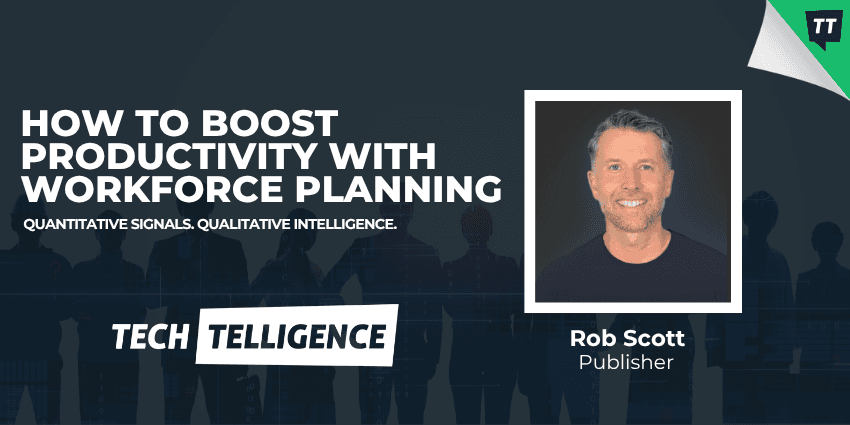
In Q1 2026, Techtelligence analysis surfaced a sharp reset in what productivity-focused leaders care about. Buyer interest in Employee Performance declined by 88%, making it one of the five fastest-declining topics in the Techtelligence research bank. Over the same period, interest in HCM Software increased by 886%, placing it among the five fastest-growing topics.
Rob Scott, Publisher of Techtelligence, explained the significance of this, saying:
“This is a meaningful reallocation of attention. It suggests enterprises are moving away from measuring people more and toward enabling people better.”
Techtelligence aggregates enterprise research behavior across HR, employee experience, UC, CX, and adjacent technology categories. The value is not just trend-spotting. It is identifying where buyers are shifting their evaluation frameworks, and what they are abandoning.
Read More
- The Benefits of Recognition for Employee Experience in the UC Stack
- Workflow Automation: How Techtelligence Research Shows Buyers Are Shifting Priorities
- UC Interest Rising: What the Market Signals Suggest
What Is Really Behind The Drop In “Employee Performance” Interest?
The decline in “Employee Performance” interest is not a signal that organizations no longer care about productivity. It is a signal that many buyers are questioning a narrow, superficial approach to performance, especially approaches tied to activity tracking, monitoring, and surveillance-heavy “visibility.”
In practice, these tools often measure motion, not progress. They can create noise, reduce trust, and push managers toward managing dashboards instead of outcomes. As enterprises mature their workforce strategies, they increasingly want fewer performance theatrics and more operational clarity.
As Rob explains:
“It is hard to build a high-trust culture with low-trust tooling. Many leaders are deciding that performance tracking is not a strategy. It is a symptom.”
That is where the language shifts. Buyers are showing more interest in workforce intelligence than in performance tracking. Workforce intelligence focuses on capacity, skills coverage, internal mobility, and where work is getting stuck. It is less about measuring activity and more about improving the system that produces results.
Why Is HCM Growth A Signal Of System-Level Productivity Thinking?
The fast-growing interest in HCM software points to a different premise: productivity is a downstream outcome of how work is staffed, supported, scheduled, developed, and measured. In other words, enterprises are moving from performance obsession to workforce design.
HCM investment decisions often bundle several priorities into one platform strategy: skills visibility, workforce planning, talent mobility, learning, payroll, and compliance. When those foundations are weak, productivity interventions tend to be reactive. When those foundations are strong, productivity becomes more consistent and less dependent on heroic management.
This is also where skills-based workforce planning becomes a practical concept rather than a slogan. Skills-based workforce planning helps enterprises align roles to capabilities, identify gaps earlier, and build more realistic capacity models. It also reduces the temptation to “solve” productivity with monitoring.
From Rob’s perspective:
“HCM growth tells you buyers are looking for structure. They are investing in systems that make good performance easier, rather than systems that try to catch bad performance faster.”
How Does HR Workflow Automation Turn “Process” Into Productivity?
HCM demand also reflects a growing appetite for HR workflow automation. Enterprises are not just buying systems of record. They are trying to reduce friction across the employee lifecycle.
HR workflow automation can tighten the loop between intent and execution. It helps teams standardize onboarding, change approval, and learning assignments. It enables managers to get timely signals without digging through spreadsheets.
This is where productivity becomes tangible. If HR processes are slow, unclear, or inconsistent, employees lose time and managers lose control.