
It’s been quite the 2023 for Microsoft.
As we approach the holidays, the tech giant’s seminal Ignite event is an opportunity to take stock of another seismic year for the company. It’s been a 2023 that’s featured lows — the European Commission’s probe into Microsoft’s allegedly uncompetitive practice of bundling Teams and Office — as well as highs, such as its leadership in the AI explosion through its collaboration with and investment in OpenAI and ChatGPT to complement its massive Copilot launches this autumn.
But Ignite is also nicely timed as an opportunity to look forward for the company, to announce exciting new products and feature updates and tease some more, to outline compelling new strategies, and to suggest a direction for the technology world to push towards in 2024.
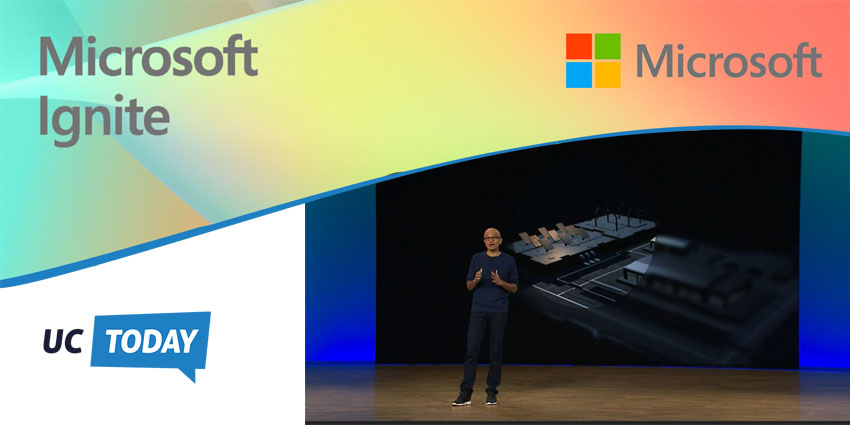
Microsoft CEO Satya Nadella’s Ignite keynote address neatly celebrated both sides of Ignite with three central themes: AI, AI, and, you guessed it, AI.
Microsoft’s ‘Age of Copilots’
We’re entering this exciting new phase of AI, where we’re not just talking about it as technology that’s new and interesting, but we’re getting into the details of producing, making, deployment, and safety. We’re at a tipping point. This is clearly the age of Copilots.”
As Nadella prepares to unveil the sweeping list of AI announcements underpinning this year’s Ignite, he begins his keynote by highlighting the practical use cases AI is only starting to introduce. He stresses that we’ve surpassed the era of AI as being understood as an obscure concept and are now at the very beginning of the age of organisations and industries toying around with how AI can tangibly transform the way they work.
And Then There Were Two Tech Leaders
One of the things I really, really love is that we’ve partnered on advancing fundamental computer science like generative AI, with the infrastructure we’ve built together. I love that we’re inventing new technologies together.”
That was not Nadella, but Jensen Huang, CEO and founder of NVIDIA, who was invited on stage to share in his and Nadella’s announcements of collaboration on the latest AI chips and technologies.
The moment came across almost as a victory lap for the first AI wars, with the success of Microsoft’s partnerships with both OpenAI and NVIDIA placing it firmly at the forefront of the technology — while also reaffirming just how momentous the era of generative AI is in computing’s history.
Did Teams Get A Mention?
It sure did, with the most eye-catching news about the imminent arrival of MESH for Teams in January.
Using avatars to express yourself with confidence, whether you’re joining a 2D Teams meeting or a 3D immersive space. With Immersive Spaces, you can connect in new ways and bring discussions all into one place. With spatial audio, for example, you can experience directionality and proximity, just like in the real world. In custom spaces, you can create a place tailored to your specific needs.”
Behind Nadella, the visuals illustrated how the 3D immersive spaces might function as meetings, both in virtual office-style environments and in smaller huddle contexts that could be useful for closer collaboration. How popular and successful MESH might be with the average Teams user remains to be seen, but its presentation certainly highlighted some neat tricks.
Copilot Studio Looks Really Cool
With Copilot Studio, you can build custom GPTs, create new plugins, orchestrate workflows, monitor your Copilot performance, manage your customisations, and much, much more.”
Nadella’s segment on Copilot Studio suggested the breadth of Copilot-based customisation options available to organisations, regardless of their industry. Copilot can help with expense management and HR onboarding, for example, by being integrated with legacy infrastructure or on-premises systems. Its potential looks immense.
Looking Forward: AI in Mixed Reality and Quantum Computing
AI is not just about natural language as an input, it goes beyond that to see, to hear, to make sense of our intent and the world around us. I want to show you a glimpse of what’s possible when the world becomes your prompt and interface. That’s what happens when you bring mixed reality and AI together.”
Nadella shows a video that resembles science fiction of frontline workers leveraging mixed reality technology with Copilot’s input to answer key questions as they work. Naturally, the video will have been glossed up with effects and editing for dramatic effect, but Nadella promises that the fundamental technology being used here is being tested as part of Microsoft’s Siemens partnership, empowering frontline workers in their day-to-day work.
If, in practice, it works as fluidly as it does in its presentation, it’s seriously impressive.
Nadella’s segment on how AI will transform quantum computing in the future was just as compelling. “Key to scientific discovery today is complex simulation of natural phenomena, whether chemistry, biology, physics, or high-performance computing,” Nadella said. “You can think of AI as an emulation of those simulations by essentially reducing the search space. That’s what we’re doing with Azure Quantum Elements(…) Just like some models can generate text; with this, you can generate entirely new chemical compounds.”
The potential impact of quantum computing on UC and collaboration is astronomical, as UC Today explored here, but combined with the influence of advanced AI in complement to quantum computing, it’s hard not to feel excited about their shared potential.