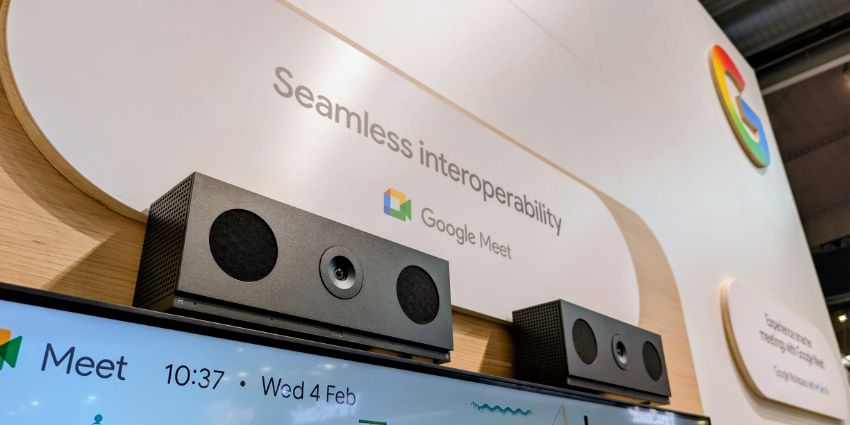

Google and Microsoft have announced new two-way meeting room interoperability between Google Meet hardware and Microsoft Teams Rooms.
Announced at ISE 2026, the capability means users can join Microsoft Teams meetings from Chrome OS-based Google Meet hardware and join Google Meet meetings from Windows-based Microsoft Teams Rooms devices.
Meet and Teams interoperability: What’s launching?
At launch, interoperability will only be available on Chrome OS-based Google Meet Rooms and Windows-based Microsoft Teams Rooms.
Google also says the feature will be ON by default and can be disabled at the organisational unit (OU) level. It also notes the new functionality won’t replace existing Pexip settings for any OU already configured that way.
On rollout timing, Google says:
Admin console visibility: Full rollout in 1–3 days starting February 3, 2026
End-user visibility: Gradual rollout (up to 15 days) starting February 16, 2026
Meet hardware already joined Zoom and Webex, but Teams was Different
Google Meet hardware has supported joining Cisco Webex and Zoom meetings through built-in interoperability for some time, enabled by default and manageable via the Admin console.
Historically, Teams has sat in a separate category for Meet hardware. Google’s published guidance has described joining Teams meetings from Meet hardware as being available via Pexip Connect, rather than the same built-in path used for Zoom and Webex.
In other words: interoperability existed, but it wasn’t presented as a first-party, two-way room experience between Google and Microsoft.
The new announcement changes that positioning.
Google: “We didn’t want to rush… and have a subpar experience”
UC Today spoke with Quentin Esterhuizen, product lead at Google Meet, at ISE 2026, who described the move as a key milestone for customers who live across both ecosystems.
“We’ve got two big announcements… one is our final interoperability with Teams. That’s been a long time coming.”
To that delay, Esterhuizen pointed to the realities of cross-vendor work: aligning product roadmaps, agreements and, crucially, user experience.
“It takes time to build this the right way… we’re really happy about the partnership, and we’re really happy about the flexibility it gives our customers jointly,” he said. “We don’t want to rush that experience and have a subpar experience.”
He also emphasised coordination between the two companies:
“You don’t want to have one person launch… and the other person a year later. Getting that alignment at the right timing is really critical.”
He added that Google wants to broaden support beyond the initial Chrome OS footprint: “Today for us right now, it’s on Chrome OS. We want to expand onto Android as well.”
The Key Takeaway
Google and Microsoft aren’t trying to collapse two meeting platforms into one. They’re addressing the more immediate enterprise problem: conference rooms that need to join whichever meeting link lands on the calendar.
In short: Chrome OS-based Meet Rooms can join Teams meetings; Windows Teams Rooms can join Meet meetings; it’s on by default; and it rolls out across February.
Also at ISE 2026: Google Expands Meet Hardware Choice With Neat
Interoperability wasn’t Google’s only Meet headline in Barcelona. The company recently expanded its partnership with Neat, as Google continues to build out its Meet hardware ecosystem.
While discussing the theme of flexibility, central to both the Teams interoperability launch and Google’s broader room strategy, Esterhuizen described the reality most enterprises face when updating collaboration environments.
“We know that not every customer has a dream or greenfield environment where they can start from scratch. They will likely have something already, and being able to transition makes that so much easier for us… we want to provide that flexibility.”
Read more from ISE 2026: