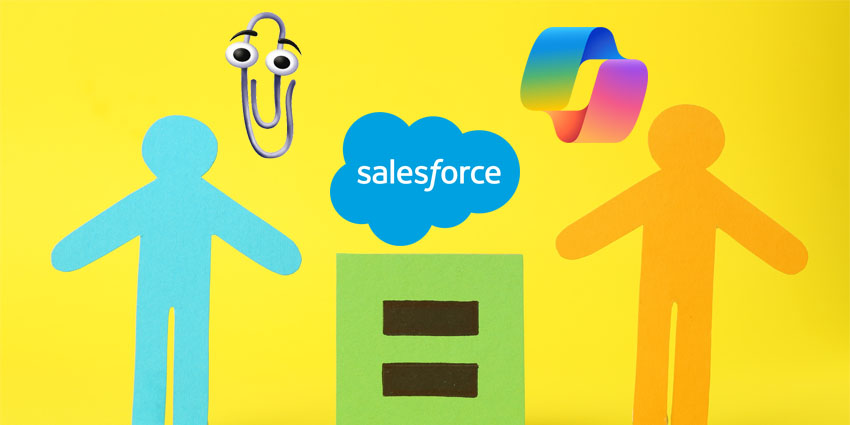

Salesforce CEO Marc Benioff has criticised Microsoft‘s Copilot AI assistant as “disappointing” and “more like Clippy 2.0” than a “transformational experience”.
Benioff took to X to express his stance on Microsoft’s AI-powered productivity assistant, Copilot, which launched last year and has since been integrated across practically all of Microsoft’s enterprise and consumer products. He argued that Copilot struggles with accuracy and functionality and “insults” customers by entailing the capacity to build their own large language models (LLMs).
“When you look at how Copilot has been delivered to customers, it’s disappointing,” Benioff said. “It just doesn’t work, and it doesn’t deliver any level of accuracy.”
Gartner says it’s spilling data everywhere, and customers are left cleaning up the mess. To add insult to injury, customers are then told to build their own custom LLMs. I have yet to find anyone who’s had a transformational experience with Microsoft Copilot or the pursuit of training and retraining custom LLMs. Copilot is more like Clippy 2.0.”
When you look at how Copilot has been delivered to customers, it’s disappointing. It just doesn’t work, and it doesn’t deliver any level of accuracy. Gartner says it’s spilling data everywhere, and customers are left cleaning up the mess. To add insult to injury, customers are…
— Marc Benioff (@Benioff) October 17, 2024
“Clippy” is the nickname for Microsoft’s Clippit virtual assistant, which was present in the 1990s and early 2000s. Initially intended to assist users with tasks in Microsoft software like Office and Word, Clippy eventually became a source of irritation. While its big eyes and playful expressions are now seen with a glaze of 90s nostalgia, at the time, many users found it intrusive, as it often appeared uninvited, offering suggestions that were more distracting than helpful.
A War Of Words In Enterprise AI
On the one hand, Benioff’s position on Copilot can hardly be considered impartial. Both companies have invested extensively in AI-powered software offerings, while Salesforce’s CRM product is a direct competitor to Microsoft’s Dynamics 365, and Salesforce-owned Slack is a major rival to Microsoft’s Teams as a collaboration solution.
After all, it was Slack that filed the anti-competition complaint to the European Commission about Microsoft’s bundling of Teams and Office, while only last month Disney dropped Slack as its collaboration platform of choice in favour of Teams.
Benioff has been more publicly pessimistic about AI’s transformative potential at large, though. Earlier this month, he posted on X that “much of AI’s potential has been oversold” and recently appeared on the podcast Rapid Response, saying, “I’ve never been more excited about anything at Salesforce, maybe in my career,” while stating that “customers have been told things about enterprise AI, maybe AI overall, that are not true.”
However, he added: “I think Microsoft has done a tremendous disservice to not only our whole industry but all of the AI research that has been done.”
Benioff’s comments about Microsoft and Copilot are obviously loaded in a fiercely competitive market, but they also reflect the broader trend of a growing AI backlash or fatigue. Many IT admins, managers, and workers seemingly feel that AI is moving too fast, too soon, for them to leverage it properly while maybe feeling oversold on its (current at least) transformative capabilities.
What Has Salesforce And Slack Been Up To Recently?
Last month, Slack integrated Agentforce into its platform, elevating the platform well beyond its origin as an enterprise messaging service.
Agentforce, formerly known as Einstein Copilot, is an AI-powered tool designed to improve worker productivity by providing actionable CRM insights and task instructions to Agentforce agents. With its integration into Slack, teams can now leverage Agentforce’s generative AI capabilities directly within the collaboration platform. This allows users to access real-time insights and receive task assistance seamlessly, helping to streamline workflows and increase overall efficiency.
Meanwhile, in July, Slack unveiled new iOS app widgets to enhance worker engagement and collaboration.
Slack rolled out four new widgets for its iOS app: “Catch Up”, two versions of “Status”, and “Slack Launcher”. These widgets are designed to help employees stay connected and productive no matter where they are. The first three are available for the home screen, offering quick access to updates and status management, while “Slack Launcher” is built for the iOS lock screen, allowing workers to dive straight into their workflows or projects with ease.
Microsoft Copilot ‘Recall’ Relaunches With Enhanced Security After Privacy Controversy
Earlier this month, Microsoft relaunched Copilot’s “Recall” feature on its upcoming Copilot+ PCs with security enhancements after the company “listened to feedback” about the product’s initial privacy concerns.
When Microsoft unveiled Recall in May, it faced backlash due to concerns over privacy. The tool was designed to take screenshots of a user’s activity every few seconds, storing them in a file on the device. These snapshots could include files, photos, emails, and browsing history, allowing users to scroll through and retrace their steps, similar to a web browser history, to find previously viewed or worked-on items.