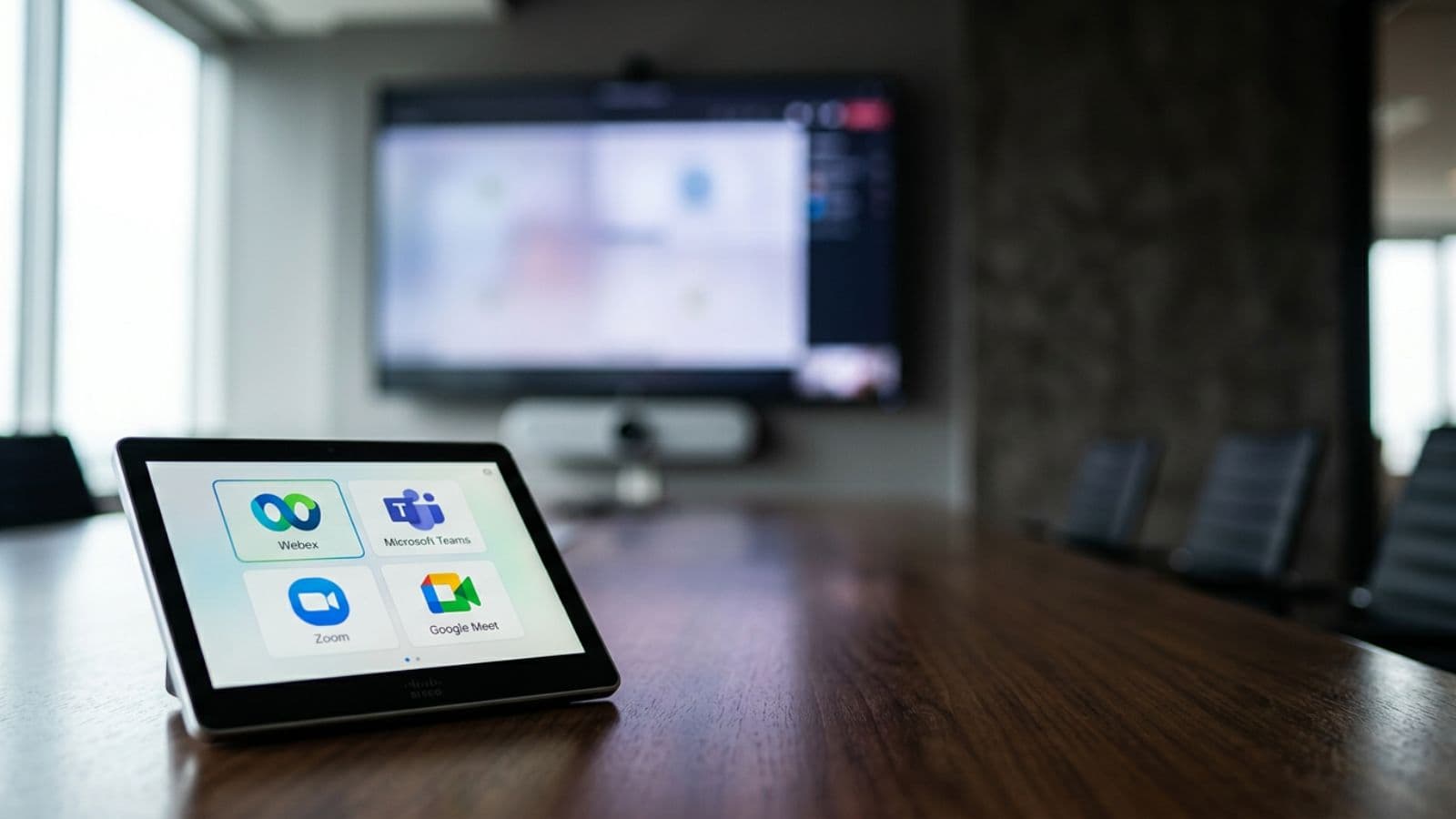
At InfoComm 2026, it was almost impossible to find a meeting room product without an AI story attached. Cameras framed participants more intelligently. Audio systems promised cleaner capture. Platforms pushed notes, summaries, copilots, facilitators, and room agents. But beneath the announcements, another question emerged: does the room know enough for AI to be useful?
The answer increasingly depends on data. For AI to move beyond summaries and framing into useful workplace assistance, it needs context. It needs to know who is speaking, where people are, and whether the room is ready. It also needs to know what devices are working, what the environment looks and sounds like, and how that information connects to enterprise workflows.
Sohail Tariq, Senior Director of Product Management at Microsoft, explained the shift when he spoke to UC Today on the show floor:
"In order for AI to work, it needs to have a really rich and accurate context and data. And that data needs to span from both software and the physical environment, hardware and the environment."
The AI meeting room is no longer mainly a feature story. It is a question about data, and whether the room captures enough of the right kind for AI to be useful.
Why the agentic workplace needs rooms that answer back
The most strategic version of this argument came from Microsoft's work with Q-SYS. Nathan Glotfelty of Q-SYS argues that the agentic future is not optional, and that tools like Facilitator and Copilot are already real and will start querying the spaces they run in.
"They are going to be asking questions of our workplaces and the only question left for us is: does the workplace have anything to say back?"
A room that can say something back has to expose a lot of data. That means occupancy, device status, audio and video quality, participant location, readiness, and workflow context. Tariq says that end-to-end picture is what makes an agent trustworthy.
"Having a system which provides that end-to-end data enables the agent to be more accurate and act more confidently, both for ensuring that the room is ready as well as the experience for people using that room is delightful."
The agentic workplace will not be built only in software. It will be built in the connection between workplace platforms and physical room intelligence.
The room is becoming a sensor layer
Henry Lavek of Logitech says meeting room hardware is now where AI gets its eyes and ears.
"What you ultimately need to be able to evaluate a space and the conditions and the workflow, you need eyes and ears in the room to be able to hear and see what's going on, and to have an intelligence to be able to understand that scene."
Lavek says the modern video bar is no longer a peripheral but a networked intelligence point that can read the environment and guide people through a workflow. That makes the camera, microphone, panel, and control system input devices for AI rather than capture tools.
The same logic runs through Cisco and Zoom's certified hardware partnership. Espen Løberg of Cisco positions edge processing as the differentiator. He says the company uses high-quality edge AI in its peripherals to push the cleanest possible signals into the Zoom platform. AI output is only as good as its input. Poor audio, weak video, or shaky attribution all produce weaker AI, which puts signal quality at the centre of the competition.
Speech attribution is the first serious data test
Attribution sounds trivial and is not. If notes, action items, and meeting intelligence are going to be trusted, the platform has to know who said what. Jeff Smith of Zoom makes that the baseline requirement.
"What's really important for all rooms in a facility is that we can capture all the conversations effectively, and that we can attribute that speech to the people that are talking."
Smith says Zoom handles this through My Notes and Smart Name Tags. The stakes run well past convenience, touching accountability, accessibility, compliance, and knowledge management. Løberg argues the certified Cisco estate is what makes that data dependable, combining the Zoom Rooms experience with Cisco's security, manageability, and assurance.
Room readiness turns AI into an operator
Room data does not only help participants. It helps IT, AV, and facilities teams run the estate. Tariq says readiness is an operational signal in its own right: whether teams have real insight into how rooms and hardware are being used, whether they are healthy, and whether they are working properly. When something breaks, he says, the goal is fast diagnosis and repair before the experience suffers.
Lavek makes the same case, noting that teams are now experimenting with how the eyes and ears in a room can serve IT and facilities, not just end users. The smartest room is not only the one that improves the meeting. It is the one that tells IT what is going wrong before users complain.
Self-healing rooms point to where this goes next
The clearest real-world version came from Kevin Reeve at Utah State University, who has launched an initiative around self-healing classrooms. Reeve says he came to the show floor looking for tools that can do more than monitor and react.
"Figure it out and do whatever needs to be done automatically behind the scenes before a teacher even has to call."
With campus locations across the state and no technician within a couple of hours' drive, a broken room is not an inconvenience but a disruption to teaching. Reeve also makes the infrastructure point that underpins the whole category.
"Everything's going network, which means our networks have to be robust."
He says the estate is no longer transporting text but video, controls, and connected classrooms at scale. Glotfelty echoes this from the Microsoft Redmond deployment. Consolidating subsystems onto a single flat network removed risk and let one platform reach across 70 different types of spaces. As more devices feed data into platforms and agents, the network carrying that data becomes as critical as the devices producing it.
Trust and governance are now part of the product
The more a room captures, the more the trust question matters. In her InfoComm keynote, broadcast journalist Mariana Atencio made trust the foundation rather than a footnote, telling UC Today that collaboration technology simply will not work without it.
"You need to trust in, first of all, the technology that you are dealing in. Is it safe? Is my information going to be protected? Is this conversation going to stay in the room?"
Atencio says responsible AI should enhance humanity rather than replace it. The industry, she adds, has to build guardrails against risks such as deepfakes to protect both consumers and the companies deploying the technology. Her sharpest line for a ProAV audience is that most of what was on show is invisible, which places trust at the centre of it.
That raises governance questions enterprises can no longer defer: who owns meeting room data, what is captured versus inferred, how long it is retained, who can access it, and what happens when AI misattributes or misreads the room. The more intelligent the room becomes, the more transparent its governance model needs to be.
The buying question has changed
The winners in AI meeting rooms will not necessarily be the vendors with the flashiest demos. They will be the ecosystems that combine the right ingredients. That means high-quality signals, accurate context, reliable hardware, network intelligence, diagnostics, workflow integration, and trust. Enterprises should ask not only what an AI meeting room can do, but what the room knows, how it knows it, where that data goes, and whether the organisation can trust the answer.
The AI meeting room will not be judged only by how intelligent the assistant sounds. It will be judged by whether the room can provide the right data, at the right time, with enough accuracy, security, and trust for the enterprise to act on it.