
The trend in transitioning to cloud-based UCaaS continues to offer immediate benefits for agility, scalability and flexibility. But it’s easy to forget the dependence this inevitably creates on quality, low-latency connectivity to the cloud-based services we depend on, especially if we’re lucky enough to take them for granted.
Continual connectivity has become a hygiene factor — something we barely notice improvements in, provided a threshold of adequacy is maintained. However, as soon as there IS a problem — in latency, dropped packets or lost connections — it affects us severely.
As Ievgen Martsin, Cloud Connect Product Manager at BICS, explained it:
“With cloud-based solutions, you are taking complexity out of your on-prem infrastructure and putting it in somebody else’s. That other party is going to take care of it, manage it, and update it for you, and that’s great. But [the trade-off here] is that you increase the complexity of connectivity to that infrastructure. Before, you had your IT guys taking care of your internal network. Worst-case scenario, that involved a network of some hundreds of meters of cables somewhere not very far away that you had full control over. Now we’re talking potentially thousands of kilometres to connect your users with your cloud service providers, wherever they may be”.
Is your connectivity the weakest link in the chain?

Connectivity dependencies also constrain flexibility and scaling too — for example if you want to migrate to a data centre in a new location for compliance issues. “The question you have to ask yourself beforehand is, is my connectivity ready for that migration?”
Because the bottom line is, your carefully selected UCaaS cannot provide that side of it. You need to get your best possible physical link in place, and this is where another architect might be required like BICS and its Cloud Connect solution.
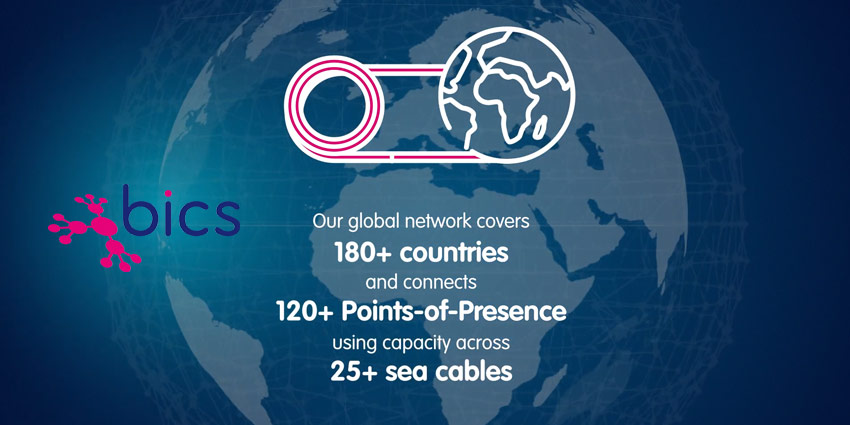
Independent of the public internet, this ‘infrastructure as a service’ solution enables private connectivity in over 180 countries, bridging your internal network directly in to your cloud provider of choice. And with 15 of the most popular cloud service providers (and growing) including AWS, Microsoft Azure and Google Cloud directly connected across 85 different access points throughout the world, BICs can help you build the secure and reliable private cloud access you need.
A private connection to your destination
As Martsin continues,
“When one of our clients needs connectivity where they are located, we can deliver on it really quickly because we already have the existing infrastructure in place around the world.”
“We’re a trusted partner for our clients, so that they can go forward, confidently securely, and in a controlled way, to the cloud”
“We directly control the connectivity. It’s not ‘the internet’, it’s a privately held network. We have the security, the visibility, and the many other things clients ask for from their actual cloud service provider, so we can deliver a fully connected experience from end to end.”
The present and the future
Given that the shift to cloud remains unevenly distributed, BICS’ solution is uniquely appropriate to hybrid set-ups too — where differences in connectivity performance are painfully apparent. As more and more global enterprises depend on cloud-based solutions to deliver, private managed connectivity will become ever more vital. It’s just not OK if the release of a Call of Duty patch measurably snags up the entire internet in one continent for over an hour, when there are business-critical applications to run and communications to deliver.
And when all our devices are soon connected by 5G we will be even less tolerant of degradation in physical connectivity. As Martsin concludes,
“With 5G the last mile is going to be amazing, sure, but at some point in between there’s going to be a cable. You’ll still need physical connectivity so contact BICS today”