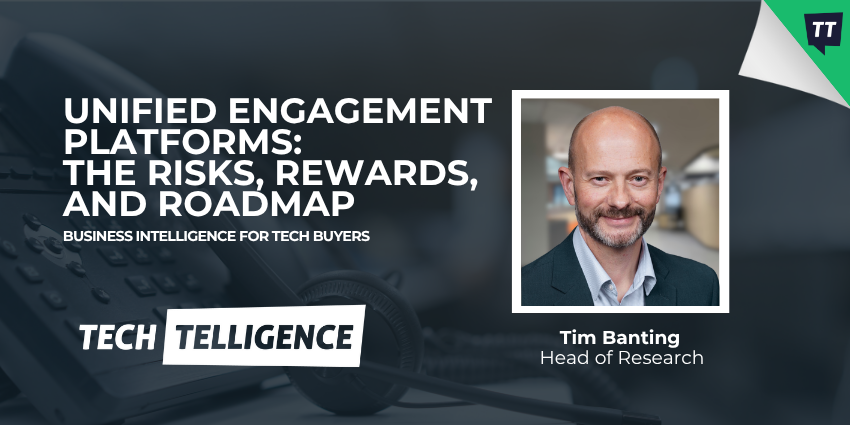

The rise of the Unified Engagement Platform
For years, enterprises wrestled with fragmented collaboration and customer engagement systems – each with its own admin console, data silo, and integration headaches.
But according to Tim Banting, Head of Research at Techtelligence, that era is ending:
“An engagement platform or a unified engagement platform is the combination of unified communications and collaboration with customer engagement”
“It’s really looking at the whole total experience across an enterprise.”
The idea is simple: consolidate tools, streamline workflows, and connect the front office to the back office. Essentially, the market narrative is shifting from “how we talk” to “how we orchestrate work.” In practice, it’s transforming how enterprises think about customer experience and internal efficiency.
The advantages: Automation & AI for workplace productivity
Unified engagement isn’t just a management simplifier; it’s a productivity accelerator. Banting points to workflow automation as one key benefit.
Imagine a customer-facing agent receives feedback that a complicated software process is not functioning correctly. Without a unified system, the agent would have to manually write an email or send a message with the necessary feedback details.
However, with all communications consolidated into one platform, agents can seamlessly hand cases to subject matter experts “in the back office”, with automation, to reduce friction and speed up resolution times.
Buyers are also particularly interested in AI’s abiliy to bridge internal silos, enabling smarter case routing and real-time access to expertise. But this only works if the data -and the governance behind it – are unified and transparent.
The AWS outage & overreliance as a risk
Buyers should be careful though, as consolidation brings new risks.
As demonstrated during the recent AWS outage, Banting warns that overreliance on one vendor or cloud host can cripple business operations when unexpected issues arise.
“If it’s hosted on a single cloud and there’s no backup, you lose absolutely everything front office, back office, the whole of your enterprise goes down.”
This means that buyers looking for unified engagement platforms should revise their criteria to include a resilience checklist:
- Ask where the platform is hosted and whether it spans multiple regions.
- Verify failover and redundancy processes.
- Confirm that new tools comply with data sovereignty and regional regulations.
Since the AWS outage, which affected businesses across Europe, started from its facility in Northern Virginia, Banting notes:
“If you are going to do this, make sure that you have a vendor that can show failover and can show redundancy and how it maps into different geographies.”
Hybrid models and a smarter migration strategy
Migration of these platforms isn’t a one-size-fits-all process. For highly regulated sectors like finance and healthcare, a hybrid approach – mixing on-premises resilience with cloud capabilities – often makes sense.
“If something goes down in the cloud, at least you’ve got your business continuity relying on your on-premise services,” Banting says.
He advises mapping workflows carefully: asynchronous, document-based processes are easier to move to the cloud, while latency-sensitive workloads like voice and video may stay on-premises longer.
Above all, decisions should weigh risk as much as cost. “Far too many businesses think of it as a cost perspective,” Banting warns. “We’re seeing enterprises moving away from purchasing based on convenience, and more towards what is compliant.”
The trends defining the future of UC tech adoption
Looking ahead, governance and trust will define the next wave of platform competition, Banting highlights. He says:
“Enterprises want platforms that they can audit, govern and trust.”
Vendors like Microsoft, Cisco, Zoom, and RingCentral are already embedding compliance, eDiscovery, and policy controls into their engagement suites.
Buyers are now asking vendors to prove who accessed what, when, and under what policy. “Providers that can turn transparency into a product feature will win,” Banting concludes.
Follow Techtelligence to stay ahead
To find Tim Banting’s full analysis on this topic, including his thoughts on ‘cost versus risk’ purchasing criteria, dive into his latest blog post on Techtelligence.com.
If you’re an enterprise technology buyer or involved in procurement decisions for your business, follow Techtelligence on LinkedIn for weekly insights, analysis, and expert advice to help you make smarter technology choices.
You can also join its growing LinkedIn Community Group to discuss trends, share experiences, and connect with like-minded business professionals driving digital transformation in their industries.