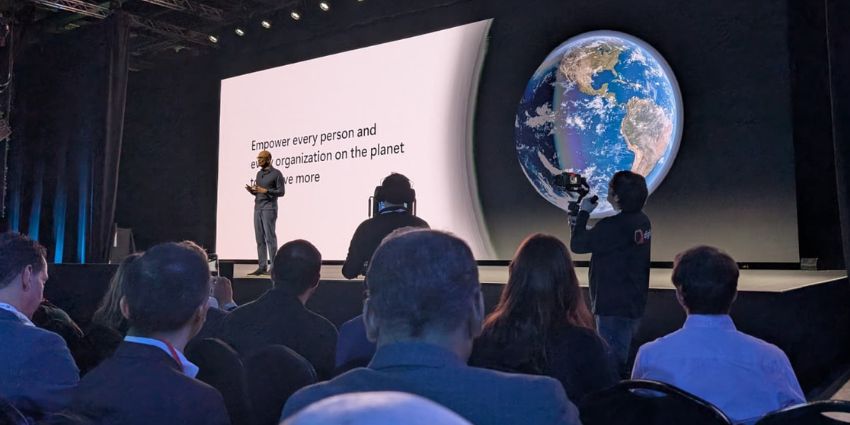

Microsoft yesterday rolled into the UK’s portion of its global AI Tour, bringing CEO Satya Nadella and a full day of workshops and live demos to London.
At first glance, things looked promising: thousands of people packed the venue, creating queues that stretched for hundreds of meters before the doors even opened. It was a clear sign that the appetite for AI among business leaders remains intense.
And why wouldn’t it? Just days before the London stop, Microsoft AI head Mustafa Suleyman made headlines by predicting that AI will be capable of automating a broad range of white-collar jobs within 12 to 18 months. With talk like that, many were eager to see what’s coming next.
Central to that future, the conference suggested, is AI agents.
“When you work with agents, it is us working with an infinite set of minds,”
Nadella told the audience during his keynote, capturing both the ambition and scale of what the company is building.
It was no surprise, then, that AI agents dominated the day’s agenda. Microsoft used the event to demonstrate that it has infrastructure at every layer of the stack. The keynote featured two intervals dedicated entirely to live demos, underscoring how determined the company is to move the conversation from theory to tangible capability.
Nadella’s Vision: Microsoft 365 as the Ecosystem For Agentic AI
A recurring theme in Nadella’s keynote was the untapped value sitting inside Microsoft 365. He argued that this data, spanning emails, files, calendars, relationships, and communications, represents a deep organizational knowledge base that can power the next generation of AI applications. The vision is one where AI agents don’t just respond to prompts but draw on a real understanding of how a business actually operates.
To illustrate how accessible that future could be, Nadella pointed to Agent Mode in Excel, a new capability that lets users interact with their data through natural language instead of complex formulas or technical commands.
He drew a deliberate parallel to the adoption of Excel macros in the early 1990s, which lowered the bar for software development and put real analytical power in the hands of non-developers.
“Excel is a great example of what happened with software development,”
he said. “Now, people who use Excel can generate code with a single prompt.”
To bring this infrastructure vision to life, Nadella highlighted the broader Microsoft suite of tools. Working with Microsoft Fabric, a process can be designed to ingest and organize data from across the Microsoft 365 ecosystem and make it available for enterprise AI agents to use in their tasks.
Above Fabric sits Microsoft Foundry, the company’s cloud-native platform for building and deploying agentic AI systems. Foundry provides the development frameworks, safety guardrails, and runtime services needed to take an agent from prototype to full production, and it currently supports more than 11,000 AI models. Together, Fabric and Foundry form the infrastructure backbone of Microsoft’s agent strategy.
Strong Signals, but Adoption Still Has Room to Grow
The energy at ExCeL was undeniable. Conversations UC Today had on the ground confirmed what the keynote made plain: AI agents are now Microsoft’s central product focus.
The company is betting that agents will be the mechanism through which AI shifts from being interesting to being indispensable. It is marshalling its entire product portfolio, from Fabric to Foundry to Microsoft 365, to make that case.
But the packed halls also raised a fair question: Was this a case of preaching to the converted? Attendees at an event like this are already engaged with Microsoft’s ecosystem and curious about its direction. The tougher challenge lies in getting the broader enterprise market to move from curiosity to committed deployment, and that is one Microsoft is still working to crack.
Reports since early 2026 suggest that Copilot uptake across the wider commercial base has been slower than the company’s public optimism implies. Microsoft’s Q2 FY2026 earnings reported 15 million paid Microsoft 365 Copilot seats, a 160% year-over-year increase and a figure the company rightly celebrated. Yet against a commercial base of around 450 million Microsoft 365 seats globally, that represents roughly 3.3% penetration.
That may be exactly why the AI Tour exists. The combination of a high-profile, multi-city roadshow, live demonstrations of real-world use cases, and bold predictions from Suleyman about the near-term capabilities of AI agents is part of a coordinated effort to shift that dial. Seeing agents in action, rather than reading about them in a product announcement, can move the needle in ways marketing alone cannot.
The Agent Era Is Microsoft’s Biggest Bet
Step back from the product announcements and demos, and a clear strategic picture emerges from the London stop. Microsoft is no longer positioning AI as an add-on to its productivity suite; it is recasting the entire Microsoft 365 stack as the foundational intelligence layer for a new generation of AI agents.
Nadella’s framing of agents as “an infinite set of minds” is more than a sound bite. It signals that Microsoft sees the agent paradigm as a step-change in productivity, comparable to how the PC or spreadsheet transformed working life in earlier decades.
The infrastructure it has assembled (Fabric for data, Foundry for building, and Microsoft 365 as the knowledge layer) gives the company a credible end-to-end story. For enterprise buyers already invested in the Microsoft ecosystem, the on-ramp to agentic AI is designed to feel natural rather than disruptive.
Looking ahead, the real test for Microsoft is whether events like the AI Tour (and provocative predictions from Suleyman about the pace of change) can accelerate the journey from that 3.3% Copilot penetration figure to something resembling mainstream adoption. The vision is compelling, the infrastructure is in place, and the momentum is real. The question for 2026 is whether Microsoft can translate an engaged conference audience into a truly transformed enterprise market.