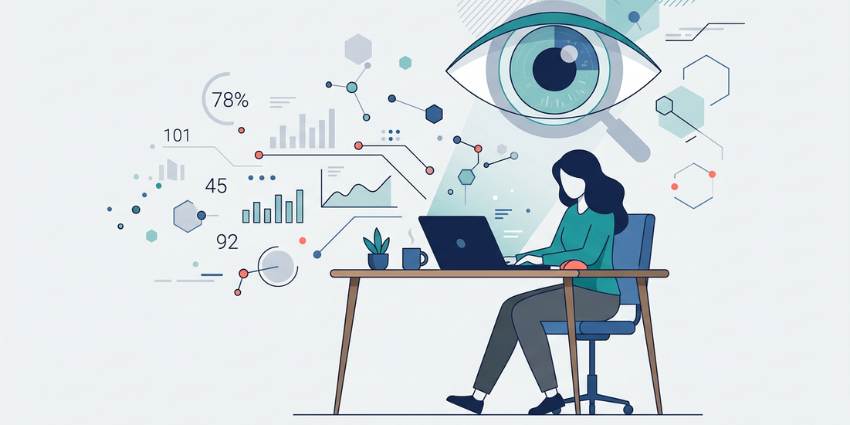

The workplace is not “back.” It is exposed.
Hybrid work did not break the office. It revealed every weak link we used to ignore. Demand now surges and dips. Teams come in expecting collaboration and leave frustrated. Meeting rooms fail at the worst moment. Leaders invest heavily, yet the workplace still feels inconsistent.
That inconsistency is the real problem. And it is getting harder to dismiss.
Hybrid remains the preference for many workers. Robert Half reports 55% of job seekers rank hybrid as their top choice. Office utilization is also rising. CBRE reports global average building utilization has increased to 53%, the highest since before March 2020. And UC Today’s hybrid office research shows meeting experiences still lag behind expectations in many organizations.
This is why workplace management is no longer a facilities-only conversation. It is a productivity conversation. It now spans workplace analytics, workplace data analytics, office optimization, and, increasingly, workforce management software.
Navigation Guide
- What Is Workplace Management & Analytics?
- What Is The Plain English Definition Of Workplace Management & Analytics?
- What Is The Cost Of Inaction?
- How Does Workplace Management & Analytics Work?
- How Does Workplace Management & Analytics Impact The Bottom Line And Fix Office Friction?
- What Are The Trends Reshaping Workplace Management & Analytics?
- How Do I Choose And Evaluate The Right Workplace Management & Analytics Tool?
- How Do I Implement Workplace Management & Analytics And Ensure Adoption After Go-Live?
- How Do I Track And Prove The ROI Of Workplace Management & Analytics Purchases?
- What Is The Future Of Workplace Management & Analytics?
- FAQs
What is Workplace Management & Analytics?
Workplace Management & Analytics is the connected set of workflows, tools, and measurement practices that help enterprises run the workplace with less friction and more proof.
In 2026, workplace management is not just desk booking. It is a broader system that spans five connected areas: office optimization and facilities operations, people and culture signals, employee experience and engagement, productivity visibility, and workforce operations.
Each layer influences performance. When they are disconnected, the workplace becomes reactive. When they connect cleanly, the workplace becomes manageable and predictable.
What does workplace management software actually do?
It connects workplace workflows and workplace data analytics to make the workplace easier to use, easier to improve, and easier to justify. If it does not improve usability, visibility, and actionability, it becomes another system producing dashboards no one trusts.
What Is The Plain English Definition Of Workplace Management & Analytics?
Workplace management is how your organization makes workdays run smoothly. Workplace analytics is how your organization proves what is happening and decides what to improve next.
This matters because the office now behaves like a dynamic system. Demand shifts weekly. Team patterns change. Collaboration needs change. If you cannot measure real usage and real friction, you end up managing the office by complaints.
What is the difference between workplace management and workforce management software?
Workplace management is the umbrella that covers space, experience, productivity insight, and operational coordination. Workforce management software is a specific category focused on staffing, scheduling, and demand forecasting to stabilize output.
What Is The Cost Of Inaction?
Inaction does not keep things calm. It lets friction become normal.
Most workplace problems are not dramatic. They are small and frequent. A meeting starts late. A room fails to connect. A team cannot find space on a peak day. A support issue repeats under new names. Each event feels manageable. At scale, it becomes a structural drain on productivity.
A five-minute delay is not five minutes lost. It is five minutes multiplied across every participant, across hundreds of meetings, across months. It slows decisions, disrupts workflows, and reduces the payoff of hybrid collaboration.
How Does Workplace Management & Analytics Work?
The strongest workplace programs do not rely on static reports. They operate as a continuous performance loop:
Plan → Enable → Measure → Improve
They plan using demand signals from workforce and workplace data. These businesses enable through workflows employees actually use. They measure what happens in real conditions, not ideal ones. And then improve by targeting the highest-friction issues first.
This is what separates organizations that “have workplace tools” from organizations that run the workplace as an operating model.
Office Optimization & Facilities Management
This layer makes the workplace usable. It includes desk and room workflows, wayfinding, utilization insight, and facilities operations. If this layer fails, everything else becomes irrelevant quickly because employees feel the friction immediately.
Notable Vendors: Microsoft, Crestron, Cisco Spaces
People & Culture Management
This layer connects organizational change to workplace impact. Hiring, attrition, and org structure shifts shape how space is used, often before workplace teams realize it. When this layer is disconnected, workplaces stay reactive.
Notable Vendors: IBM, Rippling, Oracle
Employee Experience & Engagement
This layer captures how the workplace feels in reality. A space can be fully utilized and still fail if employees cannot collaborate or focus effectively. Enterprises are increasingly looking at internal surveys, discussion boards, and culture-boosting initiatives to create an ecosystem that fosters efficiency.
Notable Vendors: Capgemini, IBM, Broadcom
Employee Monitoring & Productivity
This layer reveals where work slows down. Used well, it identifies bottlenecks and removes unnecessary effort. Used poorly, it creates trust issues. Governance and education will determine the difference.
Notable Vendors: NiCE, Hubstaff, Verint
Workforce & Operations Management
This layer stabilizes output. Workforce management software supports forecasting, scheduling, and capacity planning. These decisions affect how the workplace performs on peak days and whether operational teams burn out.
Notable Vendors: Genesys, UKG, Cognizant

How Does Workplace Management & Analytics Impact The Bottom Line And Fix Office Friction?
Workplace friction hits the bottom line faster than leaders expect because it compounds across groups, not individuals.
Productivity drains multiply through meetings and coordination
Meetings are already expensive. Executives and employees can regularly see 15+ hours of their week going to meetings. And what is also common is that workplaces add unnecessary delay through broken rooms, unreliable setups, or space scrambles. This makes the the cost multiply across every participant – and with slower decisions and more repeat meetings.
Revenue and enterprise success connect to engagement and execution
Workplace performance influences engagement. Engagement influences outcomes that executives care about.
It is true that workplace tools do not magically create revenue, but reducing friction and improving execution protects performance and supports growth.
The space paradox creates avoidable spending
Many enterprises have underused space and peak-day chaos at the same time. That is not simply a real estate problem. It is a coordination problem. Space is misaligned with how work happens. Workplace analytics exposes that mismatch. Without it, organizations keep investing in the wrong fixes.
What changes when the workplace is managed as a system
When workplace management works, the organization stops reacting to symptoms. Space becomes easier to use. Meeting rooms become more reliable. Service issues become repeatable to solve. Demand becomes easier to forecast. That is how office optimization becomes measurable and sustainable.
What Are The Trends Reshaping Workplace Management & Analytics?
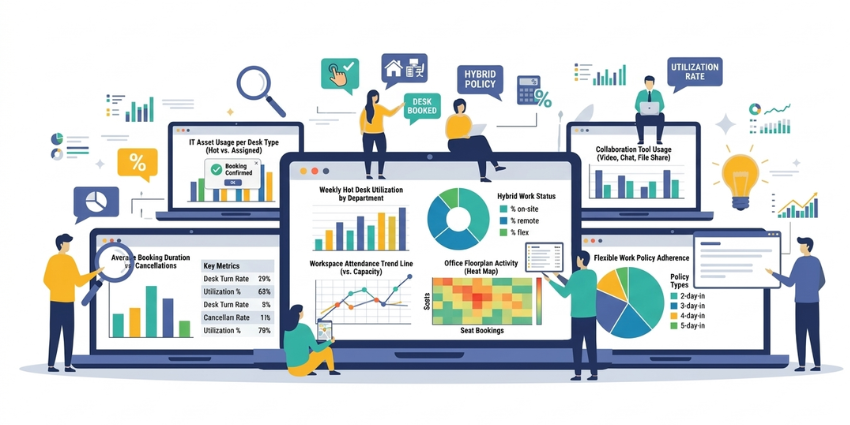
The category is moving quickly, but the direction is clear. These five trends are shaping the future of workplace management and workplace analytics.
Trend 1: Utilization is rising, which increases the cost of friction
As utilization rises, problems that were previously tolerable become visible and disruptive. CBRE reports global average building utilization has increased to 53%. More people coming in means more pressure on meeting rooms, support services, and peak-day experience.
Trend 2: Workplace experience applications become the front door to the office
Workplace experience tools are consolidating booking, navigation, scheduling support, and workplace services into a single employee-facing layer.
In the past, workers had to step through the front door to get their work started. These technology tools can now act as that gateway for modern employees. Work starts when employees access a single portal that displays their schedule, reserves their workspace, and raises to-do items.
In the future, adoption will depend less on mandates and more on whether this “front door” truly improves the day ahead.
Trend 3: AI connects intent to reality
Enterprises increasingly want to compare planned attendance with actual usage. That closes the gap between what people say they will do and what happens. Connect this data to AI and businesses can expect better forecasting, fewer peak-day surprises, and more confident office optimization decisions.
Trend 4: Hybrid meeting quality becomes a workplace KPI
Hybrid meetings are now part of workplace performance. If meetings feel unfair, laggy, or unreliable, the workplace fails even if utilization looks healthy. UC Today’s hybrid office research cites Barco’s Meeting Barometer showing 71% struggle with hybrid meetings. Expect tighter integration between workplace teams and UC teams.
Trend 5: The workplace stack expands into workforce operations
Workplace management is widening beyond space. Staffing and space decisions are tightly linked. Anchor days create peaks. Peaks create coverage strain. Coverage strain affects experience and output. That is why workforce management software is increasingly part of the workplace conversation.
Want a deeper dive on the latest trends defining this topic? Read how shifting forces are exposing weak office systems.
How Do I Choose And Evaluate The Right Workplace Management & Analytics Tool?
Most buying processes fail because they start with features instead of problems.
A stronger approach is identifying the issue that consistently disrupts your week. If employees struggle with daily workplace friction, focus on space and workflow reliability. When leadership lacks clarity on demand, prioritize workplace analytics and data integration. If output is unstable, workforce management software should be central. If engagement is slipping, experience tools become part of the workplace stack rather than a separate HR project. During times where execution feels slow, productivity visibility can help identify where effort leaks.
From there, integration becomes critical. Workplace systems must connect with identity, calendars, collaboration platforms, HR systems, and service workflows. Without integration, adoption drops. When adoption drops, workplace data analytics becomes unreliable. When data becomes unreliable, decisions stall.
Evaluation should focus on proof, not promise. The next step is to think about these three tests:
The first test is adoption. Will employees actually use the workflows in real conditions, especially on busy days? The second is accuracy. Does the data reflect reality, or does it create debate? The third is actionability. Can the platform lead to a measurable improvement within a defined period?
And remember, a strong pilot does not validate every feature. It proves one outcome. Reducing meeting room friction in one location is a strong example. Improving peak-day availability on one floor is another. If the outcome is not visible, scaling becomes difficult to justify.
How Do I Implement Workplace Management & Analytics And Ensure Adoption After Go-Live?
Most implementation failures are not technical. They are foundational.
If space data is inaccurate, employees stop trusting the system. If ownership is unclear, issues remain unresolved. When workflows feel unnecessary, adoption drops.
Start by naming the friction that already exists. Most organizations discover the same issues repeat weekly but are never treated as patterns. Then define ownership across workplace, IT, HR, and facilities. Workplace performance crosses boundaries, so accountability must as well.
Early success should focus on visible improvements. Meeting room reliability and peak-day experience are often the fastest ways to build trust. Once trust is in place, workplace analytics becomes credible. Once analytics is credible, office optimization becomes easier to defend.
After go-live, success is not “it is live.” Success is “it changed outcomes.”
In the first month, focus on signal quality and trust. Fix inventory issues. Tune workflows. Reduce noise. In the second month, reduce repeat problems through playbooks and prioritization. In the third month, translate improvements into business language, then expand what worked.
This is also the moment to operationalize the performance loop. Workplace analytics should become a routine input into monthly reviews and quarterly planning, not an occasional report.

How Do I Track And Prove The ROI Of Workplace Management & Analytics Purchases?
Measuring ROI when it comes to workplace management software is valuable, but fragmented. The most effective approach is aligning measurement to how the workplace operates.
Start with a baseline leaders trust. Capture recurring friction points, peak-day constraints, and time lost to common issues. If workforce operations are in scope, include coverage instability and scheduling inefficiency.
Then organize impact into three areas.
Cost and asset efficiency improves when space and services align with real demand. Productivity improves when friction is reduced and workflows become reliable. Experience improves when the workplace supports how people actually work.
The most important part is linking data to action. What changed? What did the workplace data analytics show? Why was action was taken and what was it? What improved as a result? That is what makes ROI credible.
What Is The Future Of Workplace Management & Analytics?
Workplace management is becoming predictive, integrated, and outcome-driven.
Leaders will expect systems that forecast demand and recommend actions, not just explain what already happened. They will expect a unified view that connects space, workforce operations, experience, and productivity into one picture. They will expect the workplace to perform consistently, regardless of how people choose to work.
The biggest mindset shift is simple. The workplace is no longer just a place. It is a system. Organizations that run it like a system will move faster, operate more efficiently, and extract more value from every working day.
Next Steps
For the latest news on workplace management, follow UC Today on LinkedIn here!
FAQs
What is workplace management?
Workplace management is the coordination of people, space, and resources to enable efficient work across the organization.
What is workplace data analytics?
Workplace analytics uses data from workplace systems to identify patterns, reduce friction, and improve decision-making.
What does workplace management software do?
It connects workplace workflows and data to improve usability, visibility, and performance across the office environment.
Is workforce management part of workplace management?
In many enterprises, yes. Workforce management software supports staffing and demand planning, which directly affects workplace performance.
What are the most important workplace KPIs?
Utilization by space type, peak-day demand pressure, meeting reliability, recurring friction points, and time-to-resolution for workplace issues.