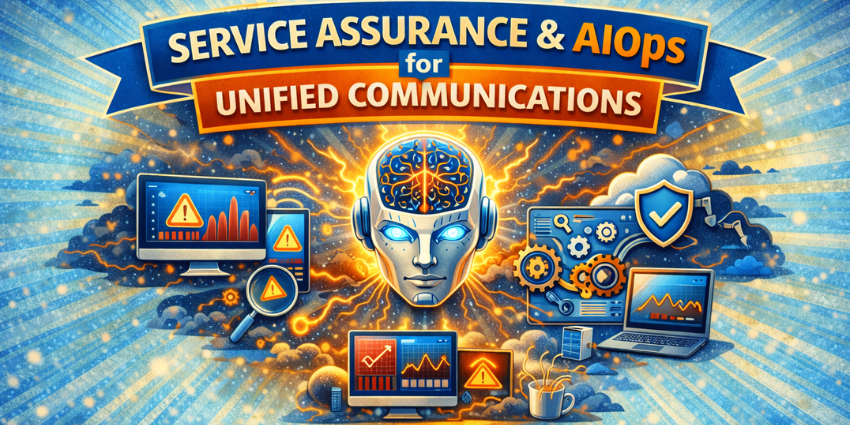

A few years ago, asking whether a UC platform “had AI” was reasonable. Now it’s meaningless. Virtually every tool a team interacts with each day has some type of intelligence woven into it. That’s introduced a new conversation for leaders about service assurance & AIOps.
Gartner has already warned that more than 40% of agentic AI projects could be abandoned by 2027 because they don’t deliver real operational value. At the same time, Gallup found that 49% of U.S. workers say they don’t trust AI at work at all, despite leadership decks insisting otherwise. There’s a disconnect between what’s being sold and what actually survives contact with day-to-day operations.
UC and collaboration tools highlight that gap more than most systems, because they’re essential to everyday work. When voice degrades, when join buttons stop working, and when audio clips mid-sentence, there’s no hiding behind “mostly working.” Quality and continuity are the product.
This is why the buying question has shifted. It can’t just be “does it use AI?” It’s whether Service Assurance & AIOps can reduce MTTR without creating new risk. Can it cut noise instead of adding to it? Will it explain itself under pressure? Can it undo its own mistakes?
Related Articles:
- UC Technology Training Strategies That Don’t Burn People Out (or Create Shadow IT)
- Cloud UC Resilience: Cloud Degradation is Inevitable, Can You Survive without Panic?
- How Service Management & Connectivity Tools Actually Improve Productivity
How Does AIOps Support UC Service Monitoring?
Most UC failures are usually small at first, which makes them easy to overlook. Audio degrades. Meetings only let some people join. Calls connect, then fall apart thirty seconds in. From a service assurance perspective, though, these are often the most expensive failures you can have.
AIOps supports UC service monitoring by helping operations teams see those signals earlier and understand them faster. Instead of responding randomly to a bunch of alerts firing randomly, AIOps systems aggregate and correlate telemetry from collaboration platforms, networks, identity systems, and voice infrastructure. They build a clear picture, with context that lets engineers to move from scattered symptoms toward a defensible explanation of what actually broke.
That’s valuable, because any downtime can be disastrous. According to ITIC’s enterprise outage surveys, over 90% of large organizations put the cost of downtime above $300,000 per hour, with many reporting losses that climb into seven figures once productivity, customer impact, and remediation pile up.
Then there’s the less visible damage. When UC quality slips, people route around it. Personal mobiles. WhatsApp. Personal AI tools that could be collecting data in the background.
Employee experience data shows the same issue from another angle. Ivanti’s digital experience research found that organizations with strong experience management see 87% higher productivity, 85% higher employee satisfaction, and 77% better retention.
UC quality sits right in the middle of all that.
Why Is AIOps Important for Modern Collaboration Systems?
Modern collaboration environments are too distributed for traditional monitoring to keep up. AIOps helps by:
- Detecting early degradation signals, such as partial meeting joins, rising packet loss, or unstable voice sessions
- Correlating events across multiple layers, including UC platforms, network paths, identity services, and carrier infrastructure
- Reducing alert fatigue by grouping related symptoms into a single operational event
- Improving response speed so teams reach a defensible hypothesis faster during incidents
- Protecting user experience by identifying quality drift before employees abandon governed tools
The important thing to remember is that AI and automation don’t help if you haven’t fixed the foundation yet. Human error still causes the biggest chunk of problems, and if an AIOps UC monitoring stack is bolted onto fragmented tools and messy processes, you just get more mess.
What Capabilities Should UC Buyers Expect From AIOps Platforms?
Minimum viable AIOps for UC isn’t about how advanced the system sounds. It’s about whether the system can form a coherent picture of what just broke, before someone starts making changes. And that starts with signals.
Signal Normalization Across UC, Network, Carrier, and Edge
If the data isn’t clean, the AI can’t help. Real AIOps UC monitoring has to normalize signals across layers that don’t naturally agree with each other:
- UC platform telemetry: join success, media streams, jitter, packet loss, policy changes, admin actions
- Network paths: WAN, SD-WAN, Wi-Fi, VPN, QoS markings, packet metadata
- Voice edge and carrier data: SBC health, SIP ladder traces, trunk status, CDRs, routing failovers
- Identity and dependencies: DNS, IdP latency, conditional access changes, cloud edge routing
Most enterprises already collect pieces of this. The failure happens when each dataset keeps its own timestamps, naming conventions, and context. Correlation engines fail when they’re fed mismatched evidence.
Correlation that Produces Defensible Hypotheses
Good correlation narrows the focus. Buyers should expect correlation to output a short, ranked set of hypotheses, not a flood of alerts. For example:
- Audio degradation tied to a WAN QoS change, packet loss on a single corridor, and rising SBC CPU
- Join failures aligned with identity provider latency, a conditional access update, and a specific region
- PSTN reachability problems that map cleanly to carrier maintenance, route failover, and dial plan edits
Each hypothesis has evidence attached. You can defend it in a room full of engineers and not feel exposed. Here, “agentic AI” hype breaks down. Gartner’s warning about agent washing is important. Systems that can’t correlate cleanly shouldn’t be acting autonomously. They should be recommending, explaining, and waiting.
Predictive Insight that Understands Human Patterns
UC traffic is rhythmic. Monday mornings see surges constantly. Quarter-end contact centers spike. Board meetings behave differently from all-hands calls.
Predictive models that flag every busy hour as an anomaly are useless. Buyers should demand proof that models learned seasonality, suppressed false positives during peak load, and improved precision over time.
If a vendor can’t show that learning curve, the predictions are decorative.
Automation that’s Reversible By Design
Automation without rollback is gambling.
Across SaaS and cloud platforms, some of the most damaging incidents in recent years came from routine changes: config tweaks, optimizations, policy updates. Small moves, complex systems, cascading effects.
Minimum viable UC service assurance with AI requires that every automated action has:
- A bounded scope
- Clear approval rules
- Validation checks
- And a tested rollback path
That’s how grown-up service assurance works.
The Trust Model for UC Service Assurance & AIOps
Everyone talks about autonomy. Very few talk about trust. In service assurance & AIOps, trust determines whether automation shortens an incident or quietly turns it into a postmortem headline.
UC environments are fragile in a specific way. They’re distributed, interdependent, and brutally sensitive to small changes. So buyers need a clear trust model.
Look for clear automation modes:
- Advise-only. The system recommends an action, explains why, shows the evidence, and stops. Humans decide. This is where weak correlation engines belong. If the platform can’t defend its logic, it shouldn’t be touching production.
- Ask (human-in-the-loop). The system proposes an action with a blast radius assessment and a rollback plan. Approval thresholds are explicit. Regional voice routing? Telecom owner plus CAB rules. Identity changes? Security sign-off. No ambiguity, even at 2 a.m.
- Act (bounded autonomy). Automation should only move on changes that are low risk and easy to undo. That means pre-approved runbooks, tight limits, and validation baked in. If the system can’t automatically prove the change worked, it shouldn’t keep going.
Shadow AI makes this more important. Unapproved agents, plugins, and bots are already shaping workflows. If automation is acting without knowing what’s in scope, trust collapses fast.
Explainability in UC Service Assurance & AIOps
At 1:37 a.m., explainability is survival. If an automated system takes an action, or even recommends one, the on-call engineer has to be able to defend it immediately.
That’s the standard buyers should apply to service assurance & AIOps: could someone explain this decision clearly, under pressure, without hand-waving?
Every recommendation or automated action in AIOps UC monitoring should ship with a complete, readable trail of the:
- Exact signals that triggered attention
- Correlation chain that linked symptoms to causes
- Confidence level and what alternatives were considered
- Expected impact and who would feel it
- Validation step that proves whether the action worked
If any of that is missing, the system isn’t ready to operate in production.
Curious what the analysts say about UC service management? Here are the need-to-read reports you should check.
Guardrails UC Service Assurance & AIOps Buyers Need
Guardrails are now the price of admission for UC Service Assurance & AIOps.
Ask about:
- Correlation quality controls: Correlation engines can overfit, latch onto the loudest signal or repeat the same fix because it worked once. Buyers need explicit controls for detecting false correlations, suppression logic that can explain why alerts were ignored, and feedback loops that learn from resolved incidents and stop repeating bad recommendations
- Auditability: immutable logs and evidence bundles: Buyers should require that every incident can produce a clean evidence bundle that answers, without interpretation, which signals were observed, what hypothesis was formed, and what action was run and approved.
- Rollback and safe-state design: Every automated action in UC service assurance with AI must have: a defined safe state, a tested rollback path, and a trigger tied to failed validation.
- Human boundaries and ownership: Buyers need clarity on who owns what. Action boundaries by site, region, and user tier. Clear domain ownership and escalation authority are baked into workflows.
What “Good” Looks Like In The First 90 Days
The first 90 days decide whether that happens can tell you a lot about whether systems for UC service assurance & AIOps are really working.
Phase 1: Visibility and Baseline (Weeks 1–3)
Inventory the signals you actually have. Normalize telemetry. Line up timestamps. Reconcile naming. Establish seasonality patterns so Monday mornings stop looking like emergencies. Then pick a small number of UC pain points people already complain about (join failures in a region, voice quality on one corridor, flaky rooms).
Phase 2: Correlation-Only (Weeks 4–6)
This is the moment where AIOps UC monitoring either builds trust or shows its cracks. Correlation should shrink an incident down to a few defensible explanations and hold up when people push back on it. Teams should try to poke holes in the logic. If the system can’t explain why it reached a conclusion, it has no business taking action.
Phase 3: Controlled Remediation (Weeks 7–10)
Now you introduce change, carefully.
Low-risk, reversible actions only. Explicit approvals. Rollback drills that feel uncomfortably real. Validation gates that stop automation when outcomes don’t match expectations. This is where UC service assurance & AIOps should start showing real value.
Phase 4: Bounded Autonomy (Weeks 11–13)
Only now does autonomy expand, and only where rollback is proven, and error cost is low. Every step should be measured against MTTR and risk.
This timing matters because AI adoption across most organizations is still uneven. Plenty of employees barely touch AI tools day to day, while ops teams are expected to trust automation in high-stakes moments. The real limiting factor isn’t the tech. It’s whether the organization is actually ready to run it safely.
What Metrics Show Effective UC Service Monitoring?
If service assurance and AIOps are working, you shouldn’t have to argue about it. The numbers should settle the conversation for you.
The problem is that too many teams measure the wrong things. These are the metrics that actually tell the truth.
- MTTR, broken down by incident class: Track MTTR separately for voice routing issues, meeting join failures, media quality degradation, identity-related outages, and carrier incidents. AIOps UC monitoring should shorten recovery where correlation and evidence are strongest. If MTTR only improves in “easy” cases, that’s a signal, not a success.
- Incident recurrence rate: When the same UC problems keep showing up again and again, in the same rooms, the same network paths, the same policy tweaks, it’s a sign correlation isn’t improving. When recurrence starts to drop, that’s usually the clearest signal that feedback loops are doing their job.
- Time to a defensible hypothesis: How long does it take from the first signal to a hypothesis that an engineer is willing to stand behind? In strong UC service assurance with AI deployments, this drops dramatically even before automation is introduced.
- Evidence bundle availability: Measure how often incident evidence is available quickly, ideally within 10 minutes of detection. Signals, correlations, approvals, actions, validations, and rollback history. When that bundle exists early, postmortems stop being forensic archaeology exercises.
- False positive rate and alert suppression: Noise reduction only counts if it’s explainable. Track how many alerts were suppressed and why. If teams don’t trust suppression logic, they’ll rebuild alert fatigue manually.
- Rollback frequency over time: Early on, rollback frequency may be higher. That means guardrails are working. Over time, rollback frequency should decline as trust models mature and automation scopes are tuned. Flat or rising rollback rates signal unsafe autonomy.
- User experience outcomes that people feel: Finally, track what users actually notice, like meeting join success rate, audio stability, and call completion rates.
Ensuring True Value from UC Service Assurance & AIOps
Service assurance and AIOps only create value when they reduce MTTR and reduce risk at the same time. Correlation quality matters more than model sophistication. Explainability matters more than fluent interfaces. Guardrails matter more than autonomy demos. Rollback and auditability aren’t “nice to have.” They’re the difference between confidence and fear when something goes wrong.
The data points are lining up in the same direction. Procedure-related failures are rising. Cyber-driven incidents are harder to predict. AI investment is accelerating faster than operational maturity. Buyers don’t need louder promises. They need systems that show their work, respect boundaries, and recover cleanly when assumptions turn out to be wrong.
That’s the real mandate going into 2026. Not “how autonomous can this get?” but “how safely can it act when everything’s on fire?”
Want the full blueprint for keeping calls, meetings, and messaging reliable, especially when conditions degrade or outages hit? Read the Complete Guide to UC Service Management & Connectivity, which breaks down the operational practices, workflows, and connectivity layers that keep communications working smoothly.
FAQs
How can AI improve network and collaboration performance monitoring?
Mostly by making the signal readable. UC environments generate telemetry everywhere: meeting platforms, Wi-Fi, WAN paths, SBCs, carriers, identity systems. AIOps pulls various streams together to form a pattern that shows teams what’s happening behind the noise.
What problems can AIOps detect in UC environments?
The annoying ones that never look like outages. Meetings that only let some people in. Calls that sound fine for twenty seconds and then unravel. Authentication delays that break the join button. AIOps works best when it links those scattered symptoms to one underlying issue.
How can organizations evaluate service assurance vendors?
Start by asking how the system explains itself. A good platform narrows an incident down to a few defensible possibilities and shows the signals behind them. It should also have clear approval boundaries, rollback paths for automated actions, and evidence you can review after the incident.
How does AIOps reduce downtime in collaboration systems?
It trims the time spent arguing about what’s broken. When signals from the platform, network, and carrier line up quickly, teams can move straight to fixing the issue. Less guesswork, fewer escalations, faster recovery.
What trends are shaping UC service assurance technology?
Two things are pushing the market. First, collaboration systems keep spreading across more networks and services. Second, buyers are demanding guardrails around automation. The winning platforms aren’t just AI-powered, they prove they can operate safely when things start wobbling.