
No one has said a word yet.
But it’s already moving.
The Room That Knows the Outcome
I step into the room.
And before I even sit down…
I can see how everyone feels.
Not in the way you used to read a room.
Not body language. Not tone.
Data.
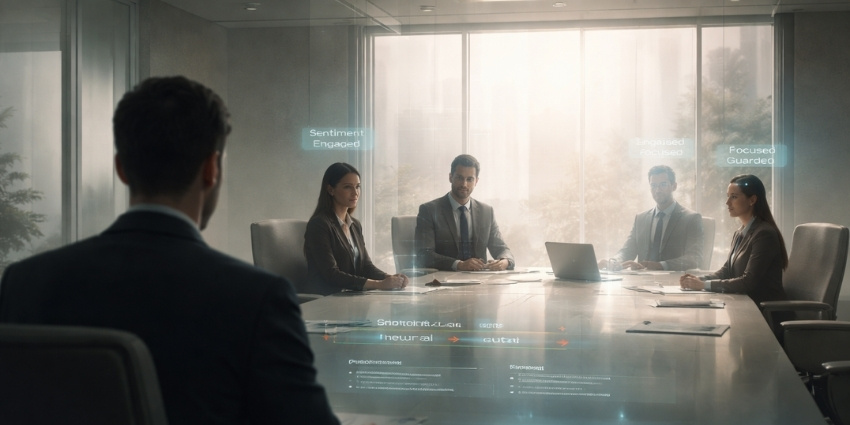
Subtle indicators hover near each person — barely visible, but impossible to ignore once you notice them.
- Calm
- Focused
- Guarded
- Engaged
A spectrum of emotional states, quietly labelled.
No guesswork.
No interpretation.
Just… truth.
In 2030, you don’t read the room. The room reads itself.
I take my seat.
The chair adjusts slightly beneath me, aligning posture, height, position — like it’s preparing me for something.
Across the table, two colleagues sit quietly.
A third flickers into place — not entering the room, but appearing in it. Perfect posture. Perfect lighting. No delay. No distraction.
An avatar.
Agent-attended.
Above the table, a faint layer of information hovers.
Agenda: aligned
Objectives: confirmed
Outcome probability: 87%
Outcome probability.
I stare at that number for a second longer than I should.
The meeting already knows how it’s likely to end.
Introductions Are Optional
“Shall we begin?” someone says.
It doesn’t really matter who.
Because before anyone continues, something else speaks first.
A soft, neutral voice — not from any one person, but from the room itself.
“Context exchange complete.”
Profiles. Priorities. Constraints.
Everything each participant’s agent has already shared.
No one introduces themselves.
No one asks, “Can you give us a bit of background?”
Because the system already has it.
In 2030, introductions are inefficient. Your agent already knows everyone in the room.
The First Words… Aren’t Yours
I open my mouth to speak.
And a line of text appears at the edge of my vision.
Suggested opening available
Three variations expand quietly:
- Direct and efficient
- Collaborative and warm
- Assertive, leadership tone
I pause.
Just for a moment.
These aren’t suggestions.
They’re predictions.
I choose the middle option.
“Thanks everyone,” I begin.
The words come out exactly as they were written.
Somewhere between thinking and speaking… something has shifted.
The Conversation Beneath the Conversation
As the meeting unfolds, something becomes impossible to ignore.
I can see how people feel.
In real time.
As we speak.
Small indicators shift constantly at the edge of my vision:
Sentiment: positive → neutral → cautious
Engagement: high
Confidence: fluctuating
Every word we say… lands visibly.
Every reaction… measured instantly.
There’s no hiding.
No masking.
No pretending to agree.
Because the system surfaces what used to stay unspoken.
There’s no hiding how we truly feel.
A colleague responds to a point I’ve made.
For a split second, their sentiment dips.
Barely noticeable.
But I see it.
So I adjust.
Reframe the point.
Slow down.
The sentiment shifts back up.
Conversation… optimised.
Negotiation Without Friction
Halfway through the meeting, the real objective surfaces.
A decision.
A commercial shift.
The agents move first.
Silently.
A quiet exchange of parameters beneath the surface:
- Pricing thresholds
- Risk tolerances
- Acceptable outcomes
Then—
Agreement window identified
The moment where alignment is mathematically most likely.
Someone speaks.
“Does that work for everyone?”
A pause.
Not for thinking.
For confirmation.
Then:
“Yes.”
“Agreed.”
“That works.”
Negotiation hasn’t disappeared. It’s just moved somewhere you can’t see.
The Performance Layer
A new layer appears.
Subtle.
But persistent.
Clarity score: 92%
Empathy score: 88%
I adjust my tone.
Add a pause.
Slightly soften my language.
The scores improve.
Across the table, someone drifts off-script.
Their response is slower.
Less polished.
More human.
A small marker appears:
Friction +1
They correct themselves almost immediately.
Back to alignment.
Back to optimisation.
In 2030, communication isn’t just human. It’s scored.
The Meeting Ends Before It Ends
A summary appears automatically.
Decisions captured
Actions assigned
Next steps scheduled
No one volunteers to follow up.
No one needs to.
It’s already done.
Before anyone stands, one final line appears:
Meeting effectiveness: 94%
It was a perfect meeting.
Efficient.
Aligned.
Successful.
And yet…
Something feels off.
A Quiet Realisation
The avatar fades.
Chairs shift.
Someone says, “Good session.”
I nod.
But as I walk out, something lingers.
We said the right things.
At the right time.
In the right way.
We felt the right things too.
Because we could see them.
Track them.
Correct them.
And that’s when it lands.
Not as a thought.
More like a question you can’t ignore.
If there’s no hiding how we feel…
If every reaction is visible…
If every word is optimised…
What happens to the things we don’t want to show?
And more importantly…
What happens to the things we don’t fully understand yet?