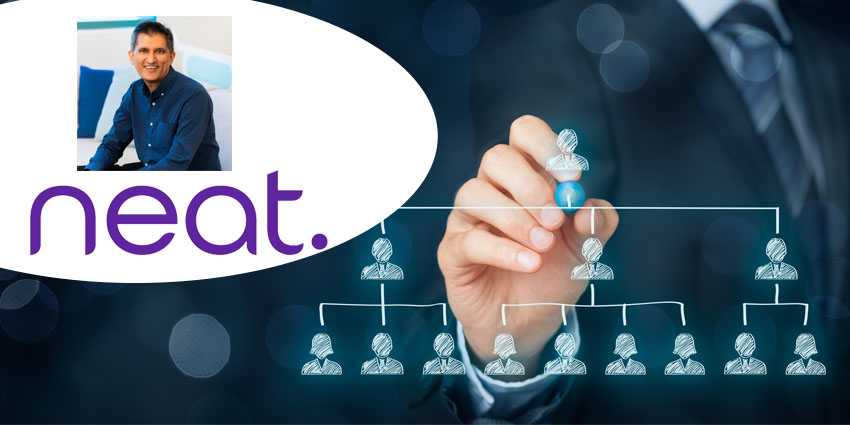

As the initial pandemic-era rush for hybrid work infrastructure settles into a mature, highly discerning enterprise market, hardware vendors face an existential mandate. They must evolve beyond mere AV peripherals or risk rapid commoditization. Enter Neat’s appointment of Javed Khan as its new CEO last month.
Succeeding Janine Pelosi, the former Senior Vice President and General Manager of Cisco Collaboration brings a formidable pedigree of modernizing Webex and, more recently, spearheading autonomous vehicle technology at Aptiv. For Neat, a Norwegian video technology firm renowned for its elegant design, this exec transition plausibly signals a definitive push toward deeper investment in artificial intelligence, specifically focusing on edge computing in the meeting room.
Contextualizing this industry shockwave, Zeus Kerravala, Principal Analyst at ZK Research, offered a gripping hook around Khan’s autonomous vehicle background and its direct translation to the boardroom in the most recent Big UC Show: “When he joined, I asked him what appealed to him about it, and he said a self-driving car is basically an endpoint with cameras, sensors, and microphones that ingest data to take action.”
In that framework, the move to Neat seems seamless.
- Neat opens London Experience Centre to power hybrid work and video collaboration growth
- Neat Brings Google Meet Directly to Its Hardware
Elevating Enterprise Credibility and the Hardware-Software Dynamic With the New Neat
As Neat navigates a market heavily dominated by entrenched titans, Khan’s arrival arguably alters the company’s posture. IT buying committees at multinational corporations require stringent assurances of scale, longevity, and visionary roadmaps before committing to sweeping, multi-million-dollar hardware deployments across their global real estate. Khan, who successfully navigated the enterprise labyrinth during his tenure at Cisco, provides that immediate executive gravity and institutional trust.
“Bringing Javed in gives them instant credibility and puts them on a much higher level when they sell to larger companies,” noted Irwin Lazar, President and Principal Analyst at Metrigy. This elevated status is crucial as Neat intends to capture market share from formidable incumbents such as Logitech, HP, and Cisco. “He certainly has his work cut out for him in a highly competitive market,” Lazar added, acknowledging the steep climb ahead for the challenger brand.
Beyond market positioning, Khan must navigate the complex architectural debate shaping modern AV strategies: the delicate balance between localized hardware and cloud-based software. As AI algorithms become increasingly sophisticated, the physical components of a meeting room are being dramatically reimagined. “There’s also the dynamic of how much will live in the hardware versus the software,” Lazar explained.
The industry is currently wrestling with whether premium hardware is strictly necessary if cloud software can artificially enhance substandard audio and video feeds, mitigating the need for expensive in-room arrays. This architectural evolution forces hardware manufacturers to justify their premium offerings through unique, on-device capabilities that software alone cannot replicate without introducing unacceptable latency. “So the question going forward for hardware vendors is how much they can do natively and locally,” Lazar concluded.
For Neat, the strategic answer potentially lies in transforming the hardware itself into an intelligent, edge-computing powerhouse that processes sensitive meeting data securely within the physical confines of the room.
The Edge AI Revolution: Transforming the Meeting Endpoint
Khan’s strategic playbook for Neat appears heavily influenced by his recent tenure as President of Aptiv’s Advanced Safety and User Experience division, where he developed sophisticated drive stacks for autonomous vehicles. The conceptual bridge between a self-driving car and a modern conference room is surprisingly direct, offering a fascinating glimpse into Neat’s future product architecture.
“When you think about a meeting endpoint, it has cameras, microphones, and sensors too,” Kerravala explained. The strategic vision is to synthesize these myriad environmental inputs locally rather than relying entirely on cloud processing. This approach not only reduces latency but drastically enhances data privacy for enterprise users, a paramount concern for Chief Information Security Officers safeguarding proprietary corporate conversations.
“If you can put them all in one device, ingest that data, and take action, like putting documents together, it’s incredibly powerful,” Kerravala elaborated.
This localized processing strategy, generally known in the tech sector as edge AI, represents a significant departure from traditional cloud-dependent collaboration models. By embedding artificial intelligence directly into the meeting room devices, Neat aims to create a more responsive, secure, and intuitive user experience that anticipates employee needs without continuous cloud tethering.
“I think the edge AI piece is the biggest part of this, and he knows that very well,” outlined Melody Brue, VP and Principal Analyst at Moor Insights & Strategy, highlighting Khan’s unique, cross-disciplinary qualifications for this technological pivot.
The convergence of automotive innovation and unified communications is becoming increasingly apparent, with both sectors prioritizing seamless, integrated, and highly contextual user experiences. “And really, the car and the meeting room are not totally dissimilar in how we use them,” Brue added.
This automotive-inspired philosophy suggests a future where Neat devices operate with a degree of spatial awareness and autonomy, potentially driving the evolution of AV hardware from passive conduits to active, intelligent participants in the enterprise workflow.
Global Expansion Strategies and the Boardroom Reality With Javed Khan as CEO
While technological innovation will likely remain the cornerstone of Neat’s strategy under Khan, the commercial and financial imperatives are equally pressing. To justify its valuation and satisfy its financial backers, the company might have to aggressively scale its operations globally, moving beyond its established strongholds.
Khan’s track record of building international business units and managing complex global supply chains will be instrumental in this endeavor. “I also think expanding outside of the US is going to be a big focus for him, and he’s built that before,” Brue observed.
Penetrating new geographic markets will naturally require navigating diverse regulatory environments, establishing robust channel partnerships, and meticulously tailoring go-to-market strategies to regional enterprise demands. For channel partners, this signals a potentially lucrative opportunity to align with a vendor preparing for a massive international push.
However, the ultimate measure of Khan’s success may lie in his ability to engineer a lucrative financial outcome for Neat’s stakeholders. As a private entity heavily backed by institutional capital, the overarching corporate narrative is inevitably driving toward a significant financial milestone.
“There is one elephant in the room we need to talk about: they’re still a private company with investors and a board, and they’re probably looking for some sort of exit event to continue their growth trajectory,” pointed out Craig Durr, Chief Analyst at The Collab Collective. The appointment of a high-profile executive with Khan’s pedigree is often a calculated precursor to such strategic financial maneuvers.
“This is their third CEO, and each had success building up specific elements of the company,” Durr noted, contextualizing Khan’s role as the potential closer in Neat’s overarching business lifecycle. “A key asset for any new CEO coming in is figuring out how to build toward a liquidity opportunity in the future, whether it be going public or combining with another company,” Durr explained.
Whether through an initial public offering or a strategic acquisition by a larger tech conglomerate, Khan’s mandate extends far beyond tech innovation. He will likely be tasked with architecting a corporate structure and market valuation that delivers substantial returns, cementing Neat’s legacy in the collaboration ecosystem.
Final Takeaways Around Javed Khan Becoming the New Neat CEO
Javed Khan’s appointment as CEO marks a major inflection point not just for Neat, but for the broader collaboration hardware market. By importing the rigorous, sensor-rich, and edge-computing philosophies of the autonomous vehicle industry into the corporate boardroom, Khan might be positioning Neat to transcend the traditional boundaries of video conferencing.
For IT and AV leaders, this might signpost a potential tweak to procurement strategies, where the value of an endpoint is measured not merely by its optical clarity, but by its localized intelligence, latency reduction, and privacy-first architecture. Simultaneously, the undeniable financial currents driving this leadership change suggest that Neat is preparing for a notable corporate evolution.
As the lines between hardware, software, and autonomous AI continue to dissolve, Khan’s vision for the meeting room will possibly serve as a leading indicator for the entire collaboration industry.