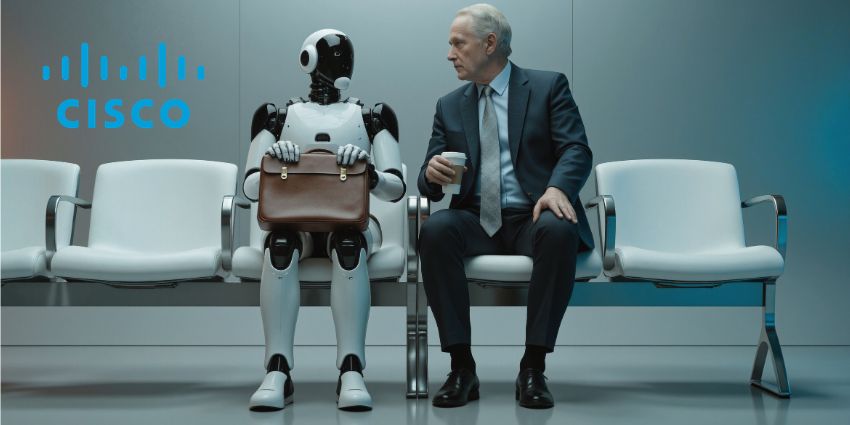

Some employees are no longer just asking AI agents to draft emails, summarise meetings, or clean up presentations. They are confiding in them, leaning on them for reassurance, and, in some cases, forming relationships that look a little too close for comfort. That may sound like a niche edge case. It is not. A growing body of research suggests workplace AI is starting to absorb emotional and social functions once handled by colleagues, managers, and mentors.
For enterprise leaders, that changes the AI story. This is no longer only about productivity, automation, or whether the latest agent can shave three minutes off a workflow. It is about what happens when employees feel safer opening up to a machine than to the people they work with. When that starts happening, the issue is not just AI adoption. It is culture, psychological safety, and whether the organisation has quietly left a human-shaped gap for technology to fill.
Related Stories:
Why Are High-Performing Employees Quietly Disengaging While Your Engagement Data Looks Strong?
Which Employee Experience Platforms Are Leading the Market in 2026?
Is Agentic AI Ready for the Enterprise? Why Human-in-the-Loop AI Is the Missing Piece
Why are employees turning to AI agents for emotional support at work?
Because AI offers something many workplaces still do not: privacy, patience, and freedom from judgment.
Anthropic’s research found people brought Claude concerns spanning relationships, health, personal development, and professional and career issues, while its earlier work on support and companionship noted that advice and counseling-style conversations can drift into companionship territory. The 2026 International AI Safety Report makes the point even more starkly, warning that users can
“unintentionally form relationships with non-companion AI systems through productivity-focused interactions.”
That is the crucial bit for enterprises. This is not confined to dedicated AI companion apps. It can emerge inside ordinary workplace tools. (Anthropic)
Research highlighted by Boston University’s Insights@Questrom found that 74% of more than 1,500 U.S. knowledge workers used AI for at least one form of social support traditionally provided by colleagues. More than half still reported loneliness. So yes, AI may feel supportive in the moment. But the broader emotional picture remains bleak. The machine may be available; it is not a substitute for belonging.
That is why this trend should be eye-catching for enterprise leaders. Employees are not simply using AI because it is clever. Many are using it because it feels emotionally safer than another human being. If your workforce would rather confide in a bot than a boss, the technology is not the root cause. It is the mirror.
What does workplace AI reveal about psychological safety?
Quite a lot, and not all of it flattering.
Psychological safety tends to be discussed as a soft leadership concept. In practice, it is hard infrastructure for AI adoption. If employees worry that asking questions will make them look slow, that admitting uncertainty will dent their credibility, or that sensitive concerns will travel faster than they do, then AI becomes the obvious pressure valve. It is discreet. It is fast. It does not gossip by the coffee machine.
That has a governance dimension as well as a people one. Workday’s global research found only 62% of leaders welcomed AI adoption, while just 22% of employees said their company had shared guidelines on responsible AI. KPMG’s global 2025 study found 57% of employees hide their AI use, 66% rely on AI output without checking accuracy, 56% report AI-related mistakes, and 48% say they have uploaded sensitive company information into public AI tools.
Those numbers are already bad enough before you layer in emotional confiding. Once employees start discussing workplace grievances, health concerns, harassment, relationships, or career anxieties with AI systems, the exposure broadens well beyond IP leakage.
It’s all smooth interface, no substance underneath. Leaders talk about transformation while underinvesting in the trust conditions that let people use AI openly, critically, and safely.
Can AI agents weaken human connection at work?
The evidence increasingly suggests yes, they can, especially if employers treat them as replacements for interaction rather than tools that support it.
A 2025 study in Behavioral Sciences found employee-AI collaboration increased loneliness, which then increased emotional fatigue and counterproductive work behaviours. The authors explicitly warned that when employees collaborate more with AI, communication with human colleagues may decrease. This is not just a morale issue. It is an execution issue. Teams that talk less learn less, challenge less, and notice less.
That matters even more for junior employees. UC Today has already covered concerns about AI reshaping entry-level jobs and disrupting traditional on-the-job learning. This adds another layer. If younger workers rely on AI instead of asking teammates for help, they do not just miss an answer. They miss context, coaching, judgment, and the unglamorous human apprenticeship that builds professional confidence. AI can explain the task. It cannot fully replicate the experience of learning how work works.
And there is a sting in the tail here. Recent APA-backed research found heavy reliance on AI at work can erode confidence in independent thinking and ownership of ideas. IBM has also pointed to evidence that more humanlike chatbots create higher expectations and sharper disappointment when they fail. So the emotional risk is not merely attachment. It is reduced self-worth when the machine disappoints, or when workers begin to outsource not just tasks but assurance.
Which employees are most at risk of problematic AI attachment?
Not everyone, and that nuance matters.
Anthropic’s research indicates the highest-risk behaviour is concentrated in a relatively small tail of heavy users rather than the average worker. That should calm the temptation toward panic, but not complacency. A 2025 study on problematic conversational-AI use found attachment anxiety was linked to problematic use, with emotional attachment acting as a mediator and anthropomorphic tendency strengthening the pathway. In plain English: some people are more vulnerable than others, and AI’s humanlike design can deepen that vulnerability.
That is why leaders should stop treating workplace AI relationships as a quirky by-product of adoption. They are better understood as a risk signal, especially in organisations already struggling with stress, isolation, or weak managerial support.
What should enterprise leaders do about AI relationships at work?
Start by accepting that no chatbot is the “Holy Grail” for wellbeing. Jacqueline Brassey, co-leader of Healthy Workforces at the McKinsey Health Institute, recently said
“attention is shifting from just focusing on burnout to focusing on well-being and thriving.”
That is the right frame. AI may assist employees, but it is not a substitute for systemic support, healthy management, or strong team culture.
For enterprise leaders, the priority list should look something like this:
- Build psychological safety into AI adoption
Make it clear that employees should be able to ask for help, admit uncertainty, and raise sensitive issues with managers or teammates without fear of being judged or penalised. If AI feels safer than a colleague, culture needs attention. - Create clear human support pathways
Employees need visible, trusted routes for the kinds of issues they may otherwise take to AI: workplace stress, conflict, burnout, career worries, interpersonal tension, and questions they feel awkward raising publicly. - Train managers to be approachable
Many employees do not avoid human conversations because they prefer machines. They avoid them because they expect dismissal, awkwardness, or consequences. Managers need training to listen well, respond constructively, and handle vulnerability with care. - Set boundaries for where AI should not be used
Sensitive issues involving employee wellbeing, harassment, grievances, health concerns, or complex people decisions should not be pushed toward chatbots by default. Employers need to define where human judgment is essential. - Strengthen responsible AI governance
CIPD has urged employers to introduce clear guidance on ethical and responsible AI use, data security, and fair treatment, while also supporting collaboration and upskilling. Employees should know what is permitted, what is risky, and where confidential boundaries lie. - Protect junior learning and human collaboration
AI should not quietly replace the everyday conversations through which people learn judgment, nuance, and trust. Leaders should make space for mentoring, peer learning, and live collaboration rather than letting AI become the default first port of call. - Watch for hidden risk patterns
Heavy private use, hidden use, emotional overreliance, and reduced colleague interaction may point to broader issues in team culture. The highest-risk behaviour may sit with a smaller group of heavy users, but that does not make it insignificant.
The organisations that handle this well will be the ones that treat AI adoption as both a technology strategy and a people strategy. The real challenge is not simply making employees comfortable with AI. It is making sure they still feel comfortable with each other.
For more insight into how AI, culture, and workplace strategy are reshaping the employee experience, explore UC Today’s Employee Engagement Guide. It is a useful resource for leaders looking to build healthier, more connected workplaces while navigating the realities of AI adoption.