







For the past year, Asana has been making a case that it is no longer a task manager but an operating system for human-agent teams. On 28 May, it put $75 million behind that argument.
The company has acquired StackAI, a no-code platform that lets enterprises build, test, deploy, and govern AI agents across the systems that actually run their operations: ERP, CRM, ITSM, and more. The deal closes the gap that has followed Asanaβs AI platform from the start: agents that can plan and coordinate work inside Asana, but canβt reach into the external systems where execution actually happens.
StackAIβs founders, Tony Rosinol and Bernard Aceituno, both MIT PhDs and Y Combinator alumni, will join Asana as part of the transaction. The startup had raised approximately $20 million before the deal, with backing from Y Combinator, NEA, Lambda, and Lobby Capital.
What Asana Gets from the StackAI Acquisition
Asana has spent the past year building out AI Studio for automating repeatable processes and AI Teammates for assigning complex, adaptive work to collaborative agents. What the platform has lacked, until now, is the ability to execute those workflows end-to-end across the external enterprise systems where business data actually lives.
StackAI fills that gap. The platform connects to ERP, CRM, ITSM, and other enterprise systems, including Salesforce, ServiceNow, Oracle, DocuSign, and AWS, reading and writing data across them so a single workflow can move through multiple systems without manual handoffs. Dan Rogers, CEO of Asana, says:
βStackAI allows us to agentify the most complex business processes from start to finish. This acquisition accelerates our roadmap and marks the next phase of human-agent work.β
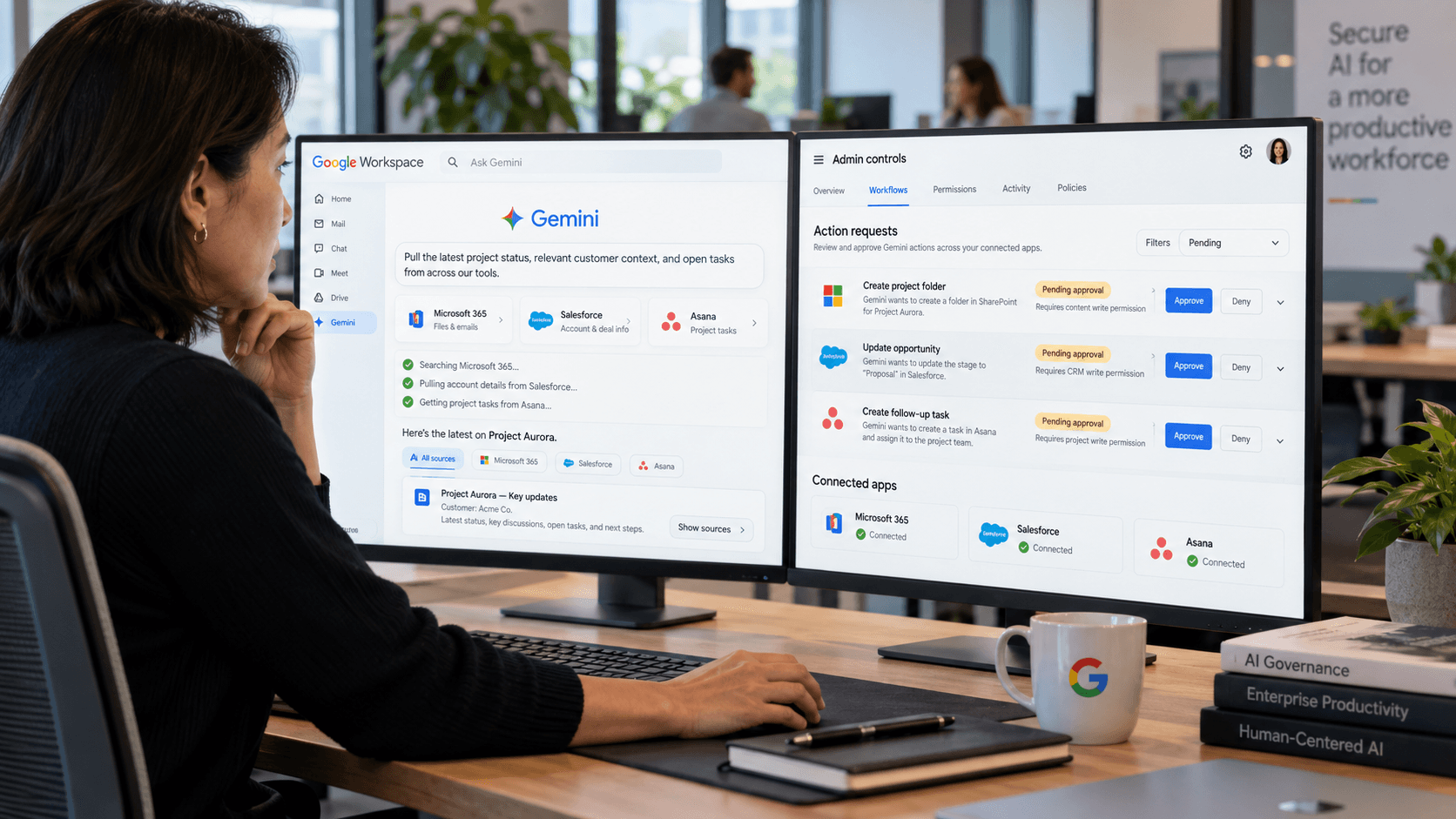
In practice, the integration works through AI Teammates as a bridge. Teammates pull context from Asanaβs Work Graph, route it through StackAI workflows for execution, and return the resulting actions and data back into the platform. As a result, a single agentic workflow can span project planning, approval chains, system updates, and cross-functional coordination, all within one governed environment.
For IT buyers and operations leaders, this matters. Most enterprise AI tools today are scoped to a single user interacting with a single agent. Asanaβs approach is explicitly multiplayer: many people can interact with, assign work to, and govern a single agent. StackAI now provides the connective tissue to the systems those agents need to act on.
What StackAI Brings to the Table
Founded in 2022, StackAI built its reputation in regulated industries where AI governance is not optional. The platform carries SOC 2 Type II, HIPAA, GDPR, and ISO 27001 compliance. It also supports on-premises deployment for organisations that cannot route sensitive data through third-party cloud infrastructure. Its customer base spans financial services, healthcare, and professional services.
The platformβs core differentiator is its Agentic Development Life Cycle (ADLC): a software engineering discipline applied to AI agent deployment. This includes versioned changes, staged environments, and pull-request approvals before anything reaches production. That governance posture maps directly onto the accountability framework Asana has built around its Work Graph.
Under the hood, StackAI operates as a drag-and-drop workflow builder that connects large language models, enterprise data sources, and external systems. It supports over 100 native integrations. It also handles retrieval-augmented generation (RAG), embeddings, and vector search for agents that need to reason over internal documentation and structured records, not just respond to prompts.
The Business Context: Q1 FY27 and the AI Revenue Push
Asana announced the deal alongside a stronger-than-expected Q1 FY27. Revenues came in at $205.1 million, up 9.5% year over year, beating the high end of guidance. Non-GAAP operating margin hit 11.5%, up 720 basis points year over year, the highest in the companyβs history. Net revenue retention improved for the fourth consecutive quarter.
Aziz Megji, CFO of Asana, says the deal reinforces confidence in the companyβs growth trajectory:
βThe acquisition of StackAI further differentiates our operating system for human-agent teams and reinforces our confidence in Asanaβs long-term growth and profitability potential.β
Meanwhile, the company projects AI bookings will contribute 15% of net new ARR in FY27. StackAI is expected to add approximately 50 basis points to full-year revenue growth.
Asana guided full-year FY27 revenues of $850 million to $858 million, growth of 7.5% to 8.5% year over year. As covered in our Q4 FY26 earnings analysis, AI product adoption has been the primary engine of customer expansion. StackAI is designed to accelerate that motion upmarket into enterprise accounts with complex, multi-system workflows.
Where This Fits in the Competitive Picture
Asana is not alone in trying to own the agentic workflow layer. ServiceNow has built a workflow orchestration narrative across its Now Platform for years. Salesforceβs Agentforce strategy positions CRM data as the governing context for autonomous agents. SAP is embedding agentic capability directly into Joule within its ERP backbone. Boomi announced its Agent Control Tower at Boomi World 2026 as a direct bid to govern multi-agent workflows across enterprise systems.
What separates Asanaβs position is the Work Graph as the context layer. Rather than anchoring agent decisions in CRM records or ERP transactions, Asana is betting on project-level context: who owns what, what approvals are pending, what the current state of execution is. In short, it treats that operational signal as more valuable than transactional records for orchestrating human-agent collaboration. StackAI gives that context somewhere to act.
As explored in our AI strategy comparison of Monday.com, Asana, and Smartsheet, Asanaβs differentiated approach has consistently emphasised governance and accountability at the team level, not just individual productivity. The StackAI acquisition extends that logic into the execution layer.
The deal also allows Asana to retire the most persistent criticism of its AI platform: that agents could plan and coordinate work inside the platform but could not take meaningful action in the systems that matter most to enterprise IT teams.
What It Means for IT and Operations Buyers
For IT leaders evaluating project and work management platforms, the acquisition shifts what Asana can credibly offer. It is no longer a platform that coordinates work around external systems. With StackAI, it can execute work inside them, with the governance controls and compliance posture that regulated industries require.
The platform will continue to operate as its own product and brand following the acquisition. This gives existing StackAI customers continuity while the integration with Asanaβs Work Graph and AI Teammates matures.
For a deeper look at how Asanaβs AI Teammates work in practice and what they mean for enterprise collaboration strategy, see our full analysis of the AI Teammates launch.