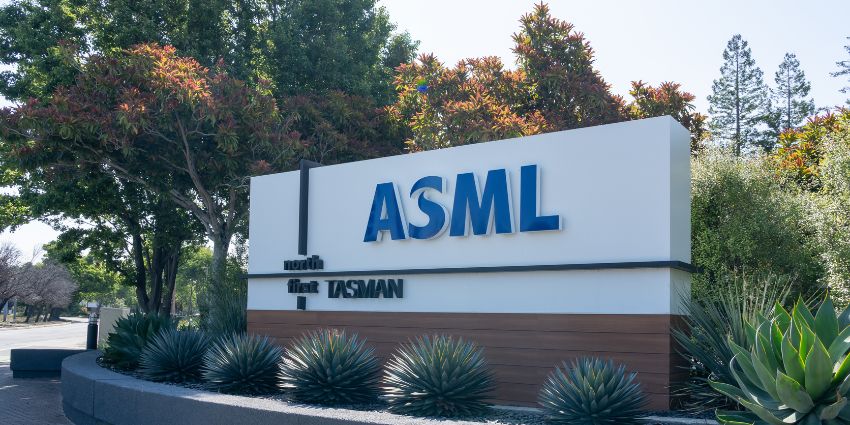

ASML, the Dutch company that holds a global monopoly on the extreme ultraviolet lithography machines required to manufacture the world’s most advanced chips, is closing in on a $700 billion market valuation after its shares surged 60% in 2026. Following blowout second-quarter earnings, analysts and investors are now openly asking whether it could become Europe’s first trillion-dollar firm — and what that would mean for the AI infrastructure race underpinning enterprise technology investment globally.
For UC Today readers, this is not an abstract financial story. ASML’s machines make the chips that power the AI data centres behind every large language model, every AI assistant, and every enterprise AI platform. The health of ASML’s order book is a direct proxy for the pace and scale of AI infrastructure investment — and by extension, the trajectory of enterprise AI adoption.
Related Articles
- Why Are Tech Prices at an All Time High?
- The NHS Just Published the Best AI Productivity Benchmarks of 2026
- Artificial Intelligence
TL;DR — Why This Matters for Enterprise AI
- ASML shares are up 60% in 2026, pushing the firm toward a $700 billion valuation — with analysts targeting $1 trillion.
- ASML is nearly sold out of its flagship EUV systems for 2027, reflecting the scale of AI infrastructure demand.
- Three major investment banks — Barclays, Susquehanna, and Bernstein — now have 12-month price targets above $2,600 per share.
- Key risks include hyperscaler spending slowdowns, China trade restrictions, and supply chain execution.
- An AI memory upgrade cycle could sustain ASML’s growth even if broader AI infrastructure spending cools.
Why Is ASML So Central to the AI Chip Supply Chain?
Direct answer: ASML is the sole manufacturer of extreme ultraviolet lithography machines — the equipment required to print the circuitry of the most advanced logic and memory chips. Without ASML’s EUV tools, neither TSMC nor Samsung can produce the chips that power AI data centres at scale.
Investors frequently describe ASML’s position as selling picks and shovels during a gold rush. Every advanced chip produced by TSMC — including the processors that run Nvidia‘s AI accelerators and the models behind OpenAI, Anthropic, and the major hyperscalers — requires ASML’s EUV technology to manufacture. There is no alternative supplier. That monopoly position is what makes ASML’s order book a structural indicator of AI infrastructure momentum, not merely a financial metric.
John Lamb of Capital Group, whose funds hold around 5% of ASML shares worth approximately $35 billion, described its position plainly:
“The fundamentals for the industry as a whole appear stronger than ever and ASML occupies a critical space.”
What Would It Take for ASML to Reach a Trillion-Dollar Valuation?
Direct answer: ASML would need its share price to reach approximately $2,600 — a 49% rise from current levels. Barclays, Susquehanna, and Bernstein all have 12-month price targets at or above that threshold following Q2 2026 earnings.
Carolyn Bell, lead portfolio manager for Stonehage Fleming‘s Global Best Ideas — with ASML comprising approximately 8% of the portfolio — said:
“I think it has a really good chance of being the first company in Europe to hit the trillion mark. I just don’t know when.”
ING analyst Marc Hesselink was more direct, claiming that ASML “can surely be” Europe’s first trillion-dollar firm. Antoine Hucher of Aviva Investors agreed the trajectory was credible but cautioned that “the volatility we have seen with AI stocks in the last few weeks suggests the journey to this achievement won’t be a straight line.”
What Are the Risks That Could Derail It?
Direct answer: The three primary risks are a slowdown in hyperscaler data centre spending, geopolitical restrictions on China sales, and supply chain execution at scale. ASML expects China to account for 20% of 2026 sales — a significant exposure to US trade policy.
Trent Masters of Alphinity Investment Management, which holds approximately 3% of its portfolio in ASML, warned that any cooling of hyperscaler spending “will flow through to ASML’s earnings.” US lawmakers have also proposed the MATCH Act, which could curtail ASML’s ability to sell and service equipment in China — a market representing a fifth of anticipated 2026 revenue.
However, analysts point to a structural tailwind that could sustain growth even if AI infrastructure spending moderates. Kinngai Chan of Summit Insights Group notes that AI memory chip makers — SK Hynix, Samsung, and Micron — are shifting production toward newer processes that require ASML’s more expensive EUV tools rather than its older DUV equipment. That transition creates a profitable upgrade cycle that is largely independent of new data centre construction.
Separately, ASML is offering employees a €20,000 retention bonus for staying with the company between 2027 and 2030 — a signal that it is investing aggressively in the talent required to execute its expansion at the pace the market is demanding.
Bottom line: ASML’s trajectory is a direct measure of the market’s conviction in the long-term AI infrastructure buildout. For enterprise leaders evaluating AI adoption timelines, the message from its order book and valuation is consistent: the organisations building AI infrastructure are betting heavily that demand for AI compute is structural and sustained, not cyclical. That conviction is now priced into the company closest to the foundation of the entire AI supply chain.
Frequently Asked Questions: ASML, AI Chips, and Enterprise AI Infrastructure
What does ASML do and why does it matter for AI?
ASML is the sole manufacturer of extreme ultraviolet lithography machines - the equipment required to print the circuitry of the most advanced logic and memory chips in the world. Every advanced AI chip produced by TSMC, Samsung, and others depends on ASML's EUV technology. There is no alternative supplier, making ASML's order book a direct indicator of global AI infrastructure investment.
Could ASML really become Europe's first trillion-dollar company?
Analysts at Barclays, Susquehanna, and Bernstein have set 12-month price targets above $2,600 per share - the approximate threshold for a $1 trillion market cap, representing a 49% rise from current levels. Multiple institutional investors with significant ASML positions have described it as a credible scenario, though timing remains uncertain and the path is unlikely to be linear.
What is an EUV lithography machine?
Extreme ultraviolet lithography is the process used to etch the extremely fine circuitry onto advanced semiconductor chips. ASML's EUV machines are the only tools in the world capable of manufacturing chips at the sub-5nm scales required for AI accelerators and high-bandwidth memory. A single EUV machine costs approximately $200 million and takes years to manufacture.
What risks could slow ASML's growth?
The three primary risks are a slowdown in hyperscaler data centre spending, US trade restrictions on China sales via the proposed MATCH Act, and supply chain execution challenges. China is expected to account for 20% of ASML's 2026 sales, making it a significant exposure to geopolitical trade policy.
What does ASML's valuation tell us about the AI market?
ASML trades at 38 times forecast 2027 earnings - a premium that reflects market conviction that AI infrastructure demand is structural rather than cyclical. Its near-sold-out 2027 EUV order book means the world's largest chip manufacturers have already committed to expanding AI chip production at scale, regardless of short-term AI stock volatility.
About the Author
Alex Cole is a Technology Journalist and Videographer at UC Today. He has experience reporting on productivity and automation, human capital management and extended reality. Connect with Alex on LinkedIn.