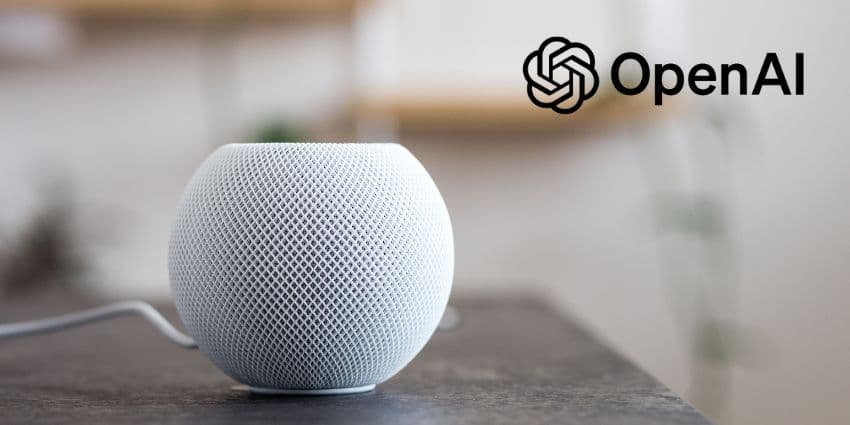
OpenAI is developing its first consumer hardware device: a portable, screenless smart speaker designed to act as a humanlike AI companion. The device — still under development — will integrate with ChatGPT, control smart home appliances, play media, answer questions, respond to messages, and access a user's broader digital life including emails. It is described as having mechanical elements that can move on their own and is designed to proactively speak without being prompted.
The device is expected to be the first of up to five hardware products OpenAI is working on, with a potential reveal later in 2026 and a ship date in early 2027 — assuming Apple's trade secret lawsuit, filed 10 July 2026, does not disrupt the timeline.
Related Articles
TL;DR — What UC and IT Leaders Need to Know
- OpenAI's first hardware device is a portable, screenless AI speaker with a camera, sensors, and mechanical moving parts.
- It is designed by former Apple engineers recruited via Jony Ive's studio LoveFrom, and will run on ChatGPT Live.
- The device accesses emails and personal data to provide proactive, personalised responses — raising immediate enterprise data governance questions.
- Apple has sued OpenAI for trade secret theft, with its complaint describing the allegations as merely "the tip of the iceberg."
- A broader hardware pipeline of up to five products is reportedly in development, with OpenAI targeting early 2027 for the first launch.
What Is OpenAI Building and Who Is Behind It?
Direct answer: OpenAI is developing a portable, screenless smart speaker with a camera, sensors, mechanical moving parts, and deep ChatGPT integration. The product was developed with significant involvement from former Apple engineers and Jony Ive's design studio, LoveFrom.
OpenAI paid $6.5 billion to acquire io, the AI devices startup founded by Apple's former design chief Jony Ive, in 2025 — a signal that its hardware ambitions were serious long before this week's leak. The speaker is described as having a "personality," the ability to learn about its owner over time, and access to a user's digital life — including emails — to provide more contextual, personalised responses.
The device features a camera and environmental sensors to understand its surroundings and includes AI models that go significantly beyond what conventional smart speakers offer. It will support ChatGPT Live — OpenAI's real-time conversational AI capability — and be able to continue processing speech while simultaneously providing an answer.
- OpenAI has backed its hardware push with $6.5 billion in investment and significant Apple design and engineering talent.
- The device is designed to be proactive — it will speak without being prompted and learn from user data over time.
- Bloomberg reports this is the first of up to five hardware products in OpenAI's pipeline.
How Does This Compare to What Already Exists?
Direct answer: The device occupies the same category as Amazon Echo, Google Home, and Apple HomePod — but claims differentiation through deeper AI integration, proactive behaviour, access to personal data, and a hardware design intended to feel more humanlike than a static speaker.
The smart speaker category is not new. Amazon and Google both upgraded their AI speaker ranges in 2025 and 2026. Apple's HomePod already positions Siri as a home-based AI hub. The honest read on OpenAI's device is that it is entering a crowded, mature market with a differentiation strategy built around model quality, data access depth, and anthropomorphic design — rather than a fundamentally new form factor.
Wesley Hilliard, Rumor Export at AppleInsider noted the irony directly, describing the product as "a HomePod, but more annoying and privacy-invasive," and pointing out that OpenAI internally believes its product "veers significantly from anything Apple has on the market today" — a claim made while simultaneously being sued by Apple for trade secret theft.
For enterprise context, Hark — an AI lab founded by Brett Adcock — raised an oversubscribed $700 million Series A in May 2026 at a $6 billion valuation to build what it describes as "personal intelligence": proprietary AI models paired with custom hardware as a universal interface between humans and machines. The category is attracting serious capital well ahead of any proven product-market fit.
What Are the Enterprise and UC Implications?
Direct answer: A device with persistent ambient awareness, access to email and personal data, a camera, and proactive AI behaviour raises immediate questions for enterprise IT leaders around data governance, shadow IT risk, and the future of the AI-native endpoint in professional environments.
The immediate concern for UC and IT leaders is not the device itself but the data model it runs on. A consumer AI companion that accesses emails, learns from personal behaviour over time, and speaks proactively is — by design — an always-on data collection endpoint. In hybrid work environments where home and work contexts increasingly overlap, the governance boundary between personal and enterprise data becomes a live compliance question the moment a device like this sits on a desk next to a work laptop.
The longer-term implication is more strategic. OpenAI is signalling a move toward owning the physical interface layer for AI interaction — not just the model behind it. If that push succeeds, the question for enterprise UC platforms is whether they integrate with, compete against, or get displaced by AI-native endpoints that sit outside the managed device estate entirely.
Bottom line: OpenAI's speaker is not an enterprise product. But the category it is trying to create — an ambient, proactive, AI-native home interface with deep access to personal and professional data — is one that every enterprise IT and UC leader will need a policy position on before it ships.
Read The Full Productivity and Automation Buyer Guide
Frequently Asked Questions: OpenAI Hardware and Enterprise AI Devices
What is OpenAI's first hardware device?
OpenAI is developing a portable, screenless smart speaker with a camera, environmental sensors, and mechanical moving parts. It is designed to act as a humanlike AI companion, integrate with ChatGPT Live, access user emails and personal data, and speak proactively without being prompted. A reveal is expected in late 2026 with a ship date targeted for early 2027.
Who designed OpenAI's hardware device?
The device was developed with significant involvement from Jony Ive's design studio LoveFrom and numerous former Apple engineers who worked on products including the iPhone and Mac. OpenAI acquired Jony Ive's AI hardware startup io for $6.5 billion in 2025 to accelerate its hardware ambitions.
How does OpenAI's speaker differ from Amazon Echo or Apple HomePod?
OpenAI's device claims differentiation through deeper AI model integration via ChatGPT Live, proactive behaviour without prompting, the ability to learn from user data over time, a camera for contextual awareness, and access to personal data including emails. Amazon and Google have both upgraded their smart speakers with AI capabilities, and Apple's HomePod already uses Siri as a home AI hub.
What is the Apple lawsuit against OpenAI about?
Apple sued OpenAI on 10 July 2026, accusing the company of orchestrating a broad effort to acquire and exploit Apple's confidential information through former employees, recruiting practices, and supplier relationships. Apple described the allegations as merely the tip of the iceberg. OpenAI has denied wrongdoing.
What are the enterprise risks of ambient AI devices in hybrid work environments?
Ambient AI devices with persistent awareness, camera access, and connection to personal email and data create governance challenges in hybrid work settings where home and professional contexts overlap. Enterprise IT leaders need clear policies on data boundaries, managed device scope, and compliance obligations before AI-native consumer endpoints become common in home office environments.
About the Author
Alex Cole is a Technology Journalist and Videographer at UC Today. He has experience reporting on productivity and automation, human capital management and extended reality. Connect with Alex on LinkedIn.