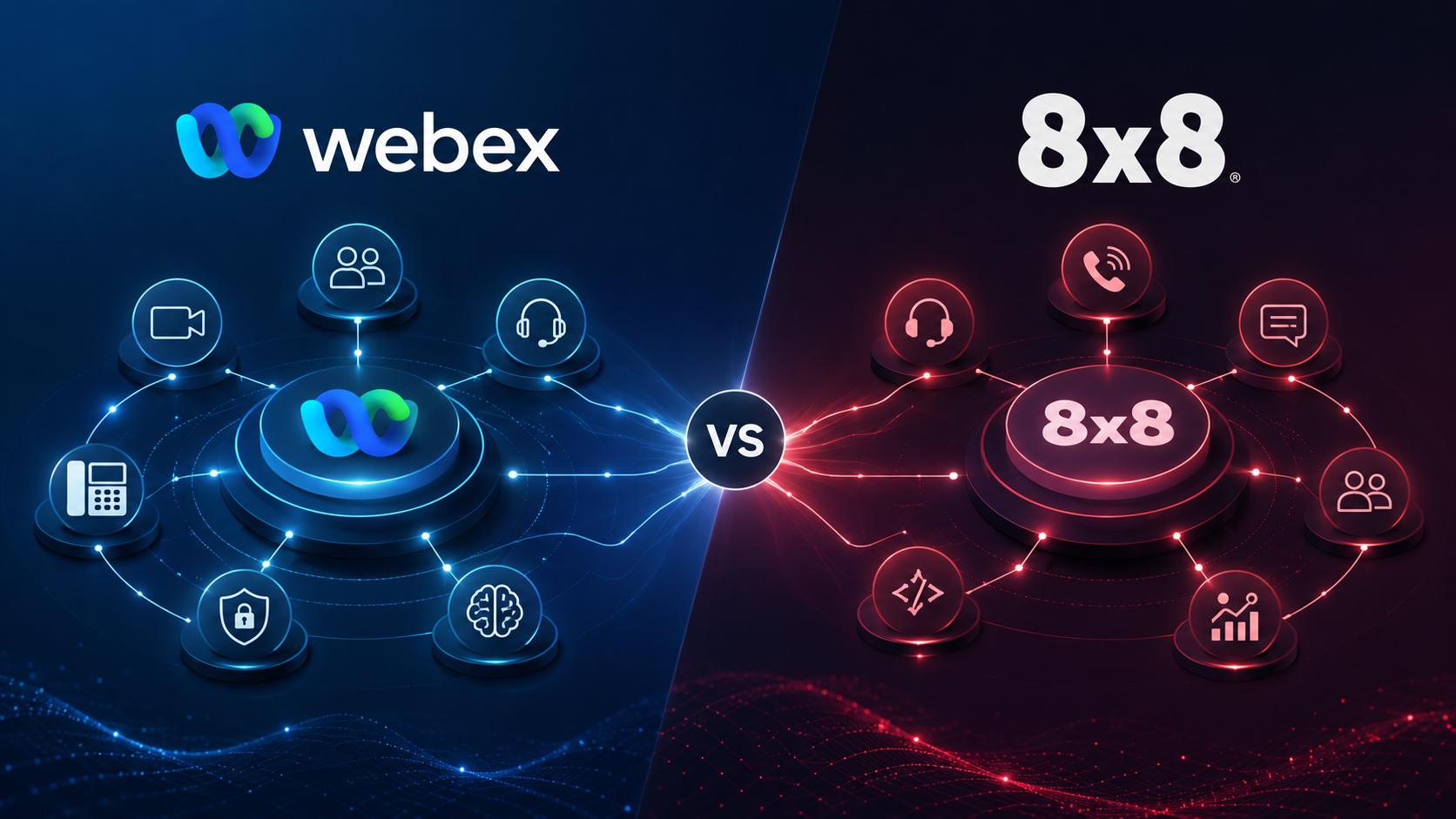

Cisco is aiming at the enterprise buyer who wants UC, contact center, devices, and AI governance under one command layer. 8×8 is aiming at the buyer who’s tired of integration work and wants UCaaS, CCaaS, and AI agents sharing the same data model from the start.
It’s a new era for enterprise communication and collaboration. We’ve progressed beyond “unified communications” into the age of the single platform powerhouse, UC integrated with collaboration, AI, events, contact center features, CPaaS, workforce management, you name it.
That’s a good thing. Our CX Today industry survey found 94% of contact center leaders already say stack simplification is a pressing issue, and the majority of business owners want consolidation to cut tech bills and confusion.
That brings the Cisco Webex vs 8×8 fight into a brand new light. Both have been top-tier enterprise communication platforms for years, but now the systems available are bigger, and more comprehensive than ever before. Comparing them on features is still helpful, particularly since both vendors have introduced a lot of extras in the last few months.
Still, it’s worth going deeper. Are you buying Cisco’s bigger control model, where Webex Suite, Cisco Webex Contact Center, Control Hub, devices, compliance, and AI governance all sit in the same orbit? Or are you buying the 8×8 XCaaS idea, where UCaaS, CCaaS, CPaaS, AI agents, messaging, WFM, and customer work start much closer together?
TL;DR: Cisco Webex vs 8×8
- Different buyers: Cisco is for buyers who need control over a complicated communications estate. 8×8 is for buyers who want UC, contact center, CPaaS, and AI working closer to the customer problem.
- Cisco can point to serious rollout evidence. Brinks moved 220+ branches and 4,000 users to Webex Calling in under 60 days without downtime, while Forrester reported 304% ROI for Webex Contact Center over three years.
- 8×8 brings a 2026 story buyers won’t ignore. First GAAP-profitable fiscal year since 2015, usage revenue up more than 50%, and 5 billion+ digital interactions moving across its APIs.
What Does Integrated UC Mean in 2026?
Defining “integrated UC” feels trickier right now, because we can’t just rely on the old interpretation: messaging, voice, video, and project management bundled together. A fully integrated platform now pulls a lot more of the stack into one place.
UCaaS aligns with CCaaS (contact center tools), plus CPaaS and APIs, then there’s a host of extra add-ons on top of that. It’s a much bigger bundle, and vendors are approaching it differently.
Cisco comes at the problem from the control side, and that doesn’t just mean it now has a compliance hub powered by Theta Lake. You’ve got tools for device management, security, AI oversight, and enterprise admin.
8×8 XCaaS, on the other hand starts with the idea that UCaaS, CCaaS, CPaaS, messaging, WFM, and AI should work together because customer work already crosses all of those lines. It has proof that it’s approach works. 8×8’s own customer research says companies using a single provider for UC and contact center tools tend to see a 56.6% jump in CX ratings, and 37.4% higher agent productivity.
Both companies are big on consolidation, 8×8 is just more about making the link between UC and CC, plus global voice simple, while Webex concentrates more on enterprise-grade scalability, and control.
Cisco Webex vs 8×8: Quick Verdict by Buyer Lens
Cisco feels safer for the enterprise buyer who needs command over a messy estate. 8×8 seems sharper for the CX leader who wants fewer moving parts and faster AI deployment.
| Buyer lens | Cisco Webex | 8×8 |
|---|---|---|
| Setup complexity | Webex Suite and Cisco Webex Contact Center give IT a bigger control surface across calling, meetings, contact center, devices, and security. | 8×8 XCaaS is simpler for pulling UCaaS, CCaaS, CPaaS, messaging, analytics, and WFM into one working layer. |
| AI readiness | Cisco has the larger AI governance story: AI WEM, AI Agent 360, AI Concierge, Control Hub, and Cisco AI Defense. | 8×8 has the more practical builder story with AI Studio, AI Routing, Pulse, and real-time communications data. |
| Pricing transparency | Enterprise and contact center pricing still needs a sales conversation. | Same problem, with extra usage modeling around AI, messaging, CPaaS, and telecom. |
| Integration depth | Cisco reaches deeper into enterprise systems, devices, security, observability, and hybrid infrastructure. | 8×8 is better when workflows need to cross agents, experts, APIs, and messaging channels quickly. |
| Proven outcomes | Stronger enterprise migration and scale proof. | Fresher 2026 usage and financial momentum. |
Is Cisco Webex or 8×8 Better for Combining UCaaS and CCaaS?
The right Cisco Webex vs 8×8 answer depends on what the buyer means by “combined.” If it means one governed estate for workplace and contact center, Cisco has the cleaner enterprise argument.
The right Cisco Webex vs 8×8 answer depends on what the buyer means by “combined.” If it means one governed estate for workplace and contact center, Cisco has the cleaner enterprise argument.
Cisco’s Webex story starts with calls, meetings, messages, webinars, whiteboards, polls, and video updates. Cisco Webex Contact Center then pulls customer service into the same setup, adding agent AI, journey context, omnichannel contact center software, among other things. Agent Builder and Cloud Control Marketplace give IT a way to keep AI managed.
For a global IT team that weight is useful. Cisco is selling control. Control Hub is the clue. The pitch is less “launch fast” and more “stop letting every business unit run its own communications kingdom.”
The ecosystem is already supporting about 95% of the Fortune 500 by Cisco’s own count, and case studies like this one from NWS.ACT shows it paying off: Webex tools helped the company resolve 60% of routine calls with AI and cut down admin work.
8×8 is chasing the same buyer headache, but 8×8 XCaaS starts from a tighter place. UCaaS and CCaaS already sit beside CPaaS, messaging, WFM, analytics, and AI, with buyers adding the pieces they actually need. Like Webex, 8×8 has AI Studio, built to create tools across the wider XCaaS stack.
Motus Commercials gives the 8×8 XCaaS story some real-world weight. The company kept service levels above 90%, cut call abandonment by 74%, and answered 85% of calls in under 30 seconds. That’s the kind of proof buyers need before trusting another “single platform” pitch.
Learn more about comparing UCaaS + CCaaS providers here.
Is Cisco Webex or 8×8 Better for AI Agents and Automation?
This is a tough call, because buyers aren’t just asking who has the best bots anymore. Anyone comparing Cisco Webex vs 8×8 wants to know if the platform can build agents, feed them live context, let them act inside business systems, track what they did, and give supervisors enough evidence to trust the outcome.
Cisco’s AI Systems
Cisco’s AI story has risk-team fingerprints all over it. Cisco Webex Contact Center now plugs into a bigger Webex AI plan across service, calling, meetings, workforce planning, security, and agent oversight
Webex AI Agent Studio gives teams an easy way to build AI and manage agents across voice, SMS, WhatsApp, and digital channels. Then there’s the backend work. Cisco agents are being tied into systems like Salesforce, ServiceNow, and Jira, so an interaction can become a ticket, a lead, a lookup, or a workflow action without bouncing back to a person every time. That’s why Cisco has gone all-in on its AI defence platform, to give leaders more control where it counts.
Beyond that, Cisco offers Agent Assist, AI quality management for reviewing interactions across channels, a new AI Workforce Engagement Management system, plus the complete AI Agent 360 toolkit for agent lifecycle observability and governance.
8×8’s AI Toolkit
8×8 isn’t standing around while Cisco takes the AI oxygen. It’s pushing AI closer to the actual traffic: voice, queues, messages, routing, CRM context, and analytics. AI Studio lets someone describe the agent they want in plain English, then build and launch it across voice and digital channels. Early users already span 15+ verticals, with some agents going from idea to live use in minutes instead of months.
8×8 is trying to remove that drag by treating AI agents like specialist workers inside the communications stack. Give them a role, knowledge, rules, and a route back to a human.
The June 2026 AI Studio update made that argument stronger: real-time translation in 13 languages, multi-LLM choice, GPT Realtime 2 support, website voice and text widgets, image sharing, and auto-attendant conversion into AI Studio flows. AI Routing adds more value, using transcripts, sentiment, history, intent, and live context to send customers to the right person across the business.
8×8 Pulse, introduced on June 3rd, 2026, turns those conversations into searchable company memory, source trails and access controls included, with the platform designed to surface the right conversation automatically instead of making someone search for it.
8×8’s Chief Product Officer, Hunter Middleton, said:
“You don’t search your own memory, the right thing just surfaces when you need it.”
There’s also 8×8 Resolve, launched the same day, which extends that same communications backbone to mobile-first incident management for deskless workers over SMS, voice, WhatsApp, and the 8×8 Work app
How Do Cisco Webex and 8×8 Compare on Security and Compliance?
Cisco has the heavier paperwork story. Webex Suite and Cisco Webex Contact Center bring FedRAMP-authorized government options, HIPAA support, SOC reporting, ISO coverage, GDPR controls, regional data residency, eDiscovery, DLP, device controls, and Zero Trust meeting options.
Control Hub is where the Cisco story gets practical. IT gets one place for policies, users, devices, analytics, and residency choices, instead of chasing collaboration data through tools different teams picked for themselves. Compliance Hub, powered by Theta Lake, helps review the messier record trail created by human agents, AI agents, summaries, transcripts, prompts, and meeting content.
8×8 has plenty for security teams to work with, especially when the risk sits across calls, messages, APIs, and contact center data. The full XCaaS ecosystem supports all of the same compliance certifications as Cisco.
In 2026, 8×8 pushed more security into the actual customer moment. Silent Mobile Authentication checks users in the background through GSMA Open Gateway carrier intelligence. Resolve keeps chasing acknowledgement through SMS, voice, WhatsApp, and the 8×8 Work app. AI Routing gives supervisors the record they’ll want if a routing decision gets questioned: where the customer went, how confident the system was, and what evidence sits behind it.
Cisco Webex vs 8×8: Pricing Transparency
Pricing is where Cisco Webex vs 8×8 gets annoyingly murky. Both vendors sell a serious enterprise stack, and neither gives buyers the clean public math they’d need to compare a full UC, contact center, AI, analytics, and global calling setup without talking to sales.
Cisco has a good reputation for its clear, tiered pricing structure, at least for Webex collaboration, calling, and suite plans. Some options are even free. But Cisco’s true cost really lives in bundles, contracts, partner support, and deployment add-ons. You can get a good idea of what you’re going to pay for certain things, like Webex Calling starting at $15-$20 per month, but you need to add everything together.
8×8 is complicated, too. Companies need to create a custom bundle based on the aspects of the XCaaS ecosystem they need. A lot of the cost is usage-based. In FY26, 8×8 reported usage-based revenue growth of more than 50% for the year and more than 70% in Q4. Usage-based revenue reached 23% of service revenue, up from 14% a year earlier.
That’s good proof of demand. It’s also a warning label for buyers. AI interactions, CPaaS APIs, telecom, messaging, authentication, digital channels, and seasonal spikes need proper scenario pricing before anyone calls 8×8 one of the best cloud contact center software choices for budget control.
Cisco’s pricing risk is bundling complexity. 8×8’s pricing risk is consumption drift.
There’s another channel-specific element worth mentioning too, 8×8 launched 8×8 Small Business on July 21, 2026, a consumption-based offering for direct resell partners serving organizations under 100 users in the UK, Ireland, and Australia. It strips out fixed seat counts and annual commitments, with partners able to provision users in as little as five days
UC Awards 2026 Categories Announced
UC Today has announced all 25 categories for the UC Awards 2026, recognizing excellence across workplace technology, collaboration, CX, AI, and employee experience.
Integration Depth: Enterprise Ecosystem or Native Communications Workflow?
Cisco’s strength is reach. Webex Suite and Cisco Webex Contact Center don’t sit alone. They connect into a much wider Cisco estate: devices, Control Hub, security, observability, hybrid infrastructure, collaboration rooms, and enterprise apps.
On the contact center side, Cisco has connectors for Amazon Lex, Salesforce Service Cloud, ServiceNow, Microsoft Copilot, Gemini Enterprise, and Splunk. Then there’s the Cloud Control system, intended to give businesses one operational surface across networking, security, compute, observability, and collaboration, including Meraki, Nexus, Intersight, Splunk, and Webex.
8×8’s case is cleaner and more CX-native. 8×8 XCaaS doesn’t have Cisco’s infrastructure depth, but it does a better job of making customer engagement workflows feel close to the tools people actually use. The Spring 2026 release made the Integration SDK generally available, letting customers and partners build CRM connections for homegrown, industry-specific, or heavily customized systems without defaulting to a professional services project.
The Maven Lab acquisition adds a useful APAC angle too, bringing Moobidesk, regional messaging know-how, automation experience, and local customer engagement talent into 8×8’s platform story. KCOM gives 8×8 a UK infrastructure route, with the 8×8 XCaaS platform hosted on KCOM infrastructure for enterprise buyers that care about local delivery. UC Today reported KCOM serves around 8,000 organizations, including healthcare, emergency services, and critical infrastructure.
Cisco Webex vs 8×8: Which One Has the Best Proof?
Cisco’s evidence is very enterprise-shaped. Brinks is the obvious example: 220+ North American branches, 4,000 users, and up to 190,000 monthly calls moved to Webex Calling in under 60 days with zero downtime. SIP trunking covered 10,000+ DIDs, and Control Hub became the management layer.
The analyst story helps too, with one caveat worth naming: Forrester’s TEI report, commissioned by Cisco, gives Webex Contact Center a 304% ROI over three years. Cisco also posted $15.3 billion in Q2 FY26 revenue, up ten percent year over year. The expanded McLaren F1 partnership adds another angle, with Splunk observability reinforcing Cisco’s data-control pitch.
8×8 has the more interesting commercial read right now. FY26 revenue reached $735.8 million, up 3%, with service revenue at $715.3 million. The standout figure is profitability: 8×8 posted its first GAAP-profitable full fiscal year since 2015, with GAAP operating income up 25% to $18.9 million.
The consumption numbers help explain why 8×8 XCaaS is getting attention. Usage-based revenue grew more than 50% for the year and more than 70% in Q4, reaching 23% of service revenue. More than 5 billion digital interactions crossed 8×8 communications APIs, which is a decent sign that buyers are using the platform beyond standard seats.
Who Should Choose Cisco Webex, and Who Should Choose 8×8?
Pick Cisco when the buying room is full of people with different fears: security, legal, network, workplace, and contact center all pulling at the same budget. That’s usually where Webex Suite earns attention. The buyer is probably dealing with a global estate, existing Cisco infrastructure, strict audit demands, hybrid calling, room systems, frontline devices, and a contact center migration that can’t afford to go sideways.
Cisco Webex Contact Center and the collaboration ecosystem works for banks, healthcare groups, public sector teams, large retailers, insurers, and multinationals with country-by-country deployment headaches. These buyers don’t just need an AI contact center platform. They need admin control, data handling, AI oversight, device management, and a believable story for the board when someone asks who governs all those AI agents.
8×8 is the smarter bet when “enterprise architecture” has started to mean slow meetings, connector debt, and six months of waiting for progress. 8×8 XCaaS fits teams that want UCaaS, CCaaS, CPaaS, messaging, WFM, AI agents, and expert routing closer to the customer work. Think regional enterprises, distributed service teams, and CX leaders who need movement before the current stack calcifies.
8×8 XCaaS also tends to land well with regional retailers, distributed customer service operations, business process outsourcers, and mid-market to lower-enterprise teams that need contact center, messaging, and AI agents working together without a multi-year integration project.
The real buyer split in Cisco Webex vs 8×8 is temperament as much as technology. Cisco suits companies that want a heavier control layer they can defend. 8×8 suits teams that want their omnichannel contact center software tied more tightly to messaging, APIs, internal experts, and AI agent building.
Final Verdict: Enterprise Control Plane or Faster XCaaS Execution?
The Cisco Webex vs 8×8 decision comes down to how much control the buyer needs before they can take the next step in their collaboration strategy.
Cisco Webex was built for companies with a lot of communications history to clean up. Old calling systems, regional rules, board-level security pressure, meeting rooms, phones, contact center queues, hybrid work policies, and AI governance are all competing for attention. Cisco is selling control over the estate, not a quick CX fix.
8×8 feels better for the buyer who’s exhausted by slow systems work. The appeal of 8×8 XCaaS is that UCaaS, CCaaS, CPaaS, AI agents, messaging, WFM, analytics, and expert routing sit closer to the customer problem.
Cisco may be the safer enterprise collaboration platform for complex, regulated, global buyers. 8×8 is the more interesting AI contact center platform for teams that want customer engagement work to move faster across channels, people, and systems.
Explore the Best Integrated UC Solution Award
The UC Awards 2026 will recognize the platform that delivers the most seamless convergence of UC and contact center technology.
FAQs
What should buyers test first in a Cisco Webex vs 8x8 pilot?
Start with the more complicated customer journey or problem that needs to be solved. Use a missed call, a chatbot failure, a billing dispute, an agent handoff, a specialist consultation, and supervisor review with real CRM data. The Webex Contact Center vs 8x8 Contact Center debate gets much clearer when the happy-path demo breaks.
Why does Cisco’s device story matter in this comparison?
CX and UC don’t always stay inside software. The technology reaches stores, clinics, branches, meeting rooms, phones, headsets, and field teams. Webex Suite has the better workspace and hardware story, which matters for workplace transformation, or when customer problems need a live expert on video or a frontline worker using a managed device.
When does 8x8 become the smarter internal sell?
8x8 works well when leaders are done waiting for a giant architecture program and want to start upgrading and consolidating fast. 8x8 XCaaS gives them a cleaner pitch: contact center, internal experts, messaging, APIs, WFM, and AI agents in one customer-work model. That can win over teams that need movement this quarter.
Which vendor gives risk teams more confidence around AI?
Cisco gives risk teams more handles, since it works with so many regulated industries: Control Hub, AI Agent 360, Cisco AI Defense, Model Provenance Kit, and the wider Webex Suite security model. 8x8 gives operations teams faster AI agent creation, routing logic, and conversation intelligence. The right answer depends on who carries the bigger risk.
What’s the 8x8 cost issue buyers should model early?
The cost question with 8x8 XCaaS is mostly around traffic behavior. A calm monthly seat count won’t tell finance much once WhatsApp, SMS, voice AI, authentication checks, API calls, international messages, and seasonal service spikes enter the picture. The platform can reduce sprawl, but buyers need consumption scenarios before calling it cheaper.
s