
When deciding on new AV solutions for an office, the process at many companies often starts the same way. IT or facilities managers review the spec sheets for the device under consideration and compare each vendor’s offering.
For the technical stakeholders in that process, this approach works because specs carry real meaning. Lumen output, field-of-view angles, and microphone pickup range all communicate something tangible. For workers at the end of that procurement decision, however, these numbers mean little if the devices do not deliver the meeting experience they expect.
That gap between specs and experience exists because leaders responsible for implementing AV solutions cannot visualize how certain devices will perform in their space. As a result, relying on over-specified specs or higher costs becomes a way for procurement teams to defend against backlash later on.
“They may choose more expensive options as a protective measure,” says Ryan Holmes, Digital Workplace Solutions Architect at New Era Technology, “thinking, ‘It must be better because it costs more.'” What looks like a rational decision is often an educated guess presented as due diligence.
But spec sheets only tell you what is being purchased, not how it will work in a space. The result is not receiving an inadequate device; it is ending up with one that does not fit the room.
Related Stories:
Beyond the Blueprint: Why 3D Visualization Is Essential for a Successful AV Transformation
RTO Risks: How to Spot the Pitfalls Stalling your Rollout
When the Room Does Not Match the Spec
This mismatch between spec and experience surfaces quickly after installation.
A high-spec camera with an impressive video feed is installed in a meeting room. That room, however, has a long-format table where participants sit both close to the camera and stretched toward the far end, outside the field of view and image zoom it was designed to cover. The feed is sharp. The framing is wrong.
The same logic applies to audio. A microphone array rated for the room’s square footage is mounted in a space where the furniture layout pushes seating toward the walls, moving voices outside the pickup zone entirely. Participants at the sides drop off the call.
The issues created by these one-time procurement decisions undermine every meeting in that room from that point forward. Voices do not carry, AI transcription misses words, and remote participants struggle to follow who is speaking. What should be a standard meeting becomes an exercise in managing technical failure, and over time, that friction compounds.
“Without visualization, organizations are forced to imagine how lighting, acoustics, layouts, camera angles, and screens will work together,” Holmes explains, “and everyone imagines something slightly different.”
That divergence is invisible during procurement and only becomes visible when it is too late and too costly to fix.
Test the Room Before You Fit It
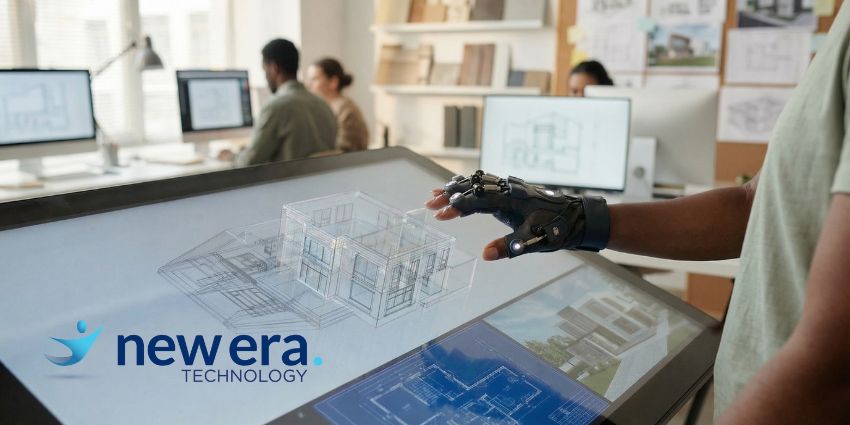
New Era Technology’s 3D visualization platform changes the procurement process at its foundation.
Instead of comparing proposals through spec sheets and scopes of work, teams can step into a fully rendered version of their actual meeting space, built to their room dimensions, furnished to their layout, and populated with real devices with accurate capabilities from vendors including Jabra, Huddly, Poly, Cisco, and Logitech.
From inside that environment, IT leaders can drag and drop AV configurations from different vendors into the same room and see precisely how each one performs against their layout. Camera field-of-view overlays show exactly which seats fall inside and outside the frame. Microphone coverage maps reveal where audio from competing solutions drops off. Screen placement tests highlight sightline problems before a single bracket is mounted.
Holmes explains:
“In 3D, teams can clearly see that a single front-of-room camera cannot properly capture a long table.”
That realization that procurement is as much about room layout and setup as it is about the technology itself is the platform’s most powerful outcome. Multi-camera strategies, repeater screens, alternative furniture layouts, and enhanced audio coverage all become visible options once the room exists as a testable environment rather than a set of dimensions on a floor plan.
For procurement teams, this knowledge shifts the conversation from vendor selection to a comparison of observable outcomes. “Cameras, audio strategies, screen placement, and layouts are judged on what people see and feel,” Holmes notes, “not on brand loyalty or headline specifications.”
Turning AV Procurement from Guesswork to Certainty
The goal of AV procurement has always been simple: get the right technology into the right space. Visualization makes that possible in a way spec sheets never could, giving every stakeholder a shared, testable picture of the outcome before a single device is purchased.
The decision about what to buy remains, but which devices will work best becomes much clearer. As a result, retrofit costs fall, approval cycles shorten, and rooms perform as intended. That alignment, established before deployment rather than discovered afterward, transforms procurement from a gamble into a genuine business outcome.
Every meeting in a poorly equipped room is a reminder of a decision that could have gone differently. Visualization eliminates the need to find out what went wrong after the room is built.
Ensure your AV investment isn’t wasted by seeing your transformation before it begins at New Era Technology