
If you think that Google AR Glasses are nothing but a distant dream, it might be time to think again. Sure, Google Glass turned out to be a flop, and Google’s Iris Project was eventually canceled – but it seems like the tech giant hasn’t given up on the smart glasses market just yet.
In 2024, demand for smart glasses is growing at an astronomical pace. innovators like Vuzix, Viture, Rokid, and XReal are introducing new AR-powered specs. Plus, other major tech leaders are getting involved, too.
Meta has its Ray-Ban Smart glasses (though they’re not very AR-focused). Amazon has its Echo Frames. Could Google be next?
Based on what we’ve seen in the last few months, from new partnerships to potential leaks at Google I/O, there’s definitely potential. Here’s what we know so far.
Google AR Glasses: The Bumpy Road So Far
Google has always strived to position itself as a leader in innovative technology, from XR to artificial intelligence. The Google ARCore platform is one of the most popular augmented reality development kits around. Plus, Google seems to constantly add new immersive features to its apps and tools.
At Google I/O 2024, the company introduced new Geospatial AR features for Google Maps, unveiled updates to various AR development tools, and even announced a partnership with HP to help revive its Google Starline project (for immersive video conferencing).
Unfortunately, Google AR glasses never seem to really hit the mark. Google Glass, one of the first examples of “smart glasses” introduced to consumers, was a massive failure. Even the Enterprise edition, introduced after the initial specs were phased out in 2015, ended up being discontinued.
In 2022, hope was revived with the introduction of “Project Iris”, a new project intended to help Google compete with companies like Apple, and their Vision Pro headset. Once again, this project was shut down shortly after, following a slew of layoffs in the technology landscape.
Every time Google starts experimenting with the smart glasses market, something seems to go wrong. Either the timing is off, the feature selection isn’t robust enough, or the market gets too competitive. Now, however, that may be about to change.
Is Google Developing AR Glasses? Insights from I/O 2024
Currently, there are no official announcements indicating that a new set of Google AR Glasses will soon be coming to stores. However, evidence is mounting that “something” may be on the horizon.
One session at Google’s I/O event this year immediately caught the attention of XR publications and market analysts. The AI-focused conference drew a lot of attention to one of the tech giant’s most exciting new projects: Project Astra.
Google describes “Astra” as an AI agent that will revolutionize how we interact with generative AI. The assistant, primarily promoted as a smartphone tool, can “see the world around it” and even answer questions about scenery.
What’s interesting is that when demoing this assistant to attendees, Google’s team didn’t just use Pixel phones to interact with the AI. One user donned a pair of smart glasses and started using them, rather than their Pixel phone, to ask questions and access content hands-free.
What Project Astra Tells Us About Google Smart Glasses
So, what does all of this tell us? Well, nothing concrete. When talking to the press, Google’s team said that the smart glasses were just a “prototype”, from the AR team at Google, and that they didn’t have any launch plans to share.
They also looked a little like the Iris glasses that were scrapped in 2023, which could mean Google just used its existing tech to showcase the potential of its new AI solution on different devices. That does make sense to a degree. After all, Google’s Astra webpage says that the AI assistant will be accessible on smartphones and “glasses.” It doesn’t specify “Google AR Glasses.”
But will the tech giant actually decide to hand the opportunity offered by a new set of AR specs off to competitors like Meta?
According to Demis Hassabis, who oversees AI research at Google, smart glasses definitely seem like the “perfect hardware” for accessing a hands-free AI assistant. So, why wouldn’t Google want to capitalize on its investment in generative AI models like Gemini and dive into the AR specs market?
Google AR Glasses: The Partnership Opportunity
There’s definitely an opportunity here for Google to dive deeper into the XR market. What remains to be seen is which avenue they’ll take. Clearly, Google isn’t against the idea of working on smart glasses or other XR tech, but it may be reluctant to design a solution itself.
It may be that Google is “once bitten, twice shy” when it comes to creating its own XR hardware. This could be the reason why the company has invested in more partnerships. The tech giant even announced it was working with Samsung on the development of its XR headset.
More recently, Google also shared that it was partnering with Magic Leap on a new solution. The details of that collaboration haven’t been released. All we really know is that Google and the extended reality innovator (Magic Leap) are working on a project. This project aims to combine Magic Leap’s AR and optics expertise with Google’s technology platforms for a new XR experience.
The companies say they’re looking forward to extending the power of extended reality and unlocking new market opportunities. However, we don’t know whether this means we’ll see a new Magic Leap device in the months (or years) ahead or a new set of Google AR Glasses.
Will Google and Magic Leap Create a New Set of Specs?
Based on what we know about Google and Magic Leap’s collaboration, new XR hardware (influenced by both companies), is probably on the horizon. However, it may be that Google simply helps to power Magic Leap’s new technology with their own innovations.
Google might follow the same path that it did with Samsung, giving Magic Leap access to its AI tools, like Gemini and Project Astra, as well as its AR development kits.
However, Google did say that it plans to bring a “wider range” of immersive experiences to the market through the partnership. This is hardly a confirmation that a new set of Google AR glasses is in the works. But, if we take a broader look at everything Google is doing, from the use of smart glasses at I/O 2024, to Project Starline, there is potential.
It’s certainly not beyond Google to produce a new set of AR specs itself. The company has the technology, the funding, and even the right partnerships. It also has the drive.
After all, with Meta and various other companies now working on AR glasses themselves, Google might be reluctant to fall behind its competitors.
What Would New Google AR Glasses Look Like?
Ultimately, like with most major innovations in the XR world, we can only speculate on what “might” be next for Google. If a new set of Google AR glasses is on the horizon, then it seems likely that Google will take a similar approach to most of the AR specs vendors we’ve seen so far.
We can probably expect a lightweight pair of glasses, that look as similar as possible to regular specs. After all, the very obvious camera on the Google Glass specs earned a lot of ridicule before. I’d assume that Google’s AR Glasses will be similar to Meta’s Ray-Bans in a few ways.
They’re probably going to be as “stylish” as possible, and include access to an integrated AI assistant (Google Astra). However, I’d imagine that Google will take advantage of it’s augmented reality credentials to add a lot more immersive content.
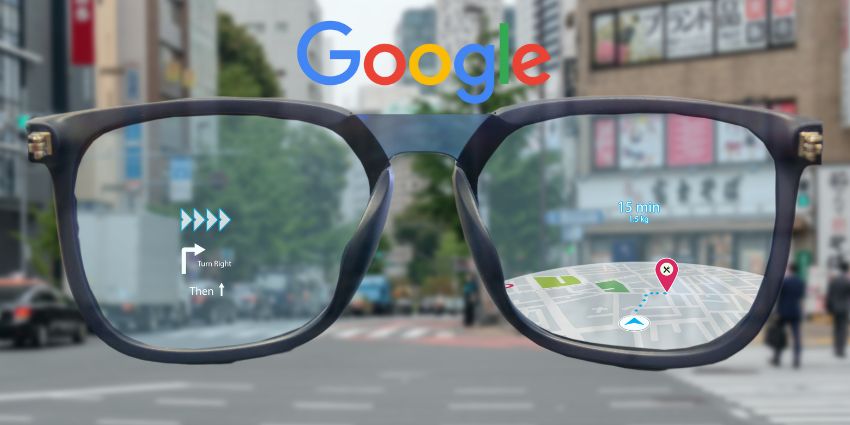
We might see AR-powered navigation from Google Maps implemented into your glasses, or tools that help you to translate languages with real-time captions. Still, this is just what I think. We’ll have to wait and see to discover what Google really does have in store for us.